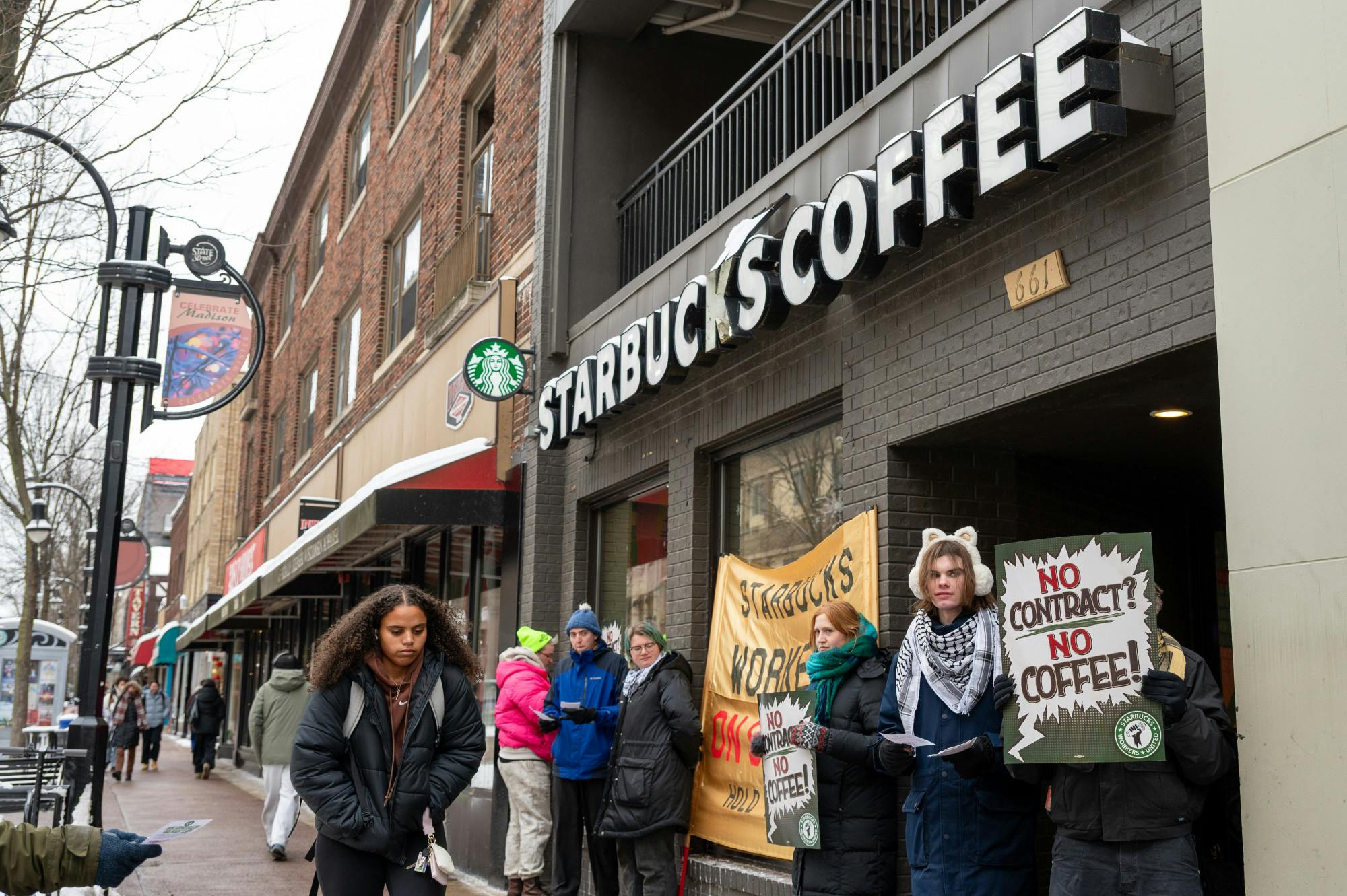
Unionized Madison Starbucks locations are back to business as usual after employees participated in the company-wide Red Cup Rebellion strike for over a month at the end of 2025. Union leadership said they wished the strike led to more for their workers.
The strike, which has largely ended and was the longest in the union’s history, aimed to challenge Starbucks’ unfair labor practices and negotiate a better labor contract with the coffee giant. Despite the campaign amassing thousands of employees, Starbucks refused to budge, leading to a loss of momentum.
“[The union] is still waiting for the company to come back to the table in good faith,” former Madison area union organizer Allie Kerr told The Daily Cardinal.
Both Kerr and Madison area organizer Joanna Weir said they have noticed shifts in attitude in the workplace once the strike ended in Madison.
“There was a lot of anxiousness,” barista Lucy Ault told the Cardinal. “We know the company itself isn’t scared to union bust, so there could have been repercussions for us striking.”
The uniquely long campaign also took a toll on the employees.
“They’re tired, and they don’t like to see that the company did nothing,” Weir told the Cardinal. “That’s a draining thing to go through, especially for people in organizing committees in their own stores.”
Weir said many Madison area employees left Starbucks during the strike.
However, the strained environment of the five-week long campaign seems to have also had a positive impact on morale.
“It was nice to stand up and be with my coworkers out there,” Ault said. “It was nice to be part of the nationwide action for sure.”
There’s also been some tangible benefits, like in-store managers being much more collaborative and less directive, boosting the overall store environment, according to Kerr.
“There have been much fewer unilateral decisions,” Kerr said. “[Store leadership] seeks feedback from people.”
The strike also strengthened the union community in Madison.
“The Red Cup Rebellion showed a lot of people what collective actions they can do if they do join a union,” Weir said.
Kerr agreed, emphasizing worker empowerment at a local level and amicable negotiation at a strategic level as two key takeaways from the strike.
“There were actions we did that didn’t seem to matter to the company and there were other actions we did that did seem to matter a lot to them,” Kerr said. “We’re thinking about shifting our efforts to moving toward some of the things that matter to the company and will help them shift their attitudes.”
The strike took months to organize and the process was rigorous, according to Ault. Ultimately, it also led to stronger leadership in Madison’s Starbucks’ storefronts.
“I think it did a great job of pulling leaders out of stores,” Weir said, adding that the responsibilities that come with organizing a strike of this magnitude has required individual workers to step up.
“Especially locally, we learned some ways to build worker power and to help people feel more control over their workplace,” Kerr said.
Weir said that despite changes in management at the Capitol Square location where she works, she has observed this trend too. New management at the Capitol Square location has made an effort to manage the store in a way that met the union’s expectations, Weir said.
“These intangibles are more important than people realize,” Kerr said. “Honestly, that’s the difference between having workers who are showing up and they’re happy to be at work every day.”
Many of the tangible concerns addressed in the initial strike are still prominent. However, Kerr believes, even in these ways, in-store managers have attempted to address the workers' concerns where they can.
Managers, while they don’t have control over pay and benefits, maintain a certain level of control over staffing and hours — two major concerns of the campaign. Kerr said in her experience, management makes an effort to alleviate these issues with the power they have.
“Corporate gives managers an allowance of hours for their workers,” Kerr said. “Management has been doing some of that advocacy around making sure people are getting their preferred number of hours.”
Local community members have also adopted a newfound empathy for the union workers.
“I think a lot more people are more aware of it now because we also asked for a boycott,” Ault said, taking note of slower business in the weeks following the strike.
“For a lot of people, that ‘No Contract, No Coffee’ pledge wasn’t just limited to when people come back,” Weir said, adding that some of her regular customers have continued to boycott in solidarity with the union. “It’s great to see that kind of loyalty from our customer base.”