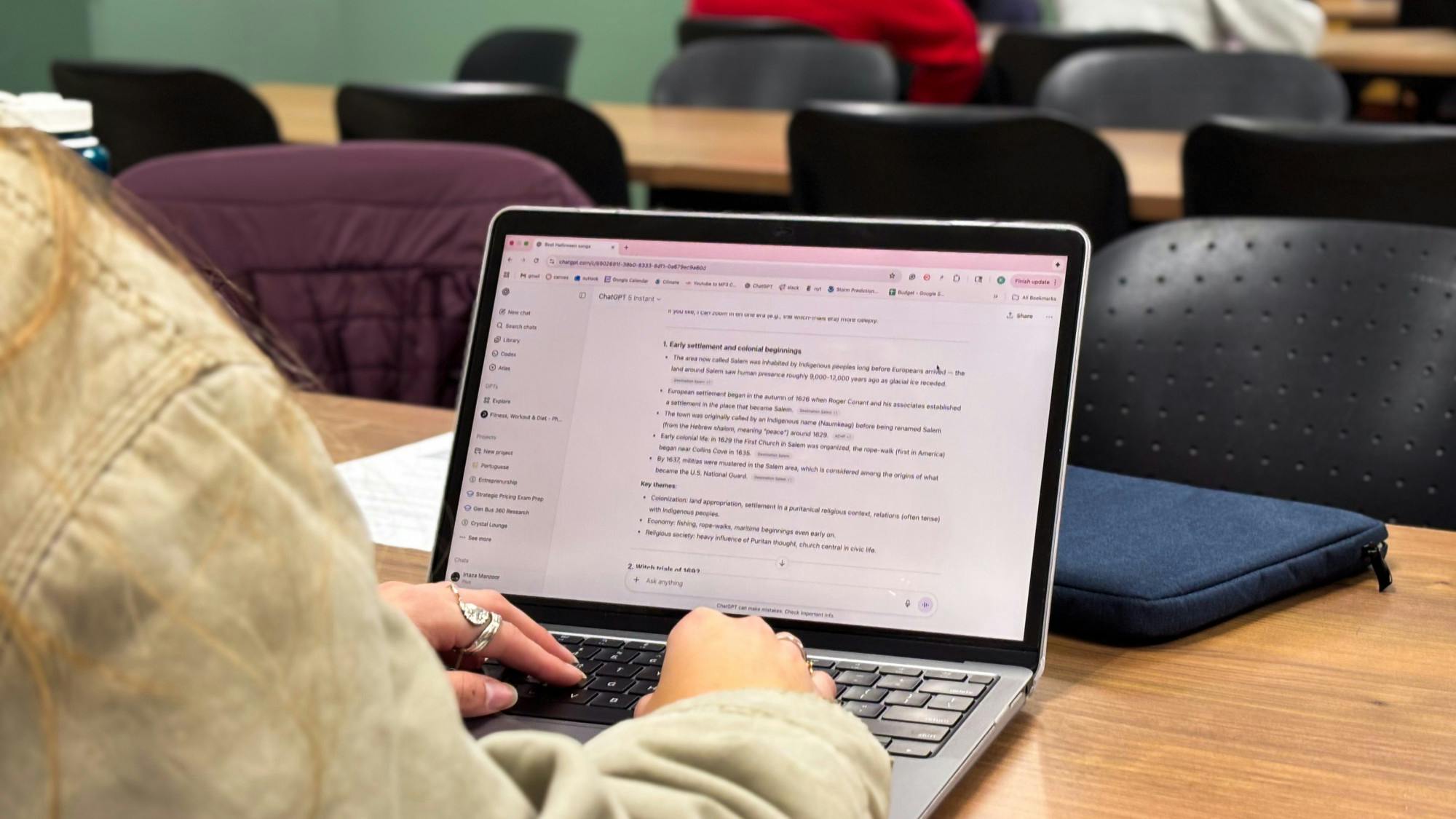
As final exam season starts, many University of Wisconsin-Madison students are increasingly turning to a new kind of study partner — one that never sleeps, charges hourly rates or judges a panicked 2 a.m. homework question.
Artificial Intelligence tools like ChatGPT have become embedded in student life with 86% of students using AI in their studies, according to a study by the Digital Education Council, marking a rapid cultural shift in how students prepare for exams and complete coursework.
For many students, AI is not replacing studying — it is reorganizing it. “I use it as a tool to summarize slides as well as just get big ideas to review for lectures, projects or tests,” UW-Madison sophomore Tommy Yothsackda told The Daily Cardinal.
AI’s tutoring appeal is obvious: it’s free or low-cost, available on demand and increasingly personalized.
But some students say AI isn’t as helpful as they would hope. “I use it when I want an outline or just checking grammar, but I never let AI do the work for me. I don’t think that’s fair,” freshman Adrianna Canino told the Cardinal.
James Murphy, a Political Science teaching assistant and graduate of the La Follette School of Public Affairs said he has seen student exams with typical “ChatGPT trends,” but feels confirming his suspicions with AI checking software would be too inefficient.
Even with AI readily available, some students prefer the hands-on aspect of tutoring.
“I think that with human connection and interaction, it was easier to understand the concepts because I was saying them out loud and having more of a conversation rather than just being lectured at,” sophomore Clementine Harris said.
That distinction — conversation vs. explanation — is central to how tutoring services are adapting.
Tutoring By A College Professor (TutoringProf), a multi-collegiate matching program that has paired over 8,000 college students with expert instructors, said its business has only expanded since AI became mainstream.
“Our business is growing exponentially each and every month since ChatGPT was launched,” Libby Marx, TutoringProf’s director of operations, told the Cardinal.
Marx said tutors are not competing with AI; instead, they are using it as a tool within sessions.
“It's really not about the tool itself. The tool is great,” Marx said. “It's about how students are using it, and our tutors integrate AI in ways that are actually effective.”
Marx also emphasized the limitations of AI when it comes to high-level understanding.
“AI can give information, but to become an expert yourself, you need knowledge and instruction from someone who has been in your shoes,” she said.
The National Center for Education Statistics reported in 2024 that students who receive high-dosage, consistent human tutoring see the largest academic gains of any intervention. Meanwhile, another report found AI tutoring works best when paired with human support, not when used alone.
Murphy and Marx agree that the future of tutoring will be a partnership, not a battle, between AI and humans.
Murphy said due to the nature of AI’s rapid development, “if you’re not using AI, you’re falling behind… A lot of it [education] is going to go to an online type of learning, so you need to know how to work it and how to use it.”