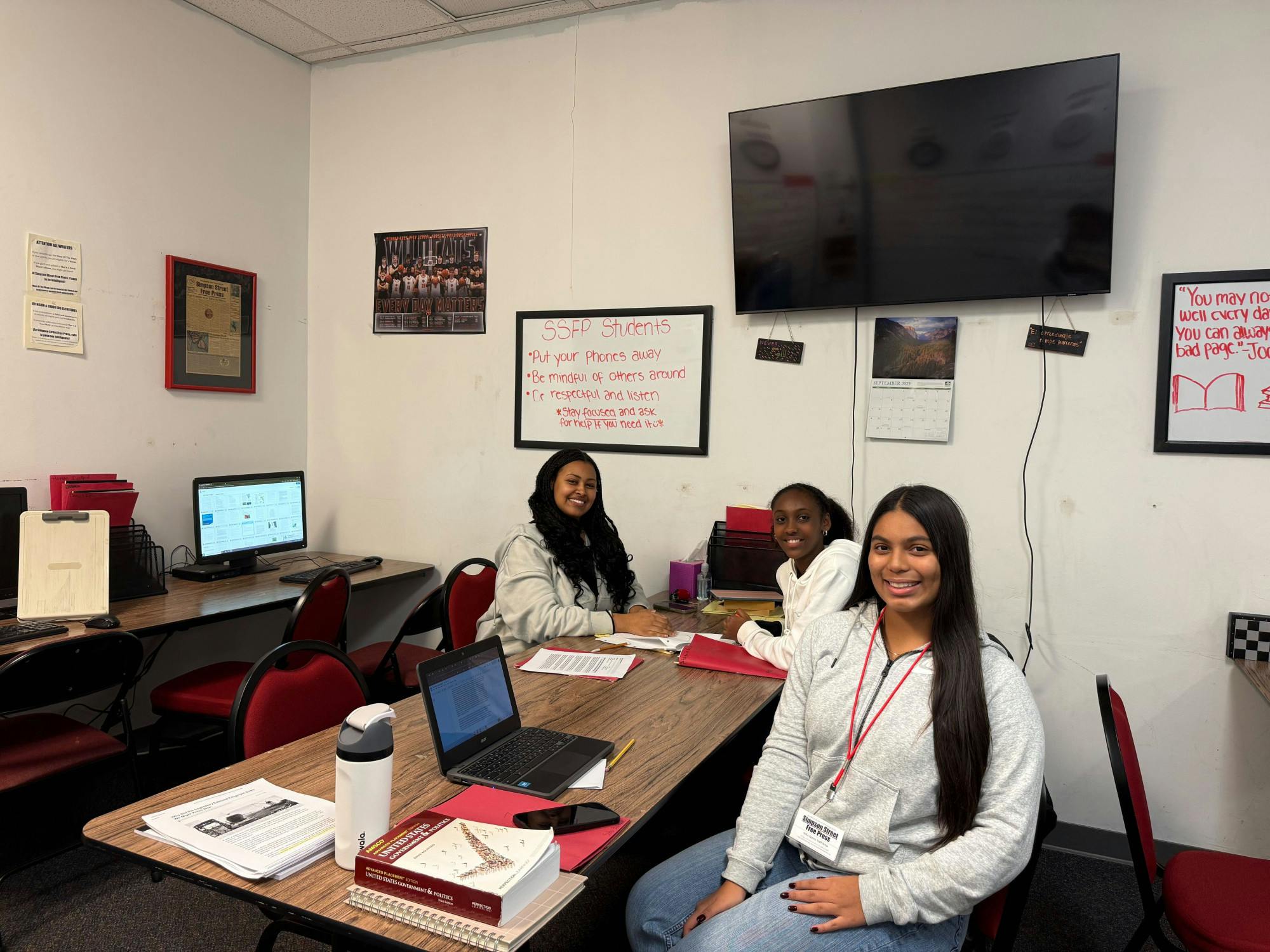
South of Lake Monona, right off the beltline, Simpson Street Free Press is lively and spirited as reporters share story ideas and plug away on new articles. But behind the bustle of your average newsroom is one that looks a little different — and younger — where the writers range from second-graders to high schoolers and the editors are in college.
Since 1992, Simpson Street Free Press, a non-profit neighborhood-based organization dedicated to empowering young voices and fostering an early interest in reading and writing, has served as a platform for students of all ages to publish articles that capture the pulse of Madison. On any given night, the newsroom emulates an after-school program that is as much about community as it is literacy.
Over 30 years ago, Jim Kramer and a group of parents from Madison founded SSFP in response to growing concerns about the city’s “reading crisis.” As SSFP’s longtime executive director, Kramer has been central in managing daily operations, fulfilling the organization’s mission and expanding opportunities for young people across Madison. SSFP serves a dual purpose for students, providing literacy support through hands-on journalism, allowing them to see the tangible impact of their writing on the local community.
SSFP runs like a professional newsroom, with students clocking in and out and earning stipends for their published work. Participation isn’t tied to any specific school; instead, students join by applying directly to the program. While journalism and reporting are at the organization’s core, SSFP also offers tutoring and homework help and runs a student book club where Madison’s youth can develop meaningful connections through literacy.
What began as a single neighborhood paper has since expanded into several student-run publications, including the Sennett Free Press, the Virginia Henderson Free Press, the James Wright Free Press and La Prensa Libre de Simpson Street, a paper dedicated entirely to Spanish-language reporting. These newspapers were once printed, but SSFP has since transitioned to a digital model.
‘I felt important’
Over the years, SSFP has equipped countless students with the skills they need to feel confident in the classroom.
“I had to learn English as my second language,” Kevin Chen, a senior at McFarland High School and current teen editor, told The Daily Cardinal. “Working at SSFP helped me improve my writing and reading.”
Students begin with a handwritten draft, which is revised with support from the program’s editors before being compiled into a complete packet for publication.
“I felt really accomplished,” said former managing editor and University of Wisconsin-Madison alum Taylor Kilgore of her early articles. “I felt important. I felt like what I was learning was sticking and paying off.”
In the years following the organization’s inception, Kramer and SSFP’s leadership team have marshaled efforts to keep the program responsive to the students’ and community’s evolving needs. These efforts include expanding from a single print publication to multiple student-run papers, introducing tutoring and homework support and implementing book clubs that help students develop reading skills throughout the school year and summer. Despite the ever-changing media landscape, SSFP remains committed to fostering a deep sense of community and facilitating student growth under a journalistic lens.
The need for programs like SSFP is consistent with the state’s ongoing challenges with early reading development. According to a 2024 report from the National Assessment of Educational Progress, 31% of students in Wisconsin performed at or above the “Proficient” level, and students who identified as economically disadvantaged scored an average of 30 points lower than their peers. SSFP’s unique approach, which combines mentorship with project-based journalism, provides all students — especially those facing greater educational challenges — with meaningful learning opportunities and real-world experience to excel in the classroom.
“As a person who enjoys writing, I love the idea of using journalism as a framework,” said Ashley White, an assistant professor at UW-Madison who previously served on the Early Literacy and Beyond Task Force. The task force, a joint initiative between the Madison Metropolitan School District (MMSD) and the UW-Madison School of Education, focused on analyzing the most promising approaches to teaching reading and made recommendations to both MMSD and teacher education programs at UW-Madison to improve reading outcomes and reduce opportunity gaps. “What better way to help students increase their literacy abilities than by attaching it to something meaningful [like] writing?” White said.
With 15 years of experience in P-12 education, White emphasized the importance of framing the conversation around reading challenges in a positive way that both acknowledges and supports each student’s holistic development. Combatting these early education challenges can lead to long-term benefits.
Enjoyiana Nururdin, who served as a teen editor for SSFP before studying journalism at UW-Madison and becoming a local government reporter for The Capital Times, credited the program with giving her direction and purpose.
“I was able to find a place in my community through Simpson Street,” she told the Cardinal. “It gave me a really strong sense of belonging and [taught me] that how you show up in your community matters.”
Building a family
By welcoming young people from every corner of Madison, SSFP creates a forum for students to build lifelong connections.
“[SSFP] is definitely a family,” Kilgore said. “A lot of people start [in] middle school or earlier and stay through high school or [beyond], so we grow up together. We praise each other’s growth in and outside of the program.”
SSFP also showcases the power of cross-age interaction. With students joining as young as second grade, the program creates a mutually rewarding environment for younger students and older mentors.
“Working with younger students, especially ones [who] resemble who I was, is a memory that sticks with me,” said Sandy Flores, an editor at SSFP and UW-Madison sophomore. “It gives me a sense of comfort that I’m doing as much as I can to help students learn to read and write, and it makes my day to [see them] get these skills outside of school.”
Despite the dynamic nature of the organization’s leadership team, there remains a steadfast commitment to preserving the program’s essence. Year after year, former student writers return to SSFP to serve as editors and mentors.
“What’s changed about Simpson Street is what has stayed the same,” Nururdin said. “Seeing the alumni become staff members is really powerful. It’s always been like that, but now more than ever, we need to have those faces who are there because they care.”
After graduating, participants are proud to carry the stories, lessons and skills they gained at SSFP into their careers.
“‘Never turn in your first draft’ — that’s [the program’s] motto,” Kilgore said. “Even today, I edit my own work before I review it with my boss and apply the editing skills I learned.”
Since its founding, SSFP has empowered Madison’s youth to embody the commitment, curiosity and community-mindedness that the program champions, while making a meaningful and lasting impact on the city at large.
“I can definitely see Simpson Street continuing to be that family resource or a space where students are supported, welcomed and wanted in a world that can make you feel like your identities don't matter,” Nururdin said. “Your identities and what you care about wholeheartedly do matter, and Simpson Street definitely fosters that.”