Former UW journalist detained in Bahrain released
By Negassi Tesfamichael | Feb. 15, 2016Freelance journalist Anna Therese Day, a 2010 UW-Madison alumna who was detained Sunday in Bahrain, has been released.
Freelance journalist Anna Therese Day, a 2010 UW-Madison alumna who was detained Sunday in Bahrain, has been released.
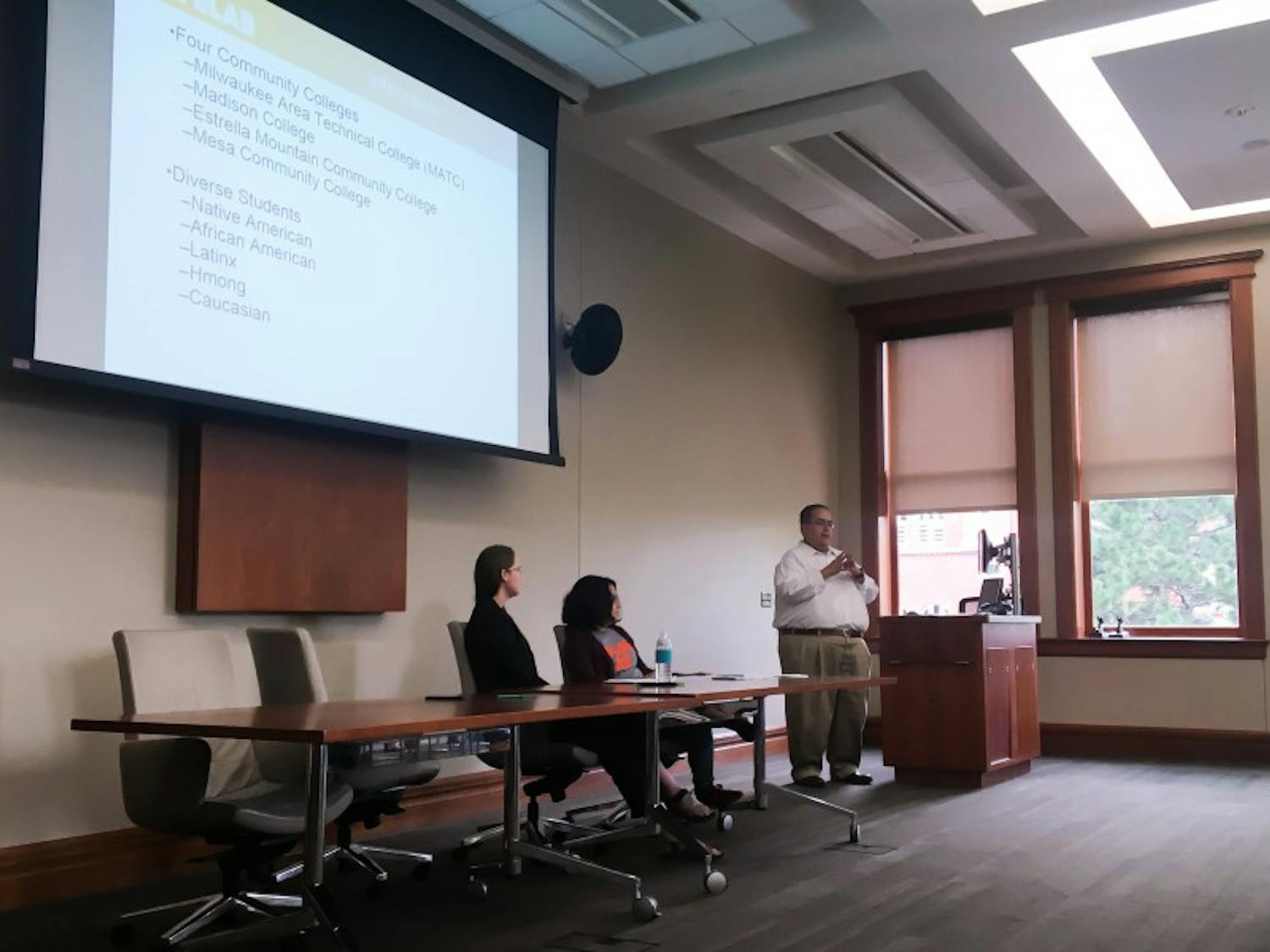
In recent months, diversity advocates expressed concerns about the UW System’s approaches in improving the experiences of minority students and Wisconsin’s educational disparity between white and black students.
The transition from high school to college can bombard a student with many sudden changes, but while most students are shocked by the size of the lecture hall, Kenneth Cole was shocked by the lack of people of color in it.
UW-Madison international student Xiaofei Xu struggled to integrate with the local community on campus—until he studied abroad in Paris with roughly 30 other students during the fall semester of his junior year. Xu grew up in a city near Hong Kong and decided to attend UW-Madison in 2013, without ever visiting the campus. Both the school’s history and journalism programs were ideal for him, Xu said. There are more than 4,000 international students from roughly 130 countries currently enrolled at UW-Madison, though most are from China. According to Xu, academic programs for international students at UW-Madison are geared toward students in science or engineering majors, which covers most of the students. But Xu, however, studies in the humanities, saying he hopes to graduate with a double major in history and journalism, while also learning French.
A recent study from UW-Madison has proven that converting farmland to areas for grassland biofuel crops could be beneficial for landowners and Wisconsin birds.
The historically Black Greek Letter Organizations at UW-Madison seek to initiate change on campus through activism and volunteering efforts.
UW-Madison researchers published a journal Feb. 11 detailing how they genetically reprogrammed the most common type of cells in mammalian connective tissue into master heart cells.
A group of UW-Madison engineers has discovered how to turn on and off specific genes within bacteria, according to a university press release.
UW-Madison researchers will begin launching experiments to study the Zika virus, according to a university news release.
Seventeen campus religious groups and the Multicultural Student Center presented a diverse panel of speakers Tuesday to discuss the different aspects of faith and race on the UW-Madison campus.
About 60 students met Tuesday at an event organized by Badgers for Bernie to show that they “feel the Bern” for U.S.
First and second-year college students can now apply to the inaugural James E. Jones Jr. Pre-Law Scholars Program at the UW Law School.
Junot D?az, an author known for his fictional works featuring the immigrant experience and his personal racial background, answered questions at Memorial Union Monday as part of the Distinguished Lecture Series.
Associate Dean and medical history and biomedics professor Dr. Richard Keller spoke Monday in Madison about the origins of the distrust in global health programs in postcolonial countries.
UW-Madison psychology professor Markus Brauer will teach a public seminar Feb. 9 at Madison Public Library that will focus on strategies supported by extensive research to best reduce discrimination in the workplace.
UW-Madison researchers are conducting a study, funded by the NCAA and the U.S. Department of Defense, that will examine the most effective ways to educate athletes on the importance of reporting concussions.
A UW-Madison biotech spin-off, Lytic Solutions, has earned substantial profits from producing its specialized product, correctly folded proteins.
University Health Services issued a warning to international travelers because of the Zika virus, which was recently called a global health emergency by the World Health Organization.
Roderick A. Ferguson, esteemed author and professor of African-American and gender and women’s studies at University of Illinois at Chicago, spoke at UW-Madison Tuesday about how black radicalism can lead to change on college campuses.
In an effort to remain a leader in the field, UW-Madison offers a master’s degree in biotechnology to merge science, business and law practices into a single, comprehensive program.