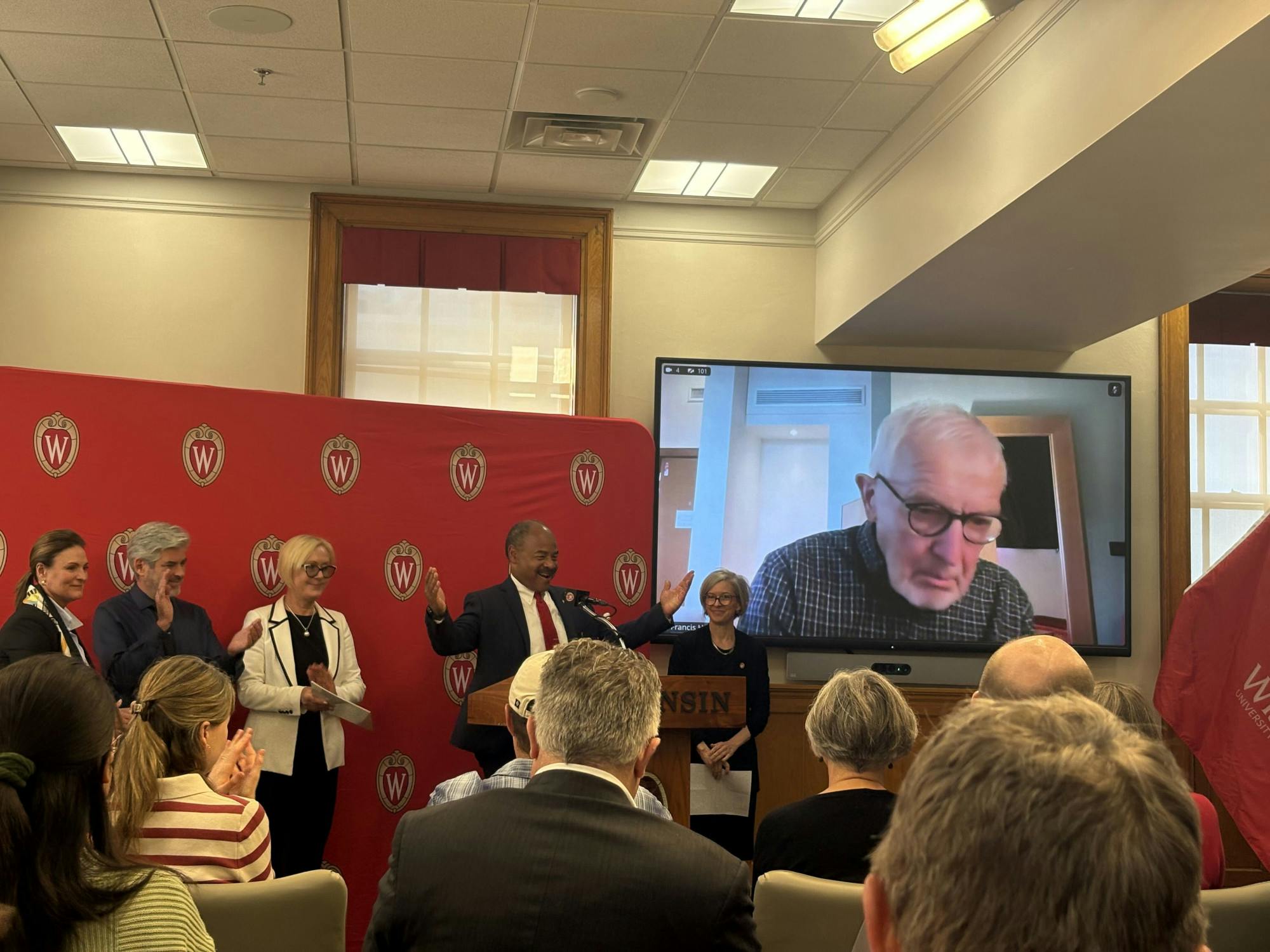
University of Wisconsin-Madison physics professor Francis Halzen won the 2026 Nobel Prize in Physics on Oct. 6 for his contributions to the IceCube Neutrino Observatory.
Halzen is the principal investigator at the IceCube Neutrino Observatory, where he and the IceCube team study neutrinos — massless, chargeless particles that travel through the universe and give insight into the deepest cosmos.
“It's nice to receive the prize, though, as a recognition of all the great collaborators I had on this project,” Halzen said in a press conference on Tuesday. “This project had many challenges, and somehow I was lucky enough that the right people showed up at the right time with the right talents to overcome them.”
The IceCube Neutrino Observatory is a research center located at the South Pole. Researchers detect neutrinos using more than 5,000 detectors buried 2 kilometers deep in the ice.
Neutrinos reveal information about the cosmic environments they originated from, as they reach Earth without changing direction or energy. This allows researchers to better understand high-energy cosmic events such as supernovas, galactic nuclei and black holes.
Halzen has been a physics faculty member at UW-Madison since 1972. Halzen’s interest in neutrinos began in the late 1980s, when he conceptualized using kilometers of Antarctic ice as a telescope for cosmic neutrinos, according to Halzen.
Halzen led the development of the Antarctic Muon and Neutrino Detector Array (AMANDA) in 1993. This was the first time anyone had considered looking for neutrinos deep in the Antarctic ice, and it served as the predecessor to IceCube, according to Dan Cooper, director of the Wisconsin IceCube Particle Astrophysics Center.
AMANDA detected the first neutrinos between 1996 and 1997, according to Halzen.
“That was the greatest excitement I ever felt about this project,” Halzen said in a press conference hosted by the university. “It was just incredible. It was the fact that we could make this work.”
Construction of IceCube began in 2004, and it took seven years to complete, according to IceCube. UW-Madison led the research, development and construction for IceCube, according to Halzen.
“UW took incredible risks on this project,” Halzen said in a press conference. “When we started this project, we had several milestones we had to pass, and at each point this project could have failed.”
IceCube announced the first detection of neutrinos from outside the solar system in 2013. The discovery won the 2013 Physics World Breakthrough of the Year Award.
Today, Halzen received the call notifying him of the Nobel Prize while attending a committee meeting for the National Institute for Nuclear Physics in Italy. Halzen is the sole recipient of the prize and the 12 million Swedish kronor (about $1.2 million) award.
Future developments for the project are underway with IceCube Gen 2. Halzen noted that future findings from IceCube remain to be seen.
“It has always been great in the past,” Halzen said in a press conference. “And there's no reason not to think that it will be great again.”