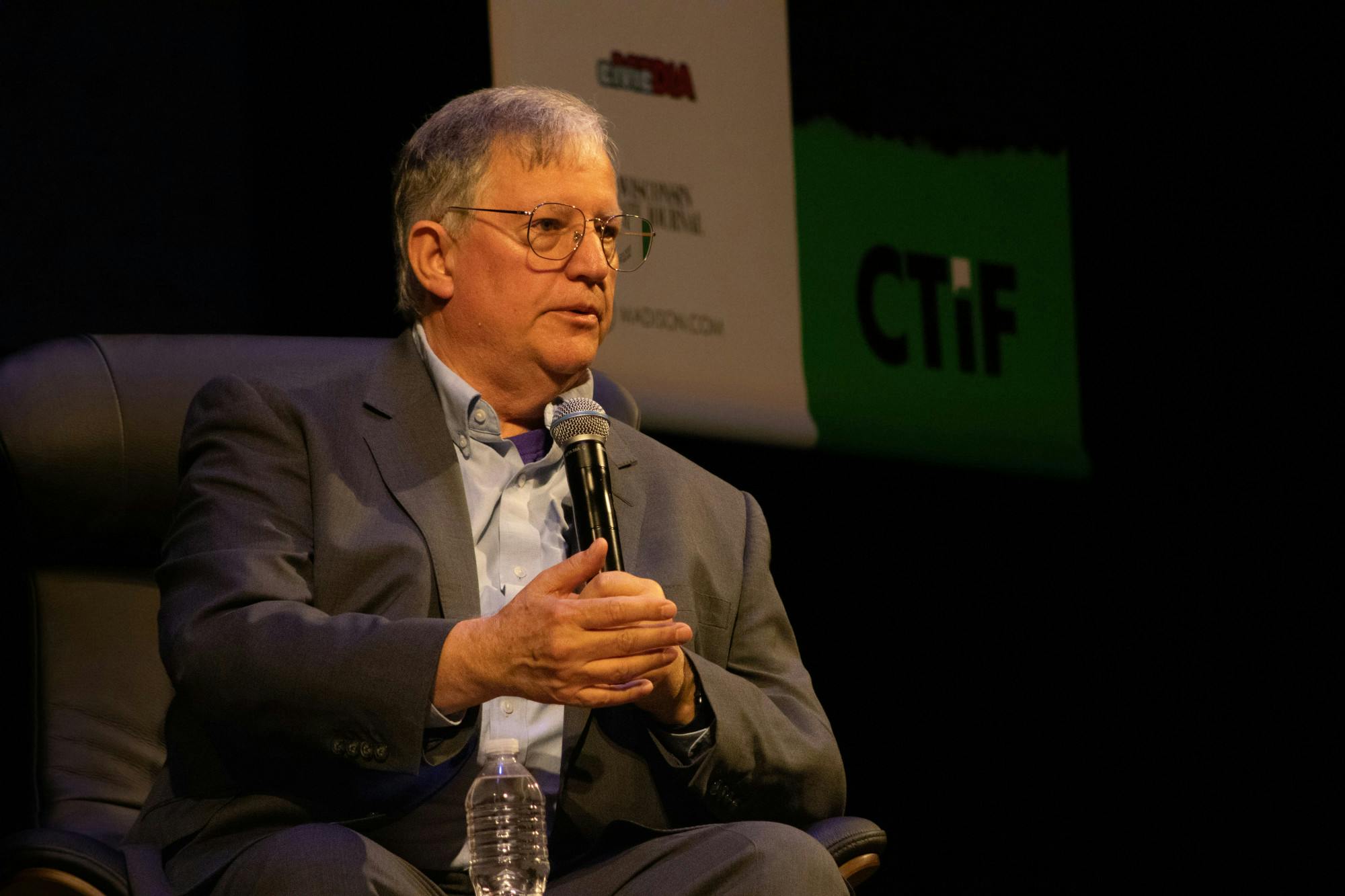
Wisconsin’s gubernatorial election remains closely divided despite strong partisan loyalty, according to polling data presented by Marquette Law School Poll Director Charles Franklin at the Rotary Club of Madison Oct. 7. With few voters crossing party lines, Franklin said, independent voters and turnout rates could play an important role in determining the outcome of the midterm election.
The September Marquette Law School Poll found Democratic candidate for governor Milwaukee County Executive David Crowley leading Republican candidate U.S. Rep. Tom Tiffany 49% to 46% among likely voters. The 3 point difference is within the poll’s margin of error of 4.8% among likely voters.
Franklin described the electorate as “almost perfect party loyalty in both parties now,” with 95% of Republicans voting for Tiffany and 96% of Democrats voting for Crowley.
“We just don’t see much crossover voting at all,” Franklin said.
With most voters supporting their party’s candidate, the race leaves little room for crossover voting. That makes the preference of independent voters, along with differences in turnout, particularly important. Previous elections have had incredibly thin margins, split nearly 50/50 between the two parties.
“For all registered voters, there are about 4% more Republicans in the state than there are Democrats,” Franklin said. “But among likely voters, it's dead even at about 45% for each party. So if both parties are getting 45% and almost perfect party loyalty, you can only get 50% of the vote from independents.”
Franklin talked about the importance of independent voters in determining the results of the election. Currently, the polls are showing 44% of independent voters supporting Crowley, while 18% support Tiffany. In the September poll, independent voters showed 55% support for Crowley and 16% for Tiffany.
Franklin recognized the necessity of independent voters, saying they are “pivotal for how you get from 45% to over 50% of the vote.”
Turnout presents another uncertainty. In the September poll, 61% of independent respondents said they were absolutely certain to vote, compared with 85% of Democrats and 78% of Republicans. Franklin said Democrats currently have a turnout advantage, although that could change by November.
Franklin also discussed the challenges candidates face in establishing their public images. Crowley’s unfavorable rating among registered voters rose from 29% in August to 44% in September, but the respondents who said they had not heard enough about him to form an opinion fell from 38% to 25%.
Franklin said he believes this is essential. He talked about the difficulties for turnout in this year’s midterm, particularly facing the Crowley campaign. Crowley briefly suspended his campaign in July 2026 after struggling in early polling, and then re-entering 10 days later with endorsement from Gov. Tony Evers.
“He is still not very well known across any of the three partisan camps,” Franklin said. “Over 20% of Republicans and 24% of Democrats haven’t developed an opinion about him. It's a problem for his campaign that he has failed to communicate to his own base voters who he is and why they should like him a lot.”
Among his own base, Tiffany’s favorability ratings have changed less over the same period — 42% to 45%, while 15% of respondents said they had not heard enough about him to form an opinion. However, compared to Crowley’s support among independents, Tiffany has lower ratings.
Franklin also discussed the potential implications of President Donald Trump’s job approval ratings for Republican candidates. The September poll found that 38% of Wisconsin residents approved of Trump’s performance, while 60% disapproved. These ratings, according to Franklin, could be a potential burden for Republican candidates everywhere.
Although the candidates’ partisan bases remain largely committed, the preferences of independent voters and the rate of turnout leave Wisconsin’s electoral race uncertain.
“This is a known-unknown,” Franklin said. “We know it is going to be a factor, we just don't know how it is going to change in the last month”
Staff writer