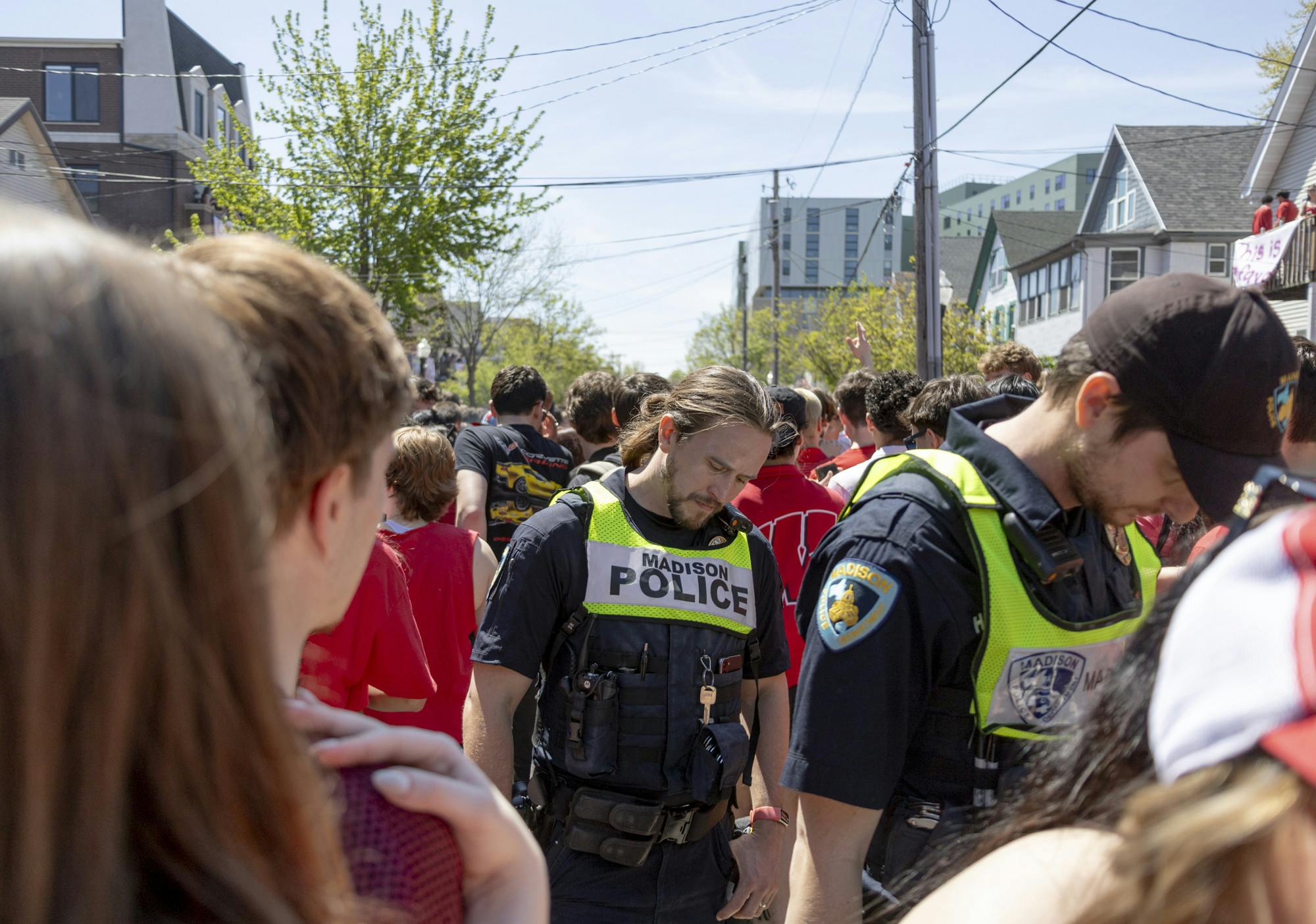
The Madison Police Department (MPD) announced Sept. 24 an accelerated plan to deploy body-worn cameras within their force, made possible through a $350,000 grant funded by the Madison Community Foundation (MCF).
The MCF grant comes in response to community members’ reactions to the death of Corey Ruiz, a Black man shot and killed by MPD in July, according to MCF Director of Communications Becki Fiegel. MCF historically partners exclusively with nonprofit organizations, making their donation to the City unique.
“After the death of Corey Ruiz and his interaction with the Madison police, we were seeing calls from a lot of different people in the community from a wide range of groups for body cameras,” Fiegel told the Daily Cardinal. “Knowing that's not a solution but a tool, it's been something that's been discussed in Madison for a really long time.”
MPD Chief of Police John Patterson told the Cardinal body-worn cameras have evolved into an essential tool for modern policing.
“I just can't emphasize enough, especially this year, the number of instances that we've all experienced where it really would have been beneficial for our entire community to have the technology in place,” Patterson said. “So I'm excited that we're going this direction.”
According to Fiegel, this is the first grant made to the City and the first grant from MCF of this calibre, overall.
“This is a different type of grant than we normally make, but it is aligned with our vision and mission, so it seemed like an appropriate thing to do,” she said.
Fiegel said MCF will continue to work closely with the City to help identify community needs that philanthropy might be able to help with, but most of their funding will continue to go to nonprofit organizations.
The previous implementation plan by Patterson was meant to be over the course of three years, Mayor Satya Rhodes-Conway said in the press conference. Numerous aldermen rejected Rhodes-Conway’s original inclusion of a stipend in support of body-worn cameras due to high annual costs.
“The three-year plan was my initial proposal — To get it done as financially modestly as possible and to really defer the costs over the stretch of several years,” Patterson told the Cardinal. “This was my number one budget priority for 2027.”
Originally, Patterson had hoped to break up the costs across the 2027, 2028 and 2029 City budgets.
“I'm very, very grateful for the MCF to really step in and remove a hurdle that was in front of us financially for next year.”
Fiegel said the donation was an “appropriate use of MCF’s philanthropy” to help the City overcome a financial hurdle so the deployment of body-worn cameras could ensue in one year instead of three.
“When we heard that the thing that was keeping the City from being able to roll this out quickly was a budgetary thing, that's something we as a foundation can use our money to move that along,” Fiegel said.
Apart from software-related costs, Patterson told the Cardinal the grant will cover personnel-related expenses of three positions needed before deployment, which Patterson said he estimates to be by the end of June 2027, assuming nothing in the budget changes.
In the press conference, Rhodes Conway said the grant “will provide the initial operating dollars to hire two IT specialists [and] one forensic analyst.” Patterson told the Cardinal they will be MPD employees, considered civilian staff, but not police officers.
Patterson said the project will create a pool of 220 body-worn cameras that will be shared among any uniformed officer in patrol or neighborhood spots. He added whoever has a frontline responsibility will be expected to wear the camera for the course of their daily duties.
Before the deployment and use of the body-worn cameras, Patterson said it’s “critical” MPD establishes a supportive structure to make sure cameras remain working.
“You've probably had moments with your phone where it doesn't do what you're trying to get it to do. I mean, it is similar,” Patterson said. “So if you can imagine 220 cameras being utilized on a daily basis — it's a lot of footage.”
Patterson said the forensic analyst will be someone who can respond to open records requests or discovery requests from the district attorney. He noted different cases have retention requirements, meaning how long files can be stored.
“If it's a case that the records are available, the video would be subject to open records requests,” Patterson said. This is similar to existing MPD video and audio surveillance policies.
Patterson wants body-worn cameras to be a tool to improve police transparency within the Madison community.
“Accountability, transparency and training are really the three main benefits that I see the community and the department enjoying when we get this,” Patterson said.
MPD will have staff, through their new service section, reviewing footage and looking at both the individual and organizational level opportunities to improve their service and make course corrections, improvements or enhancements where they're needed.
Patterson added policies regarding redaction will also be set before deployment.
“All videos [at MPD] go through a redaction process,” Patterson said. He added MPD already has a civilian staff that reviews videos and redacts faces of injured individuals or juveniles. “This would be very similar.”
Patterson said the policy hasn’t been completely established, but estimates it to be done by the end of the year.
Zoey Jiang is the Associate News Editor. She has covered breaking news on a variety of campus issues, federal changes affecting UW-Madison and local community stories.