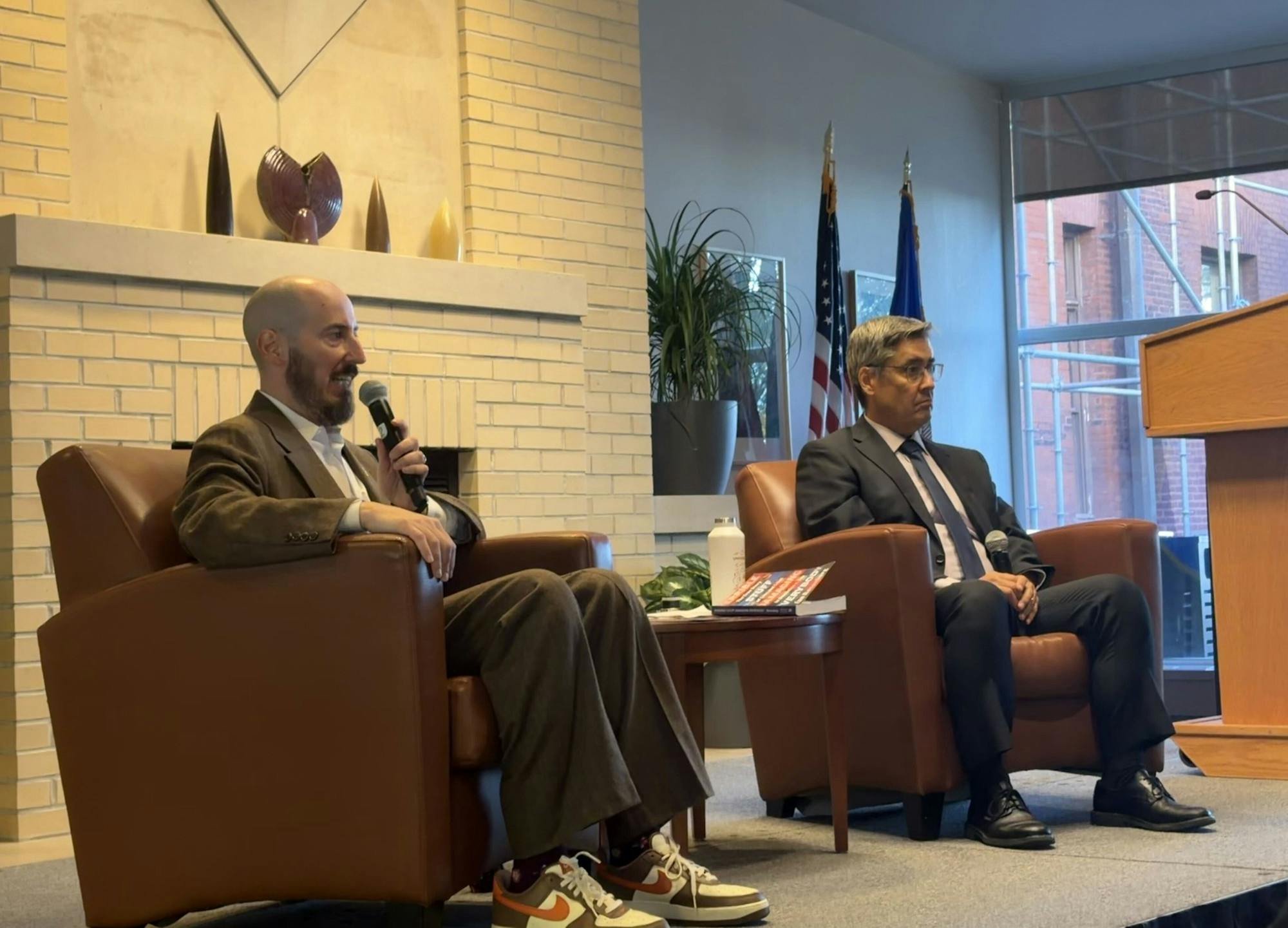
University of Wisconsin-Madison students and community members discussed democracy and free speech with Ian Rosenberg and Dan Tokaji at the Pyle Center on Oct 5.
Rosenberg, an author and media lawyer, discussed his book Terrible Stuff Damaging Everybody: The True Story of Lies and Libel in Dominion V. Fox. The discussion was facilitated by Dean and Professor of Law Dan Tokaji.
Rosenberg explained the significance of the 2021 lawsuit filed by Dominion Voting Systems against Fox News Channel in his book. In the lawsuit, Dominion argued Fox had broadcasted false claims alleging that Dominion’s voting machines had been rigged against presidential candidate Donald Trump in the 2020 presidential election.
As opening statements were set to begin in April 2023, Fox and Dominion had reached a settlement of $787.5 million, becoming the highest media law settlement in American history.
Rosenberg explained after the case had settled he became fascinated by the implications the outcome would have on the future of the First Amendment. He said a friend encouraged him to write the book following the settlement.
“This good friend of mine texted me and said, ‘I can't wait to read your book on this,’ and I laughed and I said, ‘I don't have any book, and I'm sure somebody else is going to write it,’ and he said, ‘Why not you?’” Rosenberg said. “And in a moment of immodesty, which I have fairly often, I said, ‘Why not me?’”
While writing, Rosenberg said he wanted the book to be accessible to those outside of the legal field.
“My book projects have really been very much about trying to explain complicated First Amendment issues to curious people who aren't lawyers,” Rosenberg said.
Rosenberg said he examines the case in three sections: Lies, Libel and Legacy.
In ”Lies” he explores how and why Fox News broadcasted false claims of election fraud and describes how the case’s involvement of media personalities, such as Maria Baritomo, led to its unraveling.
“If you saw [the case] on ‘Succession,’ you would think it was exaggerated with the twists and turns that unfold, but they're all real, and there's about 100 pages of endnotes,” Rosenberg said.
In the second section, “Libel,” Rosenberg explains the intricacies behind libel law, and how cases such as New York Times Co. v Sullivan and its establishment of the actual malice test are crucial to understanding Dominion vs. Fox.
Through citing the famous dissenting opinion of Justice Oliver Wendell Holmes Jr. in “Abrams v. United States,” Rosenberg argues that the protection of news media is essential to preserving democracy.
“I think that we do have a truth problem in our current media, social media ecosphere, but I do not think that the solution to that problem is limiting speech, or limiting Sullivan to make it easier to sue,” Rosenberg said. “I think to the contrary, I think we need to protect news organizations that are fearlessly or at least strongly trying to provide answers to difficult questions.”
When looking at the legacy of Dominion vs. Fox, Rosenberg believes the case outcome was a victory for the free-press.
“I don't think that there is another solution to the problems of miscommunication, other than, as Justice Brennan said, the solution, paraphrasing, the solution for bad speech is more speech,” Rosenberg said.
Michael Bernard-Donahls, a professor of rhetoric and culture and an audience member, asked Rosenberg about whether conclusions from the case about protecting “truth-seeking” institutions could be extended to academia.
“I certainly think that the lessons of protecting the project to get to truth by allowing even false statements to be made certainly applies to the academy as much as it does to the youth,” Rosenberg said.
As the panel came to a close, Rosenberg reflected on how the outcome of Dominion v. Fox will impact the future of libel law, while also serving as a reminder of the strength of the justice system within the present.
“I think the case shows that the system works, and that is a message that I think rarely gets told because the system doesn't work, but also because it feels sort of Pollyannaish sometimes,” Rosenberg said. “I think here it did, I think the libel system worked, that Sullivan worked, and even more importantly, I think the judicial system worked.