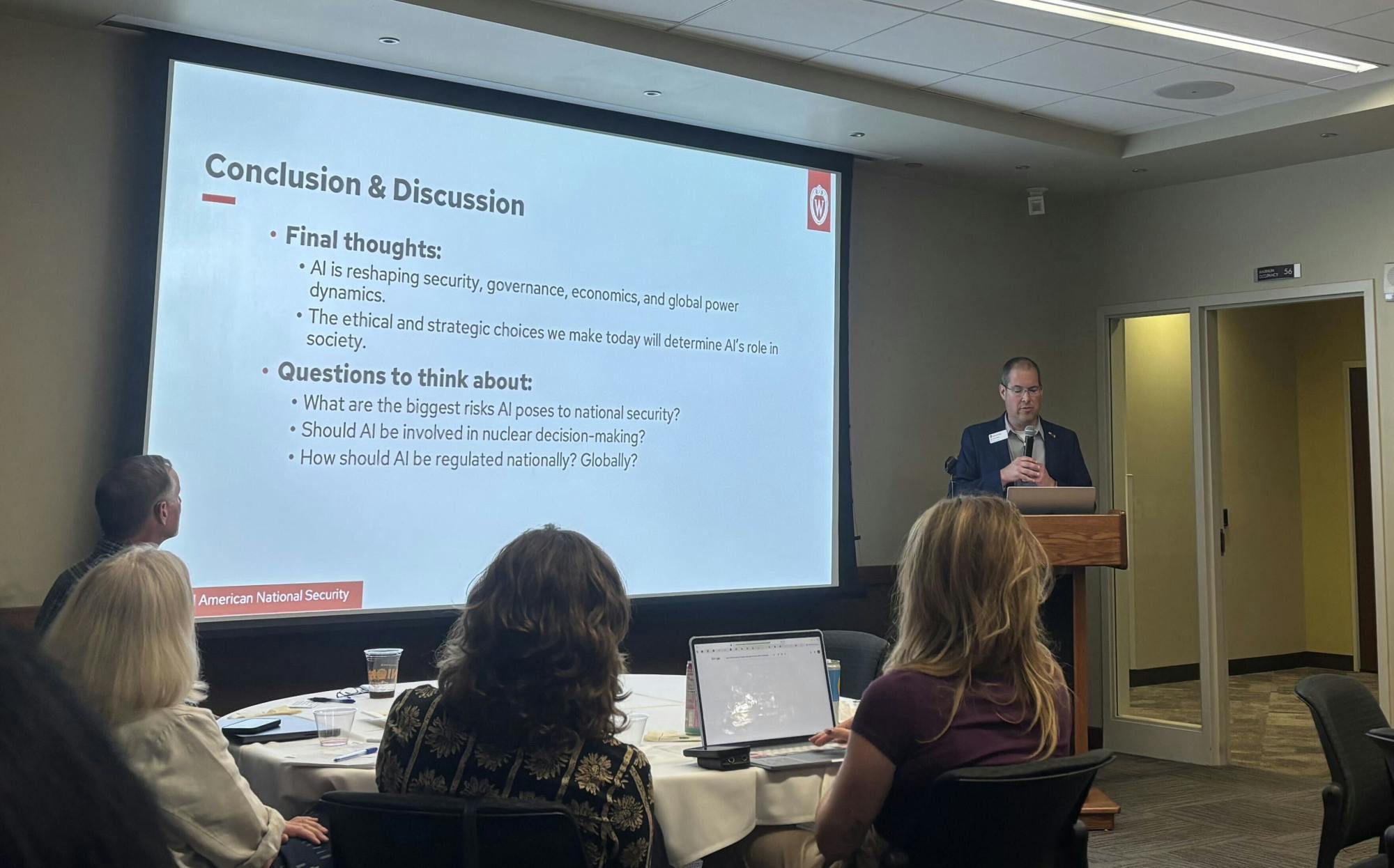
Dave Schroeder, Director of National Security Initiatives at the University of Wisconsin-Madison and Manager of Cyber Programs and Designations for the College of Computing and Artificial Intelligence spoke about AI’s role in geopolitics and increasing cybersecurity threats at a Badger Talks event hosted by the Madison Committee on Foreign Relations Sept. 9.
As AI rapidly develops on campus with the opening of the College of Computing and Artificial Intelligence, Schroeder said each time he presents, his information feels out of date because of how quickly the technology is evolving. When he began presenting about AI, it was rare that anyone in the room had interacted with it. Now, that is far from the truth.
“Really everyone is using AI in some form…the explosion of these large language models, these chatbots, have been the thing that has really animated our imagination and brought a lot of attention to this domain,” Schroeder said.
Large language models (LLMs) like ChatGPT and Gemini, while the most widely used, are only a small fraction of what AI is capable of. AI now has increasing military and government applications.
“Whether that is the targeting and decision process, or drone swarms, these things are all accelerated with AI,” Schroeder said.
Schroeder referenced the weaponization of AI controlled drone strikes in the Russia-Ukraine war, noting “the entire attack chain is AI.”
Humans are no longer in “the loop” according to Schroeder when it comes to important and lethal military decisions, often acting only as “button pushers,” allowing AI to make the decisions.
“So we need to have discussions about what it means to have human decision making removed from lethal decisions in warfare…This transcends politics. This is something that we're going to have to figure out,” Schroeder said.
Data collection controversy
Schroeder addressed apprehensions regarding the data collection necessary to train LLMs, which has caused controversy in recent months.
“It's [LLM training] coming from any data that you've agreed to in the terms of service that can be used by that service provider in any way they see fit, and if they have permission to use it, whether it's uploading photos or text, they're using it because AI models are hungry for training data,” Schroeder said.
The collection of data has led to cybersecurity threats all over the country. AI models have gained abilities to hack without any input from humans, jumping from machine to machine.
Schroeder shared examples of foreign AI gaining access to water utilities and power plants across the nation, places that may seem militarily useless, but house important data.
AI has also hacked into digital data libraries without the prompting or assistance of humans.
“Anyone who's targeted always thinks that ‘Oh, no one cares about me. I'm not a national security target.’ Well, you know what? Everything's a target, and AI is lowering the bar to targeting virtually anything and everything,” Schroeder said.
Schroeder also talked about concerns regarding the data centers and resources needed to accommodate AI technology.
More than 50 data centers currently reside in Wisconsin, with more being proposed by tech companies. The environmental concerns, such as power and water usage, as well as community worries surrounding the amount of space the centers take up has been pressing for Wisconsinites.
“What's unique about AI is compared to other types of IT services, it needs a lot more computing, a lot more power, a lot more networking, and so that equates to more physical equipment that needs to be housed in buildings, and that's where you see this current frenzy of buildouts with data centers,” Schroeder said.
AI race between the US and China
While the answer may seem to be to halt AI development, the choice is not that simple, according to Shroeder. As the United States continues to advance in the AI industry, so does China.
“We're in a race with China, and it's not unlike the race to space or to the bomb, and we need to win that race,” Schroeder said.
With the introduction of LLMs like Deepseek, China is head to head with the US in AI development, and not just in the LLM field. AI development has become a proxy of government power. Schroeder said China still relies on US technologies to aid in their development. If the US wants to stay ahead of China in the race, Schroeder said development must continue at full speed ahead.
“If we slow or stop AI development in the United States to the point where China comes out as the resounding winner, what global implications does that have?” Schroeder said.
The race with China and the rapid development of AI models has opened a door to threats AI companies do not even understand themselves, according to Schroeder.
“We're in kind of the no rules era of AI development. Full speed ahead, and you have people resigning from our frontier AI companies saying ‘I'm resigning because I think that AI is going to end humanity,’” Schroeder said.
UW-Madison AI development
Schroeder said AI developments on campus have emulated what responsible progress can look like.
“One of the College of Engineering's six moonshots is what we call embodied AI. Iit's the idea that we need to develop our own technology landscape that lets us build our own devices, whether they're more traditional-looking factory robots or humanoid robots that are not dependent on foreign supply chains and technology,” Schroeder said.
Badgers have the opportunity to lead AI in the right direction, and the campus has already received recognition for doing so, receiving more grants from the Genesis Mission — a Department of Energy federal initiative centered around AI research — than any other public university thus far.
“The idea [of the Genesis Mission] is to take AI and apply it across disciplines using all of the scientific data that we've collected…feed it into AI models, and use this to supercharge the next generation of science and discovery,” Schroeder said. “Something that we can be proud of here is that UW-Madison was second in the country for the number of Genesis awards that we got, behind only MIT.”
Schroeder concluded the talk with helping listeners find hope for the future of AI.
“The good side of AI is to use all of the things that we've already discovered and ask the question: ‘How can these things be related to make new discoveries that we might never have even anticipated?’” Schroeder said.