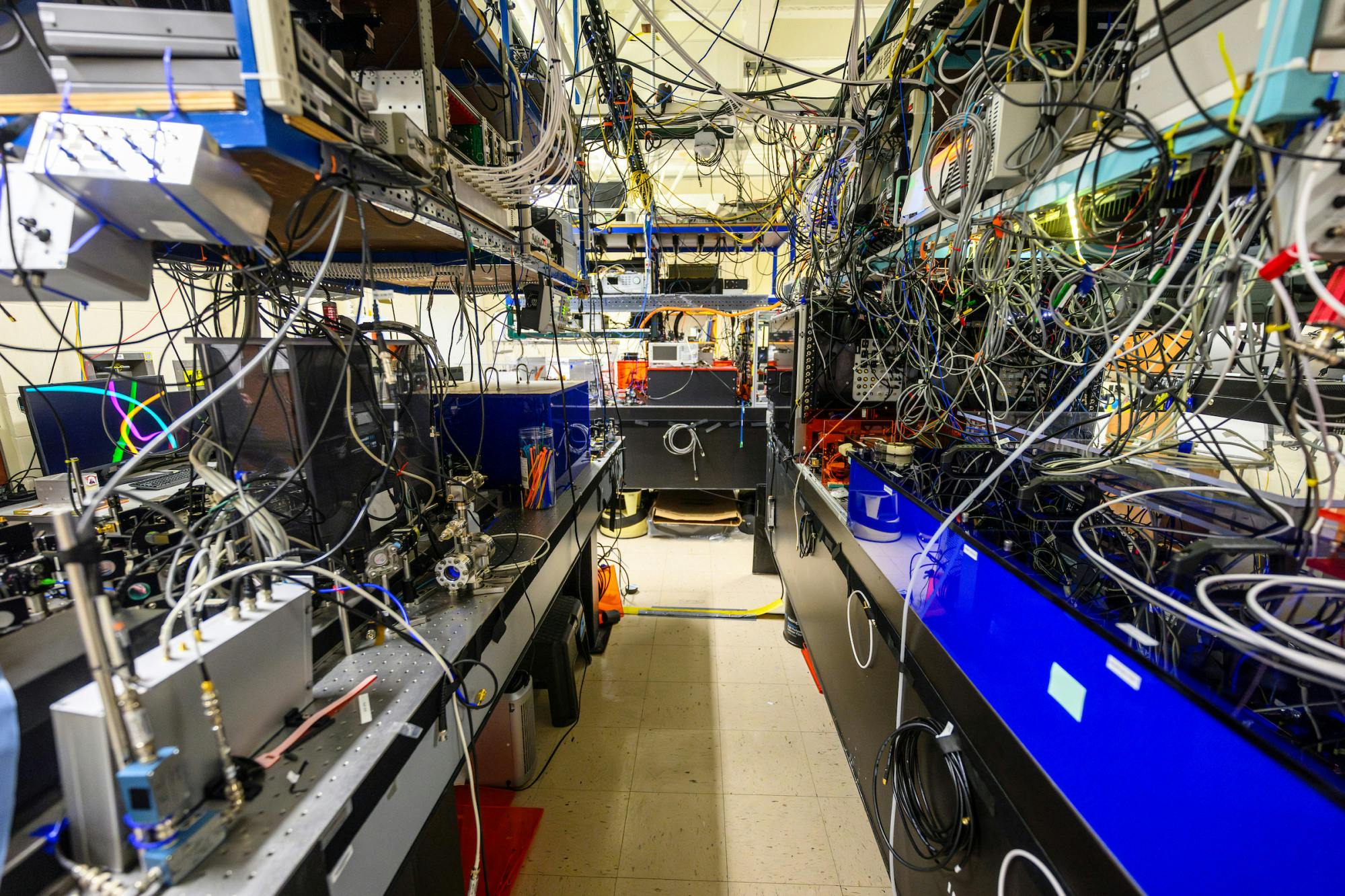
Teams of researchers at the University of Wisconsin-Madison spent months submitting proposals to the Department of Energy’s vast new Genesis Mission — an initiative centered around artificial intelligence (AI) but naming research goals in fields as varied as nuclear fusion and molecular biology. Many of UW-Madison’s proposals center around one burgeoning cross-college priority: quantum.
The Genesis Mission, launched by an executive order in Fall 2025, says that the U.S. faces an AI “race for global technology dominance” requiring “a historic national effort, comparable in urgency and ambition to the Manhattan project.” UW-Madison assigned a leader of the Wisconsin Quantum Institute (WQI) to coordinate the university’s response to the Genesis Mission, and its stated goals overlap with five of the six College of Engineering moonshots announced this May, including investment in quantum.
Executive Director of the WQI Ona Ambrozaite, who will coordinate the Genesis Mission response, told The Daily Cardinal quantum research is something that requires a team effort.
“We need the incentives to bring all of this together in kind of a sustainable way,” Ambrozaite told the Cardinal.
The Genesis Mission provides “incentives” for American quantum researchers to come together to share the work that they have been doing, according to Ambrozaite.
Ambrozaite, who also co-founded the Johns Hopkins Science Diplomacy Group, said while international quantum research efforts are important, having domestic priorities is also necessary.
“[The Genesis Mission] is a national-level mission that would help us really translate the excellent foundational research that our faculty and teams are doing here into this real-world technology,” Ambrozaite said.
Mark Eriksson, director of the WQI and principal investigator of the Eriksson Group, told the Cardinal AI can help develop and maintain quantum hardware and software.
Among other areas of research, fast quantum computing can help researchers better visualize how atoms come together to form different molecules and materials, according to Eriksson.
“Once quantum computers get big enough, it’s hoped that people will be able to use quantum computers to help design better molecules,” he said.
Quantum research is on the College of Engineering’s list of Engineering Moonshots — an ambitious list of goals published May 2026 inspired by the challenges listed in the Genesis Mission.
“By doing moonshots, we’re going to solve some hard problems,” Grainger Dean of the College of Engineering Devesh Ranjan told the Cardinal. “For me, moonshots are these audacious goals for the next ten years.”
Ranjan said that developing quantum research and giving it practical applications could grow manufacturing. Currently, Wisconsin stands as the second highest-ranking state for manufacturing employment — next to Indiana. Ranjan said he wants to bring Wisconsin back to number one.
“Manufacturing is in our DNA,” he said.
The Genesis Mission hopes to develop quantum research and computing through developing AI systems, bringing together American businesses, academia, national laboratories and existing scientific research.
UW-Madison’s engineering school looks to AI, nuclear fusion
The initiative accepted applications from a wide array of fields of scientific research — from manufacturing and materials to nuclear fission and fusion energy. Ten of the 26 Genesis Mission goals directly reference nuclear energy.
Quantum manufacturing, embodied AI and fusion energy cover three of the six engineering moonshots.
One of the engineering moonshots is “securing critical resources” in Wisconsin, which aligns with a Genesis Mission goal of “securing critical materials” on a national scale.
Ranjan said UW-Madison and the greater Midwest have the opportunity and the resources to drive the change promised by the moonshots.
“It’s not about taking advantage of the resources,” he said. “It’s about how to protect our resources.”
AI data centers have been a source of contention in Wisconsin recently for environmental reasons, with DeForest community members recently pushing back against the development of a QTS data center within their town.
Ranjan said fusion energy is one of the most important things to consider when thinking about potential drives toward AI by the government.
“If we have the energy solution first, and then we’re also working jointly to make sure the large language models are less energy intensive…I think we have a game-changer,” he said.
Staff writer