In ten years, the electricity that runs your microwave could come from the same reaction that powers the sun.
University of Wisconsin-Madison nuclear fusion startup Realta Fusion is partnering with utility company Madison Gas & Electric (MGE) to build a grid-connected fusion power plant in Wisconsin by the mid-2030s, the companies announced Sept. 2.
Nuclear fusion is a reaction occurring when two hydrogen isotopes, often deuterium and tritium, smash into each other at high pressures and temperatures, releasing energy. After being “fully developed and derisked,” fusion has the potential to be the cheapest form of energy generation, Dominick Bindl, COO of Realta, told The Daily Cardinal.
“[Fusion] gives you dense energy like conventional nuclear fission, but it has a fundamentally safer mode of operating and it could be significantly lower cost as a result,” Bindl said. “Base load power that's clean, that is safe, that is cost-effective — we think that's what Wisconsin energy consumers want, and we think that's what fusion can deliver.”
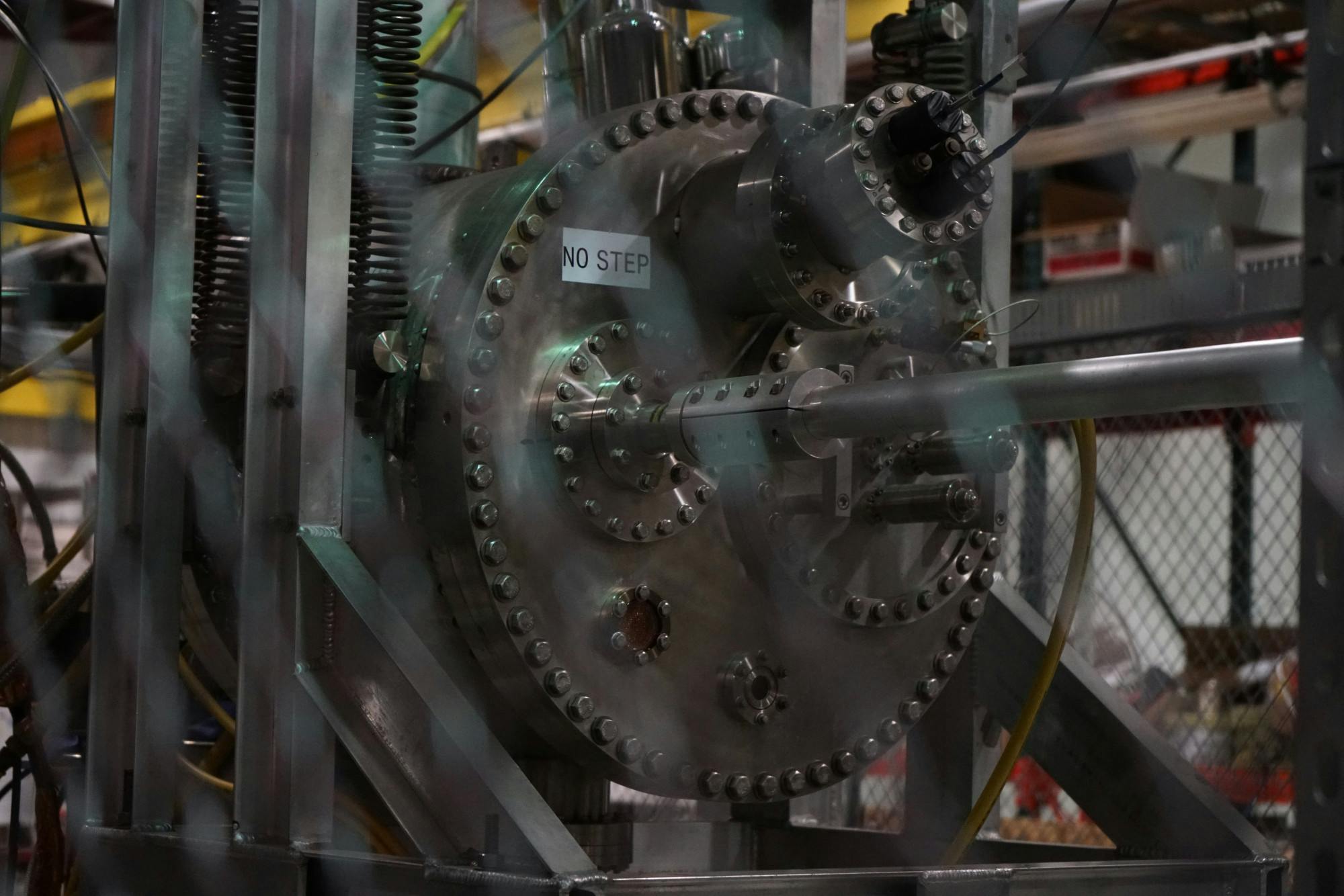
Realta Fusion, a fusion company founded in 2022, currently partners with UW-Madison to operate the Wisconsin HTS Axisymmetric experimental fusion machine at the university’s Physical Sciences Laboratory in Stoughton.
MGE provided Realta with “equipment, engineering and technical support along with assistance for siting, permitting, interconnection and financing” of the plant, in addition to a direct equity investment from its parent company, according to the press release.
According to Bindl, MGE’s interest in fusion was “a big part” of Realta’s decision to select OM Station, a former Oscar Mayer sausage factory in Madison, as the site of their research and development facility slated to begin construction by the end of this year.
Bindl said there’s no shortlist in hand for the site of the fusion reactor, adding potential sites are not necessarily limited to MGE’s jurisdiction. The company generates electricity for 170,000 users in Dane County and distributes electricity to 180,000 users across seven other counties in south-central and west Wisconsin.
Bindl expects the footprint of the fusion reactor to be visually similar to a fission reactor of the same electricity output, without the need for an “exclusion zone” around the reactor, an area with “special regulations and procedures to ensure that that plant is operated in a safe manner.”
“We [Realta] typically focus on the fusion core itself, where plasma is confined, where that heat is generated,” Bindl said. “There will be some plasma heating systems that are connected to that. There are some fuel cycle facilities to surround that as well. You’re imagining a relatively small campus with a primary building and several smaller buildings around it, including the steam turbine building for driving that electricity site.”
The press release said Realta will build a 200 megawatt-electrical (MWe) plant, which refers to the fusion reactor’s total energy output per second. The reactor’s actual size is subject to change as Realta solidifies the details of the proposal with MGE and will be officially established “much deeper” in the planning process, according to Bindl.
“The specific size [200 MWe] that has been under discussion… falls very cleanly within the range of capacities that Realta is developing technologies to deliver, and it's a size that is attractive to MGE for their anticipated customer need in that timeframe,” Bindl said.
Bindl said around 80% of the energy is thermal energy, which can be converted to electricity using conventional methods also used for coal, oil and natural gas plants. The other 20% comes from the charged helium particles produced by the fusion reaction, which would need to be converted to electricity through more fusion-specific technology called direct energy conversion.
Realta demonstrated a small-scale experiment in direct energy conversion this summer, but the technology has never been demonstrated at a grid-scale level.
The City of Madison used a total of 44.3 gigawatt-hours of electricity in 2023, which averages to a power consumption of around five megawatts. Assuming all of a 200 MWe fusion reactor energy output is converted to electricity, this planned reactor could power 40 Madison-sized cities.
Steve Schultz, an MGE spokesperson, said fusion’s ability to provide zero-carbon electricity and its long-term reliability influenced MGE’s decision to partner with Realta.
“Collaboration is an important part of being your community energy company,” Schultz said in an email to the Cardinal. “We believe that partnering with our customers to help them meet their needs benefits all MGE customers.”
Schultz said no timeline has been established for the plant between the partners.
The commitment helps MGE move toward their goal of producing 100% zero-carbon energy by 2050, according to the press release.
The news of Realta and MGE’s partnership arrived on the cusp of Type One Energy, another UW-Madison spinoff, signing a license to construct a fusion power plant with Tennessee Valley Authority, aiming to be grid-connected by 2034.
“It is no small deal to contain a very literal star inside of a vacuum vessel,” Bindl said. “Realta is very focused on building our commercial scale prototype to show that this energy source actually generates the energy that we think it should, based on our sophisticated physics models and understanding.”
Sonia Bendre is the campus news editor for The Daily Cardinal. You can reach her at sonia.bendre@dailycardinal.com.