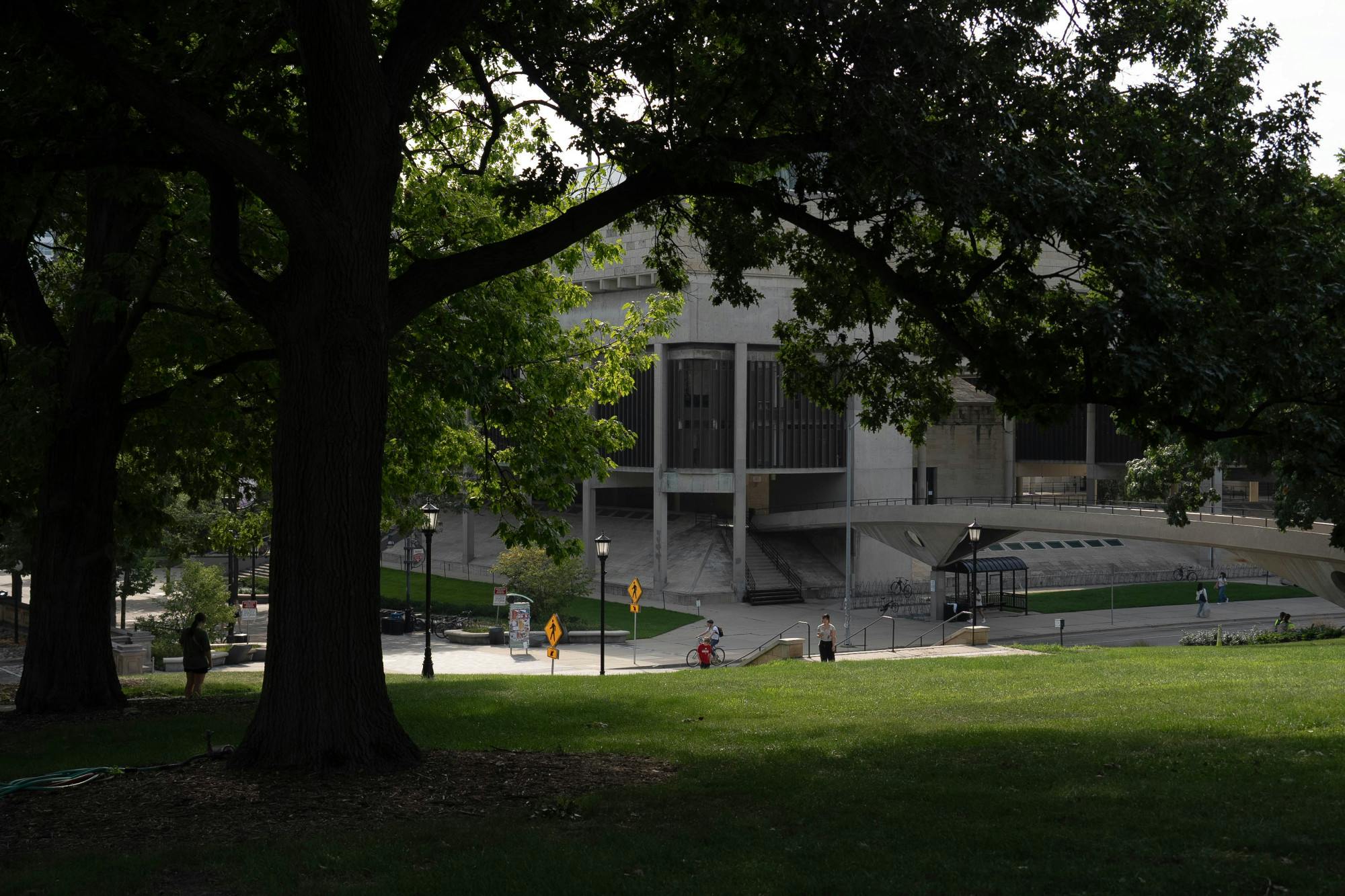
The Board of Regents unanimously approved a 2027-29 biennial budget request which included a University of Wisconsin-Madison demolition plan for the Mosse Humanities Building with a proposed budget of $463.5 million.
The project request states the money will be used to “demolish a portion of the original Art Lofts facility and the entire Humanities Building” as well as partially renovate the remainder of the original Arts Lofts facility and to fund a replacement where the music and art departments can be housed.
Distribution of funds will be a combination of General Fund Supported Borrowing ($416.7 million) and other gifts and grants ($46.8 million)
This is not the first time the Brutalist building’s survival has been questioned.
UW-Madison first announced a plan to demolish Mosse in 2003. Since then, there have been multiple requests by the university to see the plan through. In the last biennium budget request, UW-Madison asked the state for $292 million in support and private contributions to demolish the building.
“The budget request again proposes critical investment in UW-Madison’s infrastructure by finally demolishing the aging Humanities Building,” Interim Chancellor Eric Wilcots said in a university statement Aug. 20.
“The building is well past its expected useful life, with a significantly deteriorated building envelope and exterior window/wall system, uncorrectable humidification conditions, and insufficient environmental controls,” the budget request said. “The building has had numerous chronic design, functional and operational issues that have been exacerbated over time with the aging of the structure.”
In a video published by UW-Madison Campus Connection in 2022, Mosse is presented with mold, water damage, an inability to install technology, odors and HVAC issues and fixed seating leading to safety concerns.
The funding will also be allocated to construct a new facility and facility additions to continue supporting the art and music departments: Arts will see new two-dimensional (drawing, graphic design, painting) and three-dimensional (ceramics, printmaking, sculpture, wood shops, glass) programs.
The budget will provide the music department with new student performance and exhibit spaces, and an improvement of sound separation and quality of practice environments.
For the new facility, “multiple lecture classrooms will be constructed, and specialized instructional laboratories and studio spaces will be created with support for heavy equipment and appropriate ventilation and dust collection,” according to the budget request.
Wilcots said in his statement the university will work closely with “colleagues at the Universities of Wisconsin, state business and industry partners, legislative leaders and Wisconsin’s next governor to ensure the important proposals in the budget request move forward.”
Zoey Jiang is the Associate News Editor. She has covered breaking news on a variety of campus issues, federal changes affecting UW-Madison and local community stories.