When customers at a Wisconsin Union press a button to leave a “tip,” the money does not go directly to the student employee who served them.
Instead, those contributions go into the Union’s Thoughtful Investment in the Potential of Staff (TIPS) fund, an employee recognition program, rather than a gratuity system, according to Shauna Breneman, a Union spokesperson.
Last year, the TIPS fund provided employee of the month recognitions, graduating senior gift bags, student employee meal vouchers, annual and semester pins and student employee study rooms with food and beverages, according to Breneman.
Sarannya Bhattacharya and Grace Kachelski, two student catering employees who have worked for the Union for three years and one year respectively, told The Daily Cardinal customers frequently believe they are tipping workers directly, and said Union administrators verbally instructed employees not to discourage those contributions late in 2025 — even though workers in the past had been fired for keeping them.
“We’re not allowed to refuse tips, basically, and we can get in trouble if we do,” Kachelski told the Cardinal. “But at the same time, we're not allowed to take them directly, and we can get in trouble if we do. And the [customers] obviously are not aware that this is not going directly to us.”
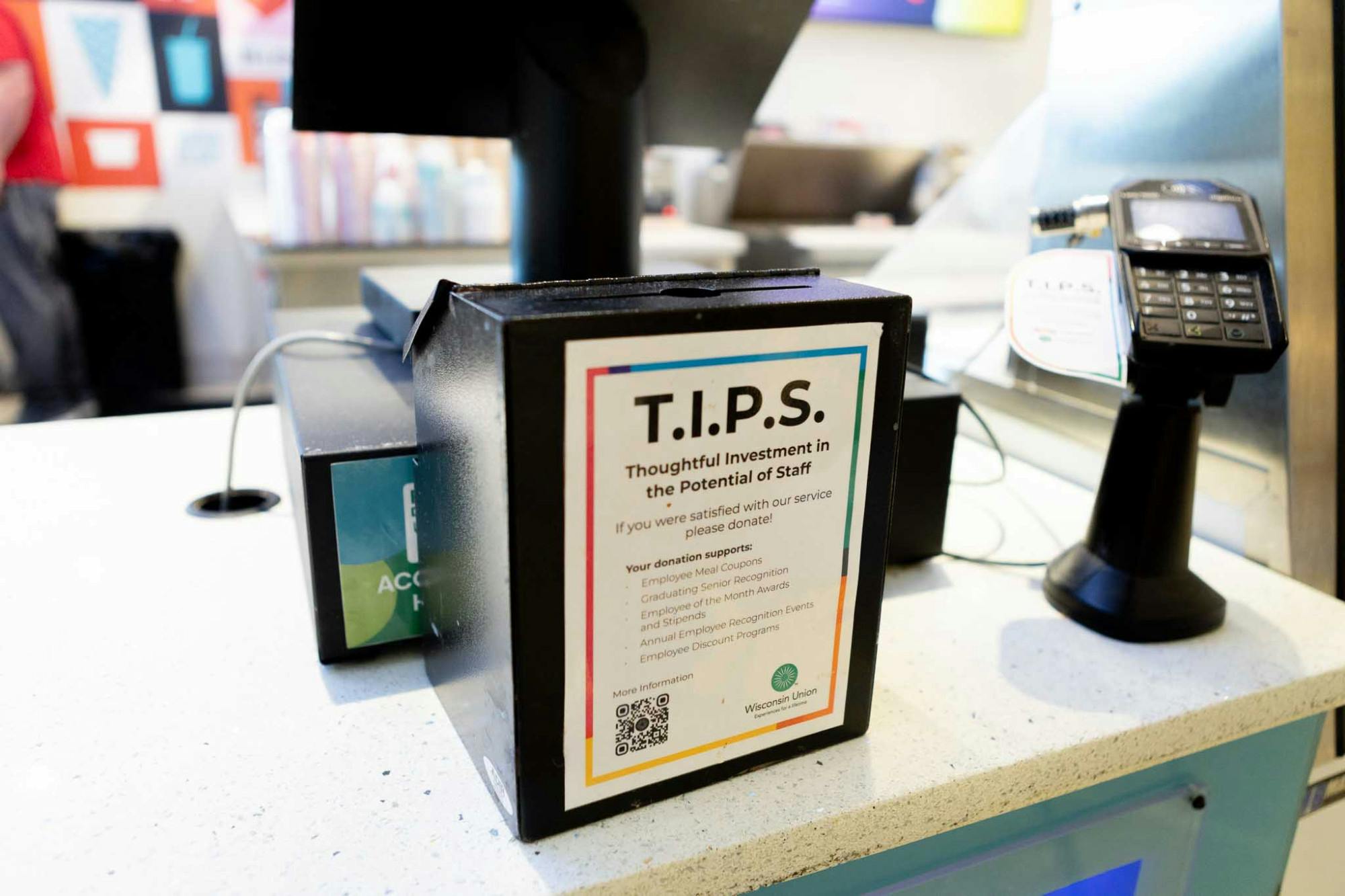
Breneman said in September of 2025 the Wisconsin Union rebranded its Wisconsin Union Student Employee Recognition Fund in some internal systems to the TIPS Employee Recognition Fund, implemented credit card donations at electronic registers and added “TIPS” stickers to existing donation boxes.
As a result, customer contributions to TIPS skyrocketed, according to Bhattacharya and Kachelski. The fund received about $77,000 in all of 2025, and has received about $209,000 during the first six months of 2026, Breneman said.
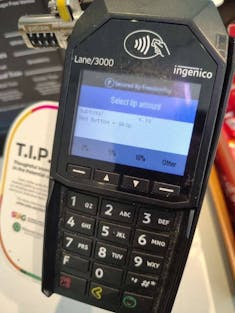
Now, customers who pay with a credit or debit card at electronic registers are prompted to “tip” zero, five or ten percent, or a chosen dollar amount, each time they order.
In an email statement to the Cardinal, Breneman said the human resources team created the TIPS acronym in September 2025 alongside the rollout of their electronic register point-of-sale system, which is hardcoded to label any optional add-on charge as a “tip.”
“Since their optional add-on is a donation to the TIPS Employee Recognition Fund, ‘tip’ was redefined with the TIPS acronym,” Breneman said.
Bhattacharya said Ben Clark, an assistant HR director, told him and Kachelski the TIPS initiative started after an employee accidentally turned on the tip option at an electronic register at The Rathskeller, and the Union “realized they were racking in quite a bit of money, a lot more money than the cash boxes were.”
Breneman confirmed that tipping was mistakenly turned on in a unit for a short period of time before the launch of the TIPS initiative, but said the Union had been discussing a credit card donation option for years and the accident “was not the impetus for the program but did coincide with a restart of the important conversation about the Fund.”
She said cash donations had been declining and “a change was needed to continue our student employee recognition initiatives.”
Student employees, who make a starting wage of $15 an hour or more, complete an HR video training module and read an employee handbook prior to starting work stating that “Union employees are not allowed to receive or accept tips in the course of their employment at the Union.”
“Administering and distributing [tips] in compliance with federal law, UW System payroll processes and accounting requirements is not operationally feasible,” Breneman said.
Prior to the electronic register system, customers could contribute cash donations to black donation boxes, which ultimately went to the Wisconsin Union Student Employee Recognition Fund, according to Breneman. In the Union’s financial systems, the TIPS money still goes into this fund. The Student Employee Appreciation Group (SEAG) — an appointed board of student employees — manages the employee recognition fund with advice from full-time staff advisors.
In addition to other student benefits, the SEAG webpage also states money goes towards staff appreciation events, but Bhattacharya and Kachelski said a banquet hasn’t been hosted in the past three years, and there are no other student staff appreciation events that they know of.
Each semester that they work at a Wisconsin Union location, student employees receive a meal voucher for up to $12.50, Breneman and the student workers said. The Union employs around 1,800 students, according to Breneman, which totals around $45,000 per year for the Union assuming each employee receives two meal vouchers a year.
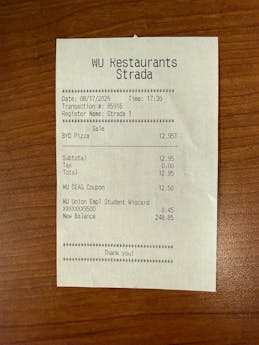
The voucher previously promised one free appetizer, entree and drink from any participating Union location, but because of inflation, the voucher’s fixed value of $12.50 often only covers the entree, Bhattacharya said. If a student uses the voucher to order a $10 meal, they don’t receive cash back, but they make up the difference if their entree costs more than the voucher value.
Breneman said SEAG will likely discuss the voucher price this fall.
The SEAG webpage states TIPS funds employee discounts, but discounts apply to all Wisconsin Union staff, not just student employees, according to Breneman, Kachelski and Bhattacharya.
“Neither the student employee discount nor the non-student employee discount is currently funded by the Wisconsin Union Student Employee Recognition Fund, and the Fund has not funded either discount in the past,” Breneman said.
The Union spent an average of $60,000 on student recognition annually over the past 10 years, Breneman said. SEAG employees receive a $350 stipend per semester funded by TIPS and choose how to fund student recognition programs. Breneman said SEAG will make recommendations for the use of the available funding in the fall.
Bhattacharya and Kachelski said when they bartend at events like weddings, they still frequently receive cash donations in black “TIPS” boxes.
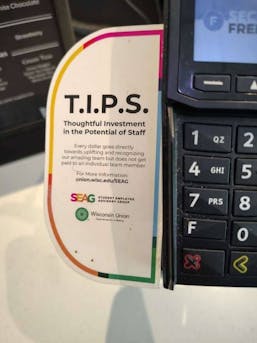
Electronic registers are labeled with “TIPS,” the full expansion of the abbreviation, and a smaller note which states, “Each dollar goes directly towards uplifting and recognizing our amazing team but does not get paid to an individual team member.” Black boxes also have the “TIPS” label and expansion, with a note that says “If you were satisfied with our service, please donate!” and a list of what donations support: employee meal coupons, graduating senior recognition, employee of the month awards and stipends and discount programs. On receipts, the TIPS are simply listed as a “tip” with no disclaimer.
“There's no actual explanation of what it is,” Bhattacharya said.
Student employees can “notify guests that donations are optional” and explain the Wisconsin Union Student Employee Recognition Fund, but cannot make the determination to accept or decline a customer contribution, according to Breneman.
Catering employees for the Union can choose to take bartending training for events including weddings and conferences, where they say they can collect thousands of dollars a night in cash donations toward TIPS. At multiple weddings, Bhattacharya and Kachelski found that guests did not know their intended cash tips were not going directly to student employees, and requested their money back when they found out.
“At the weddings in particular, I've had a lot of guests who, when they find out that we do not get the tips directly, will come back up to the bar upset that we're not the ones receiving the tips and ask for their money back or ask if they can hand it to us under the counter,” Kachelski said. “We’ve had a bunch of guests be like, ‘We didn't know it wasn't going to you.’ They were angry, they were outraged. And this has happened on multiple occasions.”
Bhattacharya and Kachelski also said they witnessed full-time staff members at the Union mislead consumers about the TIPS initiative.
“[At] a tailgate for the Badger games we're essentially just serving alcohol,” Bhattacharya said. “In those events, the tips are thousands of dollars a day. I have seen upper-level managers who are at the point of sales tell customers ‘It's for the kids,’ referring to student employees… but it's not for us.”
Breneman said student employees are directed to explain that the donations go into a fund that benefits Wisconsin Union student team members if they are asked about the donations.
“Last year, the SEAG Fund donations had dropped… We had kind of an informal policy at the time to refuse TIPS, since we didn't receive any of it,” Bhattacharya said. “That’s when [we heard that Clark] burst into the employee office, going on and on about how TIPS were down and how these TIPS fund programs like 30% [employee] discounts and meal coupons… and how it is important that we get these TIPS.”
Bhattacharya and Kachelski said Clark denied telling employees they couldn’t refuse TIPS in a meeting with him this June.
“When we brought that up to [Clark] in the meeting, he said that wasn't true [and] you just have to be kind, or not rude, about the way that you deny TIPS,” Bhattacharya said. “But anything we do that would imply that we're not accepting tips from customers, like not having [boxes] face customers, they will reprimand or try to crack down on that.”
Bhattacharya and Kachelski planned to meet Clark again for a budget discussion in mid-July, which was rescheduled to August and then canceled the day prior because “we are occupied responding to other requests for this information,” Clark wrote in an email obtained by The Cardinal.
Clark did not respond to a request by the Cardinal for an interview.
"The employee assisting the patron is not the recipient of the donation and would not make the determination to accept or decline a patron’s contribution to the Fund," Breneman said.
In several interviews conducted by The Cardinal, Wisconsin Union customers also seemed unaware of where their “tip” money was going.
George Frese, who used a credit card to purchase two beers and a popcorn from the Union, told the Cardinal he was unaware his donations went to a student worker benefits fund and not directly dispersed amongst student workers, but that the knowledge would likely not change how he tipped in the future.
Jim Wright, who purchased food with a credit card from Strada and the Rathskeller, said since he learned that the Union’s TIPS were not dispersed as a gratuity system a month prior, he will no longer be leaving TIPS.
“I was here with my dad last month and he asked… the staff member at the Rathskeller explained that actually, the tips are not pooled for the staff,” Wright said. “[University of Wisconsin-Madison] is a university that likes to promote a very liberal and ‘for the people’ mentality, but when it comes to it, they're greedy just like all corporations.”
Both Bhattacharya and Kachelski said the best course of action would be abolishing the TIPS altogether.
“I would love to see a no-tips policy,” Bhattacharya said. “Not all Union employees are in positions where they can be tipped, and the whole tip pooling system would again go to a place where there's no actual transparency of what's going on.”
Editor's note: This article was updated on August 27 at 10:00 am to include that Wisconsin Union student employee starting wages are $15 or higher.
Sonia Bendre is the campus news editor for The Daily Cardinal. You can reach her at sonia.bendre@dailycardinal.com.