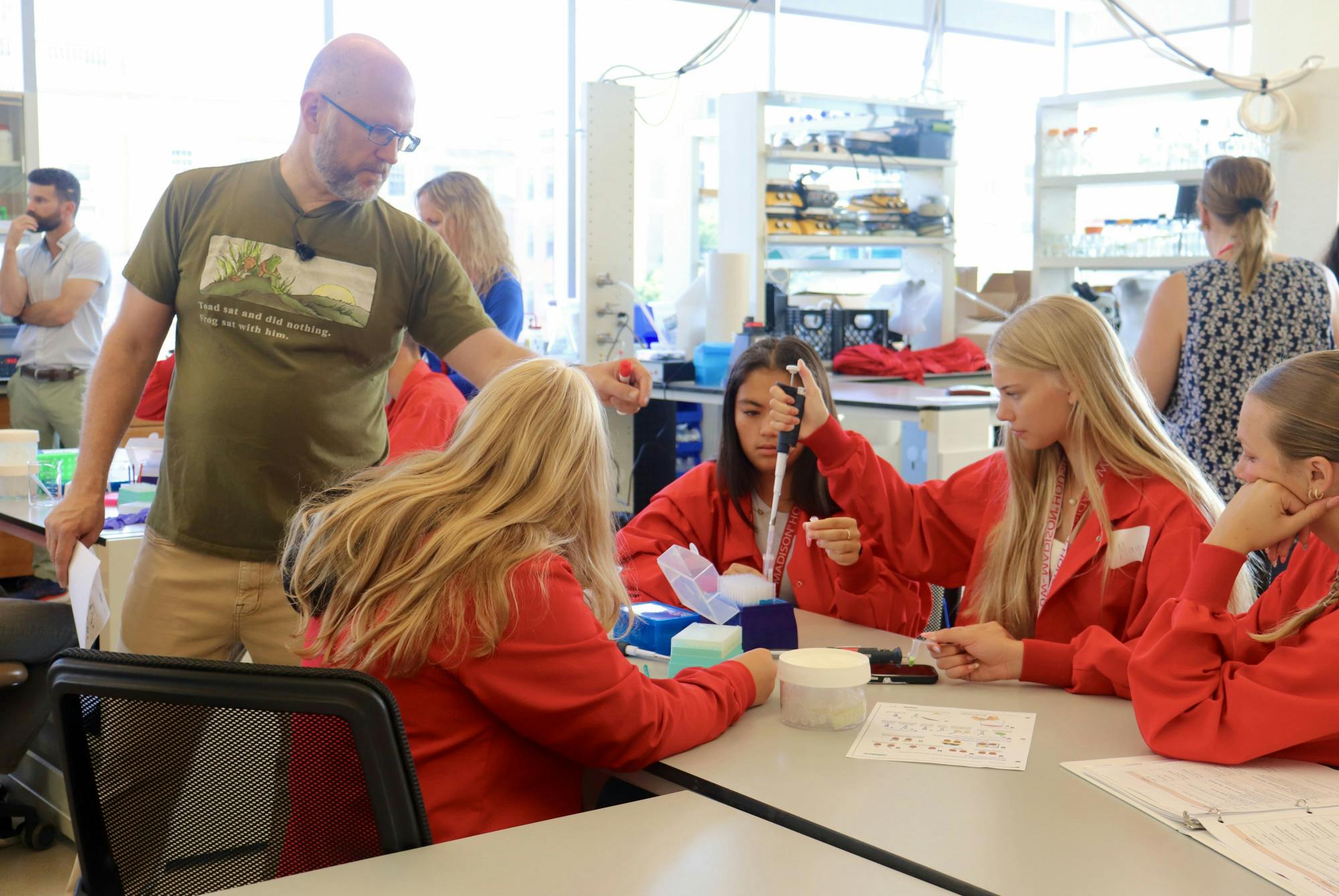
The Morgridge Institute hosted its 20th annual Rural Summer Science Camp in July at the University of Wisconsin Madison’s Discovery Building, giving rural Wisconsin high school students a week to explore the realm of biology and conduct hands-on experiments with scientists.
The camp offered students the opportunity to explore the sciences beyond the limitations of rural high school curriculums and funding, allowing them to explore their interests using cutting-edge equipment at a top research university.
During their all-inclusive week on campus, students engaged with faculty and scientists and dove deep into molecular biology. Experiments included detecting GMOs in soy and corn food, observing beating-heart stem cells and adding new DNA to bacteria.
“It’s such an amazing opportunity for our students,” Beth Roidt, a science teacher from v who chaperoned six students, told The Daily Cardinal. “Because of time constraints, because of classes, because of school size, we don't get to do these labs. We don't get to do these activities.”
The summer camp allowed Roidt’s students to use lab equipment, talk to real scientists and “expand their horizons about what science actually looks like” without the limitations of high school funding and equipment, she said.
“We just don't have the money for this,” she said. “This is an opportunity that can only happen when we have access to it through something like [the summer science camp], which is really a big deal for us.”.
Schools are selected and prioritized for the program based on size and economic need. At Monroe High School, lab equipment is often stretched thin and irreplaceable, Roidt said.
“I need this stuff to last 20 years,” she said. “If something breaks, I have to write a whole grant to get another one.”
The camp ran three week-long sessions this July — each week featuring a different group of four to five high schools occupying Dejope Hall and various labs around campus.
“We got to look through a $1.3 million dollar microscope, and that's how much we spent on renovations for our school this year,” Riley, a sophomore from Fennimore High School, told the Cardinal. “Let's be so real. You can't compare this.”
Wesley Marner, the director of Engagement, Education and Equity for the Morgridge Institute, told the Daily Cardinal students participate in hands-on experiences each day of camp, particularly in biomedical science. They also get a taste of campus life, staying in Dejope Hall and eating in dining halls throughout their stay.
“I'm looking into a research job, and it really shows what a future work environment could be,” Kaleb, a senior from Platteville High School, told the Cardinal. “They were talking about wavelength stuff and lasers. That really interested me. Like all the equations. I just love that.”
The goal is to have high school students explore the possibility of pursuing a STEM degree after they graduate from high school, ideally at UW-Madison, Marner said.
“This is just such an amazing opportunity for our students that they would never otherwise get. It's all paid for,” Roidt said. “They get room, board, housing. They get to experience UW, which is so incredibly awesome.”
Aside from the lab experiments, Roidt and her students got a glimpse into the life of a UW-Madison student: exploring state street, enjoying ice cream on the terrace and visiting the Capitol.
The camp ultimately serves to expand students' horizons, both in science and their future college prospects, Marner said.