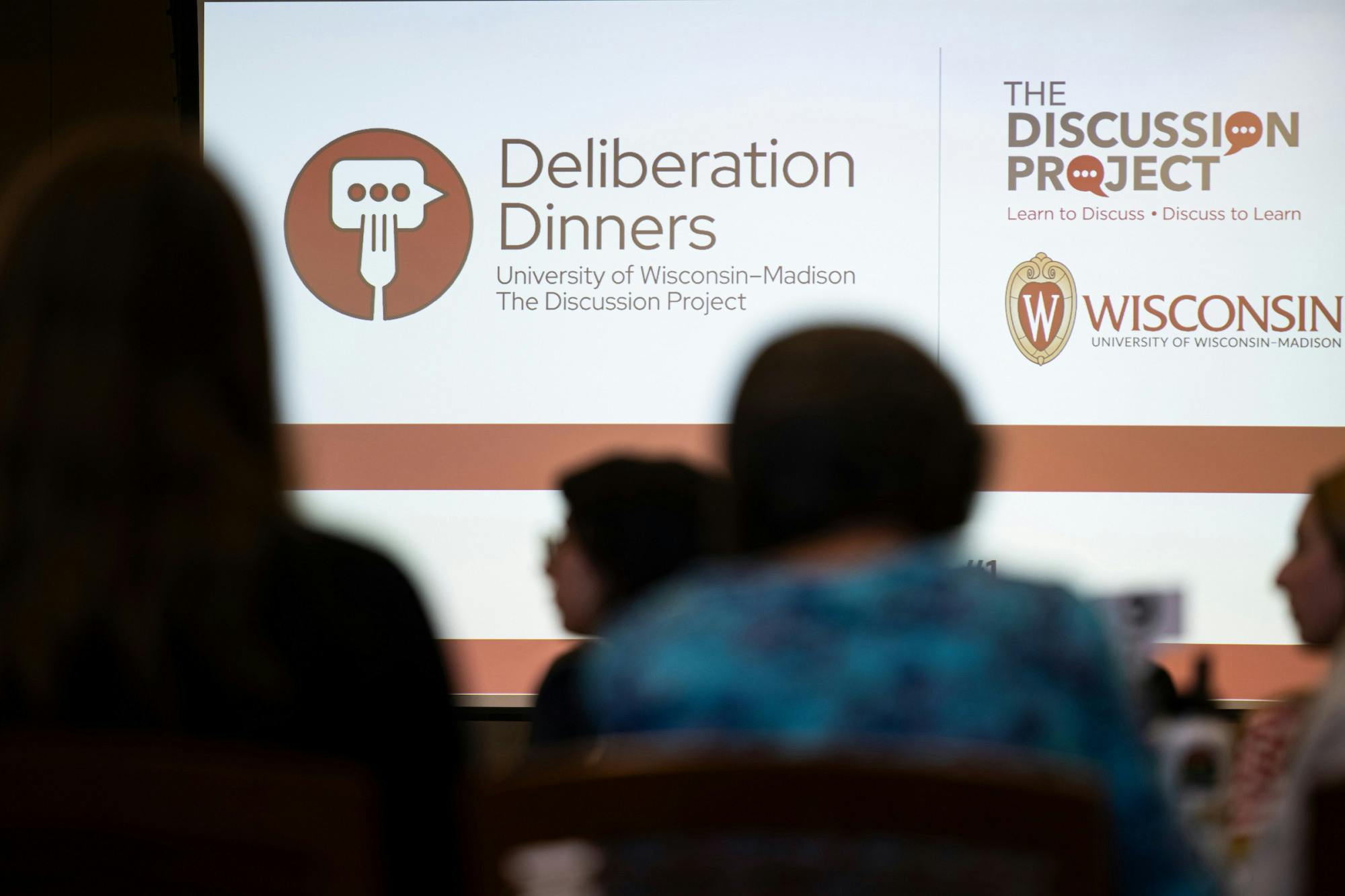
The University of Wisconsin-Madison’s Deliberation Dinners returns for its fourth consecutive year, giving 375 undergraduates with diverse perspectives the opportunity to deliberate on controversial political issues over six moderated meals throughout the academic year.
The discussions aim to maintain a respectful and collaborative environment and promote civil dialogue among undergraduates.
UW-Madison staff members and graduate students act as discussion facilitators, providing structure to the students’ debates and instruction on discussion techniques. Facilitators train in discussion pedagogy through the program’s sister project, The Discussion Project.
Students who apply to participate in the program must complete a confidential Pew Political Typology quiz, which categorizes participants into nine different political groups. These categorizations are used to create small discussion groups of 10-12 students that have diverse ideological perspectives.
Deliberation Dinners, established in 2023, play a key part in UW-Madison’s Wisconsin Exchange: Pluralism in Practice initiative, which started in 2025 under former chancellor Jennifer Mnookin. Interim chancellor Eric Wilcots indicated the initiative will remain an institutional priority in 2026.
Henry Johnson, a sophomore majoring in legal studies who participated in the program last year, told The Daily Cardinal the 2.5-hour dinners offered a safe space for openly sharing a wide range of views, along with free food and student stipends, which are $50 this year.
“The best skill [I’ve learned] is definitely being able to talk to people and being able to confidently share my opinion,” Johnson said.
According to the program’s website, deliberation “is a discussion that answers the question, ‘What shall we do?’ — without requiring or seeking consensus.”
Johnson is also an active member in pro-life club Badgers for Life and christian campus ministry Badger Cru. He’s a volunteer firefighter who wants to go into law enforcement, and he’s running for office in Assembly District 78 this year.
“I would highly recommend conservatives, liberals, independents, anyone to do [Deliberation Dinners], because I think it makes you a lot more well-rounded of a person and stretches you to make good arguments,” Johnson said.
Participating students are assigned 20 to 25-page readings before each dinner that outline different perspectives on the chosen topic, according to Johnson.
Johnson also said it was helpful to not only learn about the subjects, but to be able to go back to the document and discuss different arguments or statistics throughout the deliberation.
The program has grown from 110 participating students in the 2023-2024 school year to 365 in the 2025-2026 school year.
Last year, around 97% of students agreed that peers respected different opinions during discussions. Many also felt that the experience helped them understand different perspectives and learn from their peers in an inclusive and engaging environment.
The program’s effectiveness is independently measured by the Wisconsin Evaluation Collective using “student pre- and post-program surveys, exit ticket surveys after each dinner, and a post survey of the facilitators.”
This data is used to make any changes to the program, as well as to determine how the students have learned from the Deliberation Dinners.