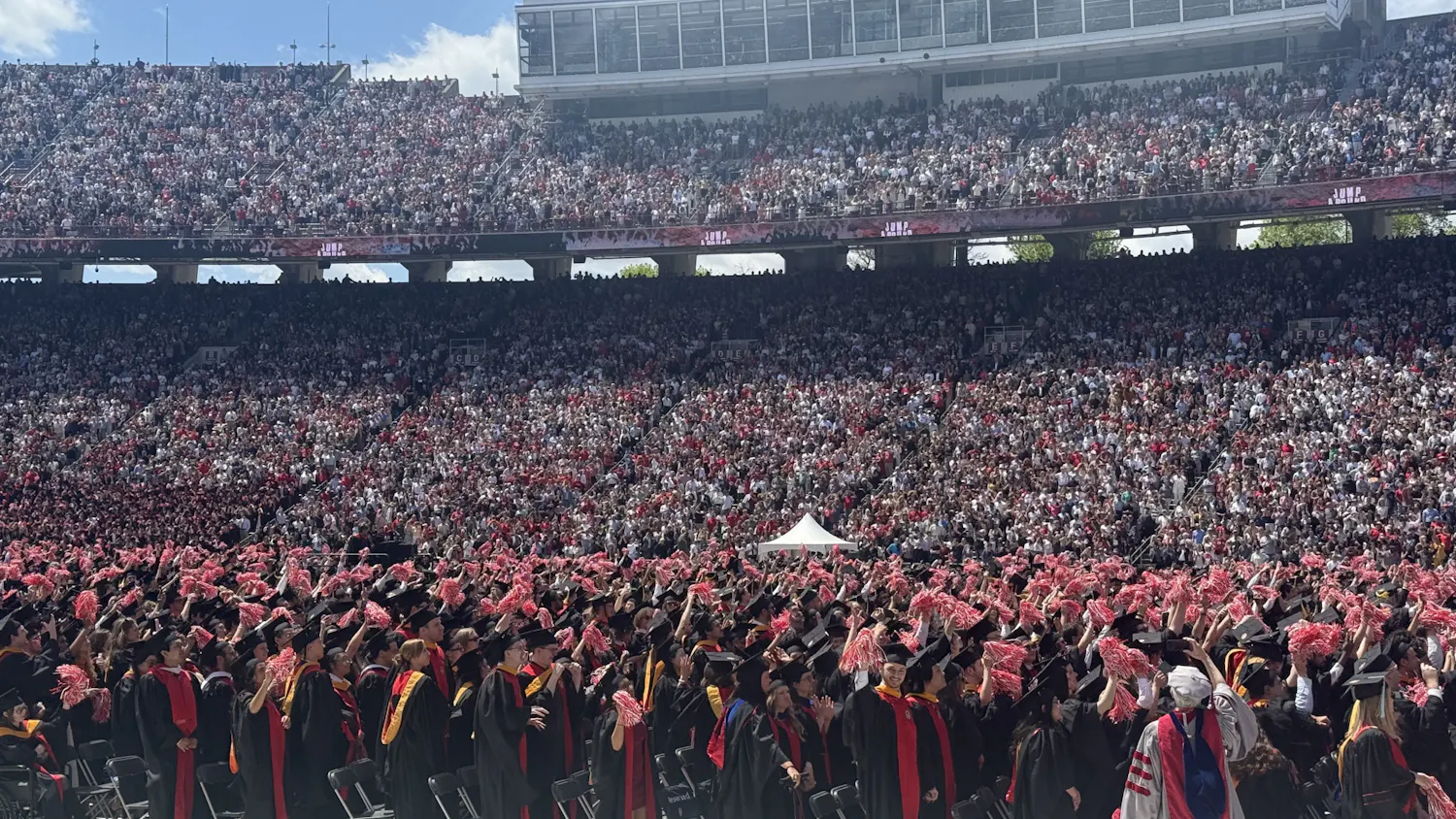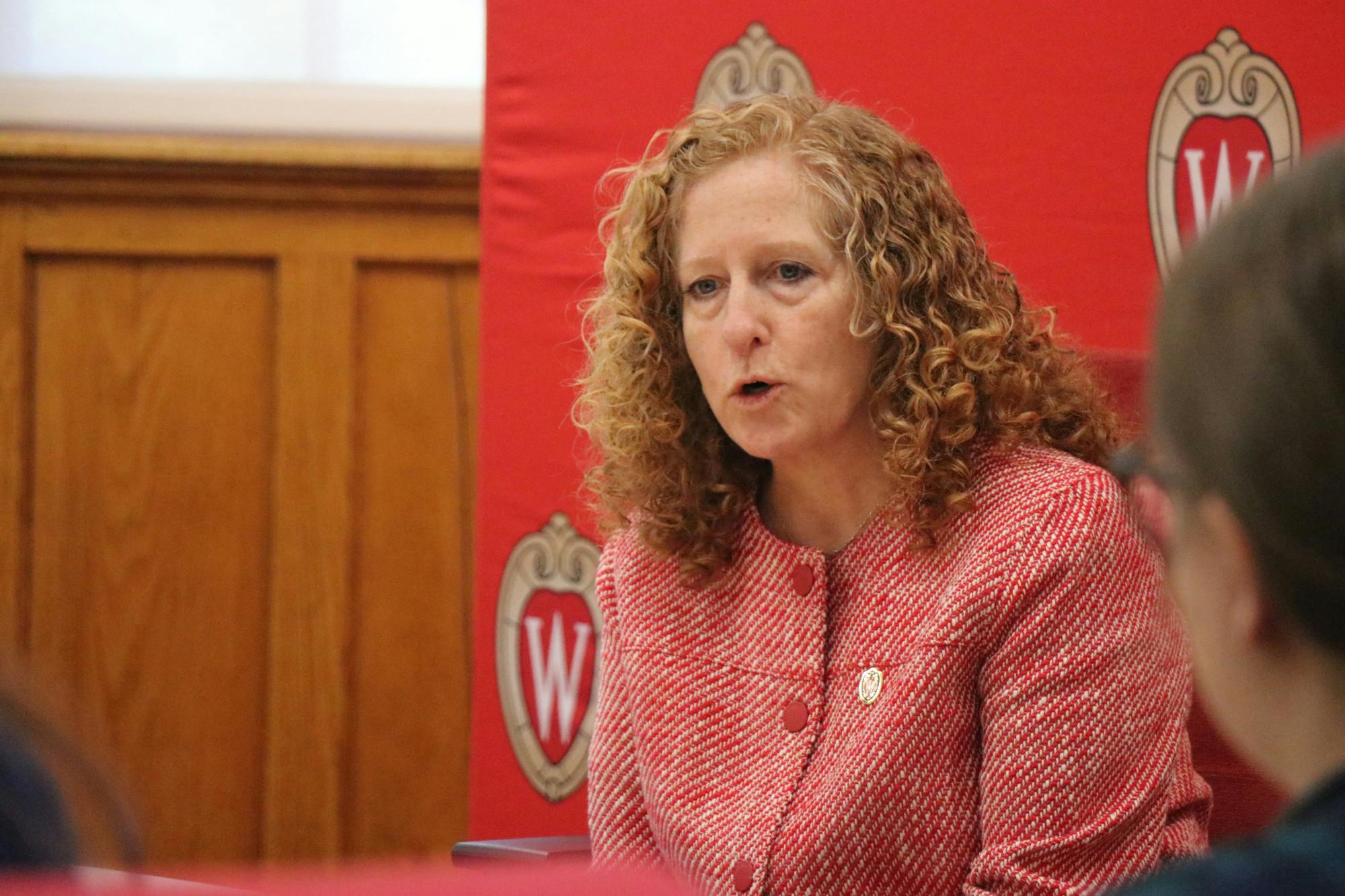
University of Wisconsin-Madison Chancellor Jennifer Mnookin shared insights into her four-year tenure at a roundtable discussion May 11, highlighting her pluralism efforts, her attempts to negotiate with students and her experience navigating a “growing distrust in institutions” of higher education statewide and nationally. Mnookin will step into her new role as Columbia University’s president July 1.
Mnookin characterized her tenure as a struggle in a time of “dramatic polarization,” describing the pro-Palestine encampments as some of her worst days as chancellor. She celebrated the administration's wins — among them the creation of Bucky’s Pell Pathway for low-income students and a program offering free tuition for members of Wisconsin tribal nations.
Mnookin also called on the state legislature to grant UW-Madison bonding authority, which would allow the university to borrow from markets rather than relying on state funding.
Tenure marked by student discontent, administrative uncertainty
One of Mnookin’s main priorities during her time as chancellor was to foster campus-wide pluralism — an initiative aimed at promoting open dialogue and creating a campus atmosphere where “different points of view are both expected and respected.”
During her four-year term the university launched programs like the Wisconsin Exchange and Deliberation Dinners to support pluralism, but Mnookin faced criticism for not being receptive to student viewpoints. Members of student groups including The BLK PWR Coalition, Associated Students of Madison and Students for Justice in Palestine have all previously voiced frustration over Mnookin’s lack of face-to-face discussions about university issues.
After a UW-Madison student’s racist rant went viral and sparked campus-wide protests in 2023, Mnookin appeared briefly at a Blk Pwr sit-in. Students said she arrived late and physically stepped over students during her exit, staying for around 20 minutes.
Mnookin appointed an ad-hoc committee to produce a working report with recommendations for supporting Black people on campus, including reconnecting with Black alumni, expanding financial aid for minority groups and creating Black student and faculty councils.
Lavar Charleston, former vice chancellor for inclusive excellence and director of UW-Madison’s now-sunset Division of Diversity, Equity and Educational Achievement was originally tasked with implementing the report’s recommendations.
Charleston was soon after laid off as a result of “poor financial decision-making,” Mnookin said. Amid his layoff and shifting policies under the Trump administration, the university has done “less with [the recommendations] than I would've hoped, but more than nothing,” she said, adding that the report influenced how Wisconsin Foundation and Alumni Association engages with alumni.
In May 2024, Mnookin authorized police removal of a pro-Palestine encampment on Library Mall. Officers arrested 34 protesters including students and faculty, drawing widespread criticism across campus.
Calling in police enforcement against the encampment, which was led by Students for Justice in Palestine, put Mnookin at the center of a campus flashpoint. Hundreds of students, faculty and community members attended the encampment to call for “financial and social” divestment from Israel, a topic that remains salient at UW-Madison, where the university responded critically to a pro-divestment ASM resolution passed March 25.
At a Faculty Senate meeting following police action at the encampment, where she did not take questions, Mnookin played a voicemail UW-Madison had received from a caller requesting to set up an encampment that would chant “Death to Black people.” She said at the time she could not make an exception for the pro-Palestine encampment without facing questions about doing the same for neo-Nazi groups.
“It's absolutely critical that we have rules that we will apply in a content-neutral way, that we will apply the same rules about protest and speech, whether those protesting share a commitment that we feel very strongly about or have a political perspective that is extremely different from our own,” she said at the roundtable.
Mnookin said notifying the police of the pro-Palestine encampment was a “responsibility” because participants were violating laws against hosting encampments on university grounds.
“I regret it in the sense that as a leader, one never wants to have to bring in law enforcement if you can avoid it, but I don't regret it in the sense that the students were breaking a law,” Mnookin said. “They knew that they were breaking a law, and they weren't interested in stopping breaking that law and we have a responsibility to uphold the law.”
She also cited UW-Madison’s open campus as a rationale for involving the police: “There was no way to close [the] area off or do anything like that.”
When the tents returned that week, Mnookin said she “made the commitment that unless there was an extremely acute safety issue, as long as we were engaged in genuine efforts to resolve the situation, I would not bring the police back.”
The university eventually formed an agreement with Students for Justice in Palestine that ended the 12-day encampment, but students said the university slow-walked their end of the bargain.
Mnookin said social media inflamed discussions across campus throughout her tenure: “It’s very easy on social media just to support your people, so to speak, rather than engage in a more thoughtful and nuanced way,” she said.
In addition to the university encampment, Mnookin received criticism for securing state approval for a new engineering building in a deal some saw as compromising UW-Madison’s DEI efforts.
Mnookin also said navigating confusing state and executive orders was another challenge. For the majority of the Trump administration’s research cuts, the university was “playing on defense,” she said.
“Some Fridays we'd get a new executive order that would come out and [we’d] have to quickly figure out what it means and what it was going to mean for [what] we were working so hard to protect,” she said. “Working through Act 15, trying to find a pathway through that would recognize the incredible variety of ways in which our faculty and instructional staff contribute to learning, that was tough too.”
Students said they wished Mnookin, who had direct authority over athletic director Chris McIntosh, made personnel changes instead of supporting hires like McIntosh and Luke Fickell with high pay and contract buyouts.
Mnookin was frequently blamed for increased bar raids, an area she has little authority over. At the roundtable, she said she had nothing to do with increased nightlife supervision.
Mnookin calls for bonding authority, university-specific policies
As Mnookin reflects on her time at UW-Madison, she also looks to the future of the university and its expansion. She hopes the university can secure bonding authority, which would allow UW-Madison to borrow funding for projects like a new dorm, without state approval. The authority is something Mnookin said every other school in the Big Ten, and “virtually every other system and flagship out there,” is already allowed to do.
“Administratively, we are sometimes having to operate as if we're moving forward with our parking brake on,” Mnookin said.
With bonding authority, UW-Madison wouldn’t have to rely on the legislature to approve a proposed dorm, a project Mnookin has reiterated her interest in since Fall 2022 — the university could begin construction itself.
Mnookin has said UW-Madison can no longer “comfortably house” all first-year students in residence halls: with University Housing operating above capacity, rooms meant to be doubles turned into triples and third spaces, like study rooms, were modified into private quads. A new $300 million residence hall could lessen the current squeeze for dorm space.
Currently, UW-Madison is treated like a state agency for purposes of procurement, or purchasing. Outside of purchases made with private funds or grants, UW-Madison’s projects must be approved by the state.
Mnookin said she also clashed with the Board of Regents when they proposed “one-size-fits-all solutions” for the 13 UW System universities, though she maintained good relationships with fellow chancellors, Regents and former UW System president Jay Rothman.
The benefits of keeping UW-Madison within the UW System outweighed the risks of losing a cohesive vision for higher education across the state and promoting competition between the flagship and other state schools, she said.
Mnookin said she pushed back when members of the university system implied UW-Madison was suffering from low enrollment after the university intentionally reduced its incoming class size following an unusually large cohort the previous year. The university had around 74,000 applicants this year, with a 96% retention rate.
“There was almost a hands-on-hips, ‘But [UW-Madison’s] enrollment is slightly down,’” Mnookin said. “That was intentional. That was on purpose. That would be a very different message than if another campus saw a reduction.”
A successful chancellorship for research, fundraising and financial aid
One of Mnookin’s biggest wins was establishing Bucky’s Pell Pathway in 2023, a program covering tuition, housing and food expenses for Pell Grant-eligible students from Wisconsin. Over 7,800 students have participated in the program since its founding, with around 26% of fall 2025 students covered by the Pathway.
Mnookin also started the Wisconsin Tribal Education Promise, which granted full tuition and cost-of-living expenses to about 100 Wisconsin residents who are members of tribal nations.
Mnookin said 89.7% of UW-Madison students graduated after six years or fewer, taking an average of 3.78 years to complete their degree. About two-thirds of students graduate debt-free.
Mnookin also cited the university’s socioeconomic contribution to Wisconsin. Recent studies found UW-Madison ranked in the top five universities nationwide for research expenditure and provided 9% of state jobs, contributing an average of $38.9 billion annually to Wisconsin’s economy and generating a $21.66 return on investment for every dollar spent.
She highlighted the 2024 RISE initiative for recruiting faculty in “areas that really matter and where some of the biggest, toughest challenges are likely to exist,” mentioning artificial intelligence, sustainability and health span.
Mnookin said the current fiscal year, which ends in June, is on track to see the largest donations of any year in the university’s history. In her time as chancellor, she said the university raised $1.6 billion from 127,000 donors.
In remarks at the beginning of the roundtable, Mnookin praised pluralism and advised her successor to engage deeply with the state and listen to a variety of viewpoints.
“When you're leading a public university in complex times like ours, there's a responsibility to listen carefully to different points of view and to try to find common ground when you can,” Mnookin said. “We’ve been able to keep UW-Madison moving forward in pretty challenging times, in part by taking seriously the range of perspectives that we've seen here in Wisconsin across the aisle.”
Sonia Bendre is the campus news editor for The Daily Cardinal. You can reach her at sonia.bendre@dailycardinal.com.