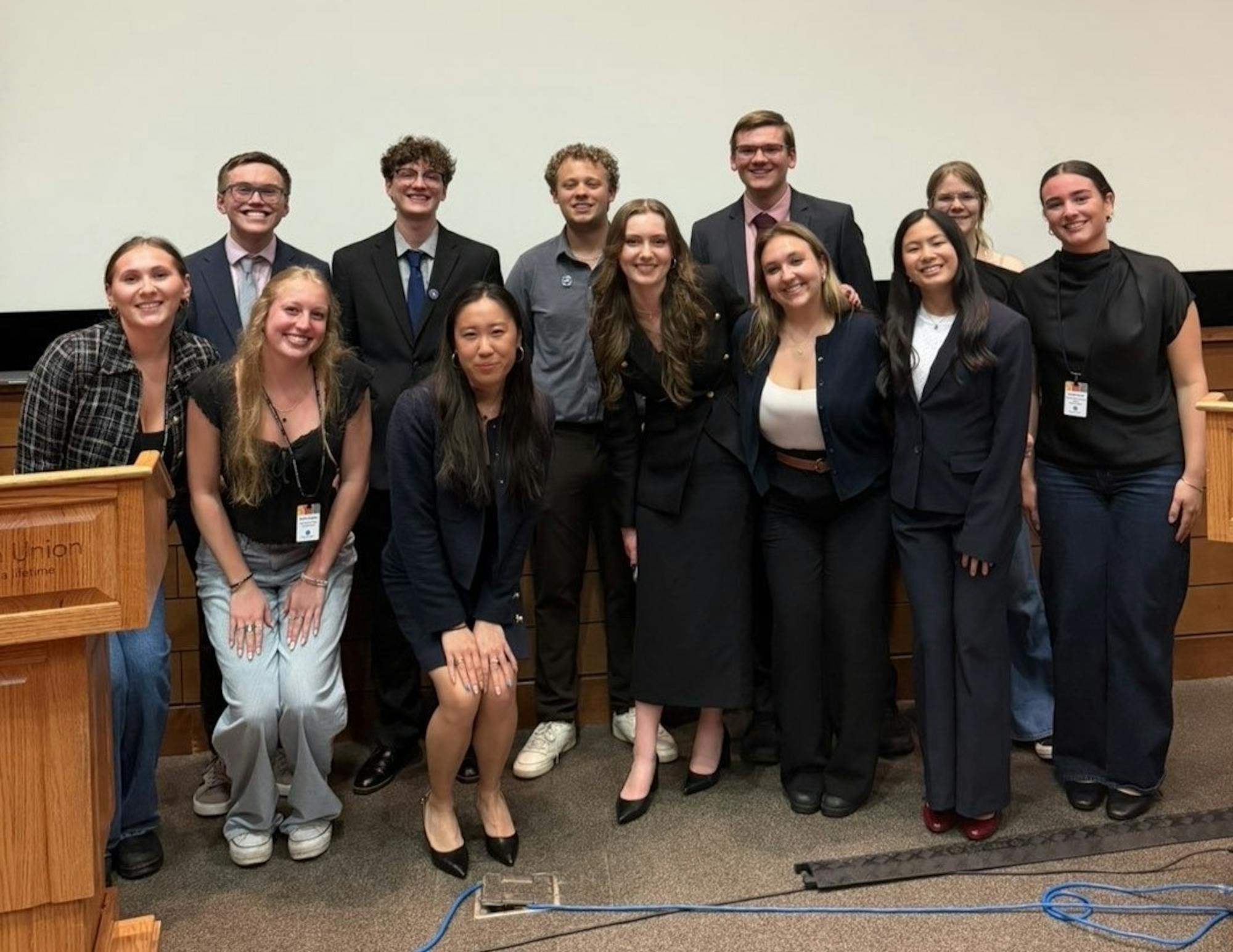
University Wisconsin-Madison College Democrats and Republicans debated campus free speech, foreign policy and political polarization at Union South Monday in an event focused on fostering productive conversations between those with differing opinions.
The Wisconsin Union Directorate Society and Politics Committee moderated the conversation.
Free speech on campus
Free speech and censorship on campus took center stage with both parties viewing the state of campus speech differently.
“Republican’s on campus have not been suppressed, and their freedom of speech is here,” said College Democrat Charlie Schmit. “We consistently have had conservative speakers on campus on multiple occasions: Charlie Kirk, Ben Shapiro, Matt Walsh, Micheal Mills and last month, Boris Johnson.”
Schmit called out campus officials who he said have been working to silence voices and protest on campus.
“Madison still has funding from the state government, and the current administration has been silencing voices on campus, specifically pro-Palestinian students…making it harder to protest on campus,” Schmit said.
While agreeing the university has hosted conservative speakers on campus, the College Republicans argued UW-Madison lacks conservative faculty and classroom presence. A recent survey from UW-Madison's Tommy Thompson Center found that 45% of UW-Madison’s faculty would be less likely to hire a candidate who expresses conservative views on immigration and 29% would be less likely to hire a pro-life candidate.
Ben Rothove, a representative for the College Republicans, said these findings represent a bigger free speech issue on campus.
“This isn’t just a conservative political problem. We have a serious, serious problem of free speech on campus,” Rothove said.
U.S. foreign policy
President Donald Trump’s use of tariffs as a tool for foreign policy and the economy was among the first issues debated. Moderators asked representatives to discuss the role they believe tariffs should play in U.S. economic policy.
“President Trump’s use of tariffs is his way of equaling the playing field,” Emily Briski, a representative for the College Republicans, said. “In the U.S., tariffs can also be used as economic tools to encourage global production and as foreign policy tools for negotiation.”
According to Briski, the main goal of tariffs is to have “free trade with free nations.”
On the contrary, College Democrats said tariffs are not a tool for success, but rather a destructive mechanism that increases the cost of living and can harm American businesses.
“The price of gas is up, housing is up, as [college students] all know and experience, and the price of food is up. This isn’t what the people voted for,” Kathy Biann, a representative for the College Democrats, said.
Both parties debated the U.S.’s leading role as a strong military presence and the sustainability of conflicts domestically and internationally, specifically whether the U.S. should scale back its role as the world’s “global policeman.”
“We need to reframe what ‘global policeman’ looks like…I believe we should advocate for more diplomacy and soft power, and switch back from warmongering and investing in expensive and extremely immoral wars that hurt the American people,” Biann said.
However, she did agree that despite flaws in our current situation, it’s still essential for the U.S. to maintain a strong military presence.
“I agree it’s still important to maintain a strong international presence, but the United States should maintain a strong international presence so we don’t let our adversaries swoop in and take over the role,” Biann said. “But that shouldn’t be going into countries and bombing them, but reinvesting and reestablishing US aid and reinvesting in diplomacy.”
The College Republicans held a different view, stating the U.S. should keep a strong military presence in order to stand tall among enemies abroad.
“The United States needs to continue to be leader of the free world…when you pull back, who else is going to be the leader of the world?” Courtney Graves, a representative for the College Republicans, said.
Political polarization
Audience members asked questions to the representatives during a Q&A, highlighting political violence and polarization as important issues. Representatives from each group discussed methods for working together and bringing an end to political violence.
“When we talk about political violence, it’s not a left wing or right wing issue; it’s an every wing issue. It needs to stop,” Schmit said. “It’s not productive. It’s not helping this democracy, and it’s absolutely not helping us ensure that we can make this a more equitable world for…Americans.”
The College Republicans agreed political polarization is a present issue but is not as large of an issue as people think.
“I think that we just kind of have to recognize that pretending like the sky is always falling [on us]...the fact is that things aren’t ever really that bad,” Rothove said.
Schmit rebutted this view, claiming U.S. Immigration and Customs Enforcement has played a large role in orchestrating political violence and polarization. Schmit cited the fatal shootings of Alex Pretti and Renée Nicole Good in Minnesota this year as proof.
Democrat representatives discussed increasingly uncivilized discourse, especially among older generations, who they said are “losing the ability to be able to communicate in ways that aren't just completely hateful.”
“I’ve talked to College Republicans in both civil discourse and just in conversation. Sometimes it’s honestly fun to talk to them,” Schmit said. “At the end of the day, that’s us as young people talking to each other, and that’s what we have to model for older generations.”
To end the debate, the representatives were asked about what they respect about the other party.
“I really appreciate how effective [the College Democrats] are on social media, and you truly lean into the causes that you fight for,” Graves said.
College Democrats emphasized the two organizations may agree on more topics than they originally thought.
“I will say, the College Republicans in this debate space — we have very similar ideas about how to regulate things…what I learned from today is that there are some issues that we can definitely agree on, and negotiate and collaborate on,” Biann said.