I think it was the orange explosion that changed me. It wasn’t only that my ears heard the blast or that my body felt the shake. My eyes saw it, the color. A sudden, overwhelming orange, as if the fire itself had exploded just in front of my windows. Looking back now, it was one of the most frightening moments -- though not the only one -- that I have lived through since the US-Israel war on Iran.
I am a Ph.D. candidate at the UW-Madison School of Journalism. I had returned to Tehran to conduct fieldwork for my dissertation and was staying with my parents in Karaj, a city about 30 minutes northwest of Tehran, where I stayed during the 40 days of war.
From the first days of the war, we worried about two places near our home. I had the same fear during the 12-days of war in June with Israel, when I was still in Madison. One was an electrical power plant just a few minutes from my parents’ house, and the other was an oil depot about 10 minutes away. Family memory made both feel even closer. During the Iran-Iraq war, older family members said, these sites had been targeted multiple times. Whether fully accurate or not, those stories had become something like a collective subconscious. To us, they marked danger points. After the war began in February, several aunts and uncles called, urging us to stay with them until it ended out of fear for these two locations, which we of course refused.
During those 12 days in June, I followed the war mostly through family and friends inside Iran, especially Fatemeh, my cousin and closest childhood friend, now a mother of three. She lives about 15 minutes from my parents, and her husband, a firefighter, was one of the most reliable sources of information in my circle. Back in June, when I asked her about these two facilities, he had no information about the power plant but had told her that the oil depot had been partially emptied of fuel, though not completely. There were limits to what could be done.
It was the eighth night of the war, around 10:30 p.m., I was in bed, scrolling through news channels on Bale, an Iranian messaging app. With the internet largely down, domestic platforms were the only sources available. It had been quiet for a few hours; no fighter jets, no air defenses firing at drones or missiles. The silence made it all the more frightening, as you were waiting for something, anything, to happen. Like every other night, I refreshed the channels, waiting for updates, matching what I read with what I heard overhead.
It did not take long for the jets to arrive. My heart started racing. I froze in bed, staring at my phone, waiting for the first explosion or the phone alert. It often worked in the same way: you hear the roaring sound of the jets; then either you hear the explosion and feel the shake, depending on how close you are, or, after a few minutes, you see an alert on your phone about explosions in Tehran. One channel would post, and within seconds, the others would copy it word for word. I read that, “Tehran’s oil refinery is bombed!”
The message hit me instantly. A refinery meant something massive, uncontrollable, a chain of explosions and fires. But within a minute, an official channel corrected it: not the refinery, but an oil depot in southern Tehran, in Shahr-e Rey, was hit.
That correction did not calm me; it did the opposite. It brought the danger closer. I immediately thought of the depot near our house. I texted Fatemeh, asking if her husband knew whether it had been emptied. Her husband didn’t know. “If they haven’t,” she wrote, “we’re all done, sis!”
I lay back, put my phone aside, and closed my eyes, hoping that would be the last alert of the night, still hoping they had emptied the depot. Then, with my eyes still closed, I saw it, a sharp orange light behind my eyelids. I opened my eyes. Through the thick fabric curtain, through the thin gaps where it did not quite meet the ceiling, the entire room had turned orange. The white walls, the ceiling; everything was washed in that color. Then I heard the explosion.
I screamed and ran toward my parents’ room. I felt there was another wave of light on the walls of the living room. I could not tell whether it was a second strike or an echo of the first. The living room, with its wall of windows, glowed orange too. My mother was already awake, sitting up in bed. “Is it the power plant?” she asked. “I don’t know, it might be the oil depot,” I said.
My father got up as well. I helped my mother as we moved quickly to my dad’s office, the only room in the house without windows or exterior walls. Outside, through the curtains, the orange glow had fallen on the white building across the street. There were voices in the street, loud, scattered and urgent. When my father opened the door, someone outside was shouting, “They hit the oil depot.” “It’s dangerous! Come in, Dad!” I called.
I was moving without thinking, grabbing blankets, pillows, pulling mattresses from the closet. “We sleep here from now on,” I said quickly. My father resisted at first, insisting he would sleep in his own bed. “It’s safe now,” he said. “No, it’s not,” I replied. He didn’t insist further and eventually gave in.
I kept repeating instructions: don’t open the windows, don’t go outside, we are going to sleep here, and finished making the beds. “Let’s sleep,” I said, as if I had been assigned to that role, as if managing the moment could somehow contain it. Later I wondered why I was like that, what if they did not even want to sleep! While doing all this, I called Fatemeh. Her voice was shaking. “Tahereh, they hit the oil depot,” she said. I told her I knew. In the background, she was shouting at her husband, who was heading to the rooftop with neighbors. The call dropped.
The house was still lit, or maybe I had just left the lights on in the leaving room. Outside, I could still hear voices. My father lay down and somehow managed to fall asleep. My mother sat upright, watching me, asking for updates as I scrolled through the news, and texted family members. I wrote to my sister and others that the depot near us is hit, but that we were safe.
My sister called. Over the phone, I could hear my nephews shouting: “It turned orange!... they hit the other side.” The call dropped. When she called back, she told me they had been watching the glow from the Shahr-e Rey depot in the south when they heard the explosion to their west. We later realized it was Shahran oil depo.
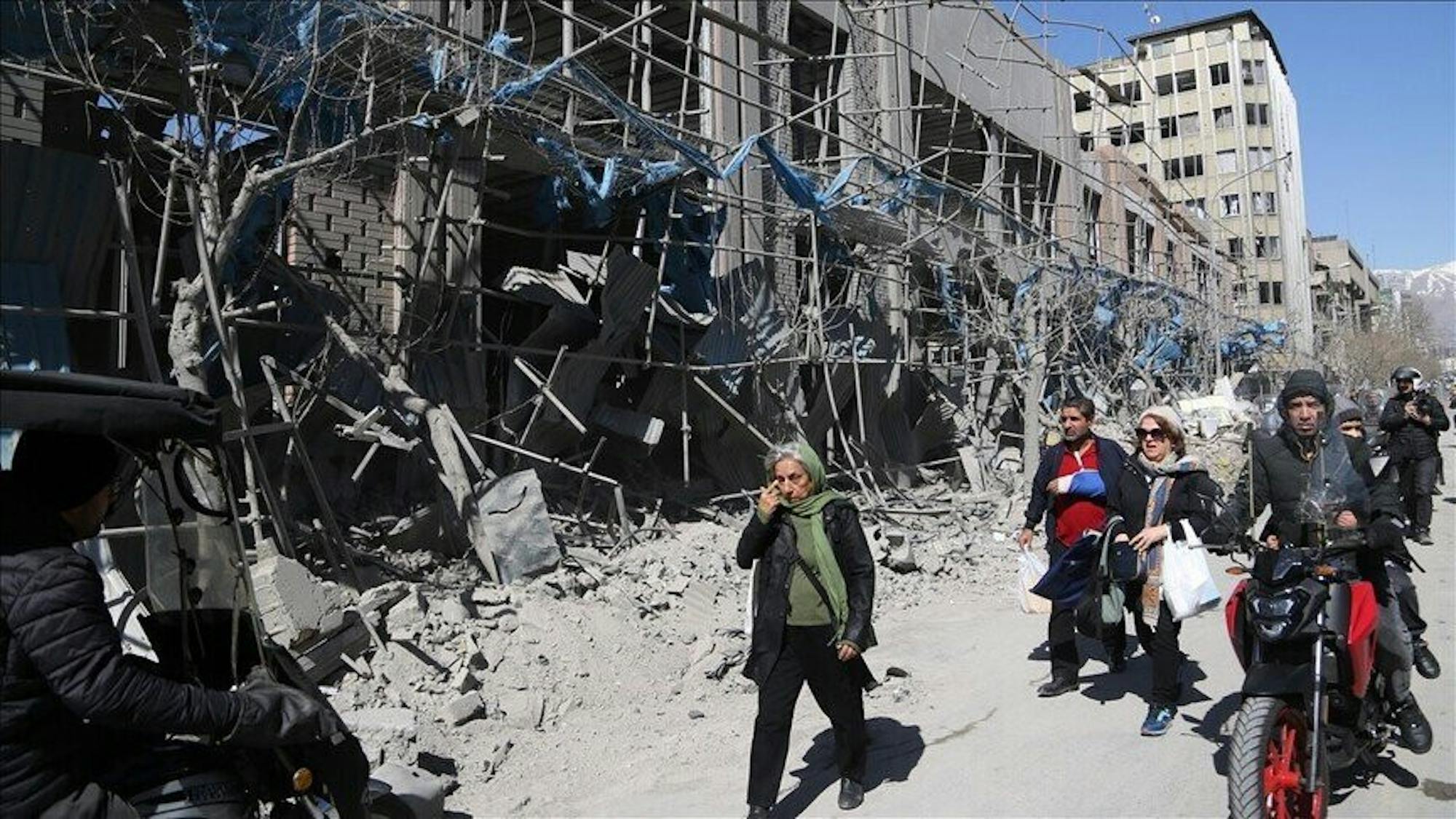
Calls kept coming. Phones rang constantly, mine, my parents’, and our landline. We found ourselves repeating the same short account over and over. One cousin in Azimieh, in northern Karaj, close to where the US later hit the B1 bridge, said they had been terrified by the orange glow, at first thinking it might be a chemical or even a nuclear bomb. A friend who lives near Shahran later told me that Shahran’s explosion was the worst. Not only because of the huge fire and explosions, but because burning oil had spilled into the streets. Tehran, like Karaj, sits on a slope, descending from the foothills of Mount Damavand toward the plains. From the north you can see much of the south, and things flow in that direction too--water, and in this case, burning oil.
Within a few hours, Israel confirmed that it had struck several fuel storage facilities in Tehran and Karaj. Besides the one close to us, there were three others in Tehran: Shahran in the west, Aghdasieh in the northeast and Shahr-e Rey in the south.
At some point, while the sky was cloudy and it was drizzling, my mother said she could smell smoke inside the house, and soon I smelled it too. I called Zahra, a friend who is a nurse. She said we could cover the windows with wet cloth, but that would have required opening them, and I did not want to do it.
It did not matter much anymore. The smoke stayed with us. By morning, the cloudy sky had turned dark gray, and we could smell smoke in the air. We stayed inside the entire day. Tehran was different, and only by morning did the scale of the attacks became clear. With three major depots burning, even if they had been partially emptied, the city woke to something like another night. Black smoke covered not only the sky but buildings, cars, streets. And then the black rain started falling. People I spoke to, including a cousin who went to work that morning, said it felt as though they were moving through the city at midnight, the air heavy and sticky. Even in their mouth, they told me, tasted like oil. Only after a few hours, with light rain and a slight wind, did the darkness begin to lift. Officials told people to stay indoors. There were warnings about toxic air, even acid rain. Some people went to emergency rooms. A relative of ours, in his seventies, was among them.
That night, I barely slept. I kept replaying the sequence and reviewing every moment, the orange light, the delay before the sound, the run to my parents’ room. The next morning Fatemeh told me that there had been two or three explosions. Since they live closer to the depot, her account should be more accurate. However, in my memory, there is only one. I keep returning to it, trying to locate the exact second when it began. What did I do first? Did I hesitate? Did I really scream as I ran? If the windows had shattered, would I have stopped to put on the sneakers I had left under the bed, just in case?
I do not have answers to those questions. What I have is the color, the dirty burning orange glow.
Tahereh Rahimi is a Ph.D. candidate in the Wisconsin School of Journalism and Mass Communication. She completed her B.A. in Journalism at Allameh Tabataba’i University in Tehran. Send all comments to opinion@dailycardinal.com