Throughout Wisconsin’s turbulent 2025-26 season, the line between dominance and incompetence was razor-thin.
By emphasizing a faster offensive tempo and prioritizing 3-pointers, Wisconsin created a volatile scoring threat that left Wisconsin vulnerable to wide gaps of inconsistency throughout a season that ultimately ended in disappointment.
Because of this dichotomy, the Badgers were among the most perplexing teams in all of college basketball. While they stacked some of the most impressive wins of the college basketball season with victories at No. 2 Michigan and No. 8 Illinois, both Final Four teams, they also lost handily at Ohio State and Oregon.
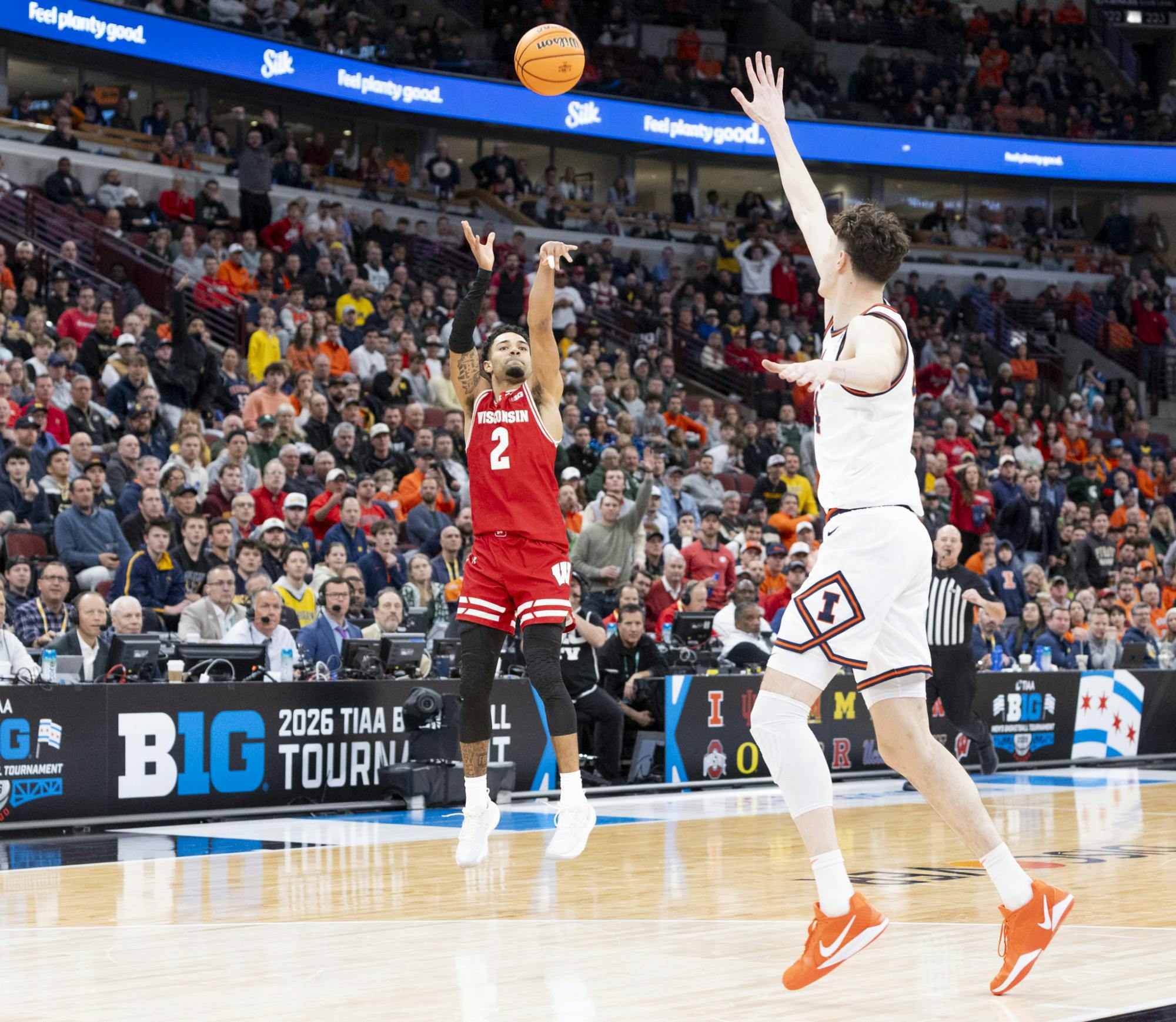
The base layer of Wisconsin unpredictability came through their pace of play. As a result of their increased pace, which resulted in 71.5 possessions per game, the Badgers looked to shoot more threes, as Wisconsin ranked 7th nationally in 3-pointers attempted per game and 56th in 3-point percentage.
When Wisconsin made their 3s, they were able to take down teams like Michigan and Illinois in the regular season. But when the 3s weren’t falling, the Badgers fell victim to the scoring droughts they became synonymous with over the course of the season. While defeating both Illinois and Michigan in the regular season, the Badgers went on scoreless droughts of more than two and three minutes against Illinois and Michigan in the Big Ten tournament, respectively. These droughts, particularly down the stretch of games, eventually led to letdowns to teams like Oregon and High Point, which ended Wisconsin’s season.
In their wins over Michigan and Illinois, the Badgers shot 45% and 44% from 3-point range, respectively. Replicating that efficiency beyond the arc is nearly impossible, but the Badgers managed to shoot above 44% from three four times this season, winning all four games in the process. Meanwhile, Wisconsin shot 31% and 27% in their losses to Oregon and Ohio State.
In their game against Oregon, the Badgers were especially vulnerable, shooting a program record 45 times from deep, making only 14 of them. In the first half, 68% of the Badgers’ attempts were from 3, allowing Oregon to settle in defensively without worrying much about interior penetration.
The Badgers ranked 7th nationally in 3-pointers attempted per game and 56th in 3-point percentage. The unpredictability of the Badgers can be further explained by their inconsistent rebounding. A result of their new system, focused on fast-paced, transition offense, the Badgers rebounded the ball less compared to previous years. Rather than crashing the boards, guards like Nick Boyd and John Blackwell looked for an outlet pass to push the tempo and get a transition layup or 3-point shot. Consequently, fewer Badgers were looking for rebounds, and second-chance opportunities were more abundant for their opponents.
This season, Wisconsin averaged 35.5 rebounds per game, down from 36.5 last season. Not only did they rebound less, but their opponents rebounded more. Last year, the Badgers had a +2.5 rebounding margin, nearly two rebounds more than their margin this year. Beyond that, the Badgers ranked 194th nationally in rebounds allowed per game. While playing quickly and pushing the pace allowed the Badgers to score faster, it also gave opponents more second-chance opportunities, which can kill momentum in close games.
Perhaps the most poignant example of Wisconsin’s rebounding woes came from their loss against High Point in the NCAA Tournament. The Badgers gave up 13 offensive rebounds, leading to an abundance of second-chance points for the Panthers, often from deep. By the end of the game, Wisconsin was outrebounded 40 to 37, which in a one-point loss could have been the difference.
Despite not having Nolan Winter and going on the aforementioned scoring drought, the Badgers managed to outrebound and ultimately beat Illinois in the Big Ten Tournament. Illinois’s star forward, David Mirkovic, who averaged 8 rebounds per game, was held to just 5 against Wisconsin, and their center, Tomislav Ivisic, was held to two. Without Winter, Austin Rapp and Aleksas Bieliauskas both contributed 9 rebounds and were key to keeping Illinois off of the offensive glass. While some games saw the Badgers do a phenomenal job limiting second-chance opportunities, other games had the opposite outcome. The inconsistency in rebounding was a quintessential factor in the volatility of the Badgers.
Going into their first-round matchup, the Badgers knew they needed to keep High Point off the glass, but failed in doing so.
“We knew they went to the offensive glass. I mean, that’s evident in their numbers. It’s evident on film,” Wisconsin head coach Greg Gard said following the loss.
As much as fans may point to specific players or stats, the answer regarding the inconsistency of the Badgers is nuanced. Their volatility was not a product of a single factor within their system — rather, a collection of weak points that, when occurring simultaneously, made for perplexing losses. Ultimately, these weak points culminated in a season that left fans asking, “What could have been?”
The month of March has not been good to Badger basketball fans as of late, and the volatility that comes with the pace at which the Badgers play may be the reason. With Wisconsin not making the Sweet Sixteen since 2017, Badger fans are once again left with cautious optimism that next March will be better. Perhaps the key to soaring into the second weekend lies in mitigating the turbulence that comes with playing quicker. While pace may have won Wisconsin games, it also cost them the chance at a championship.