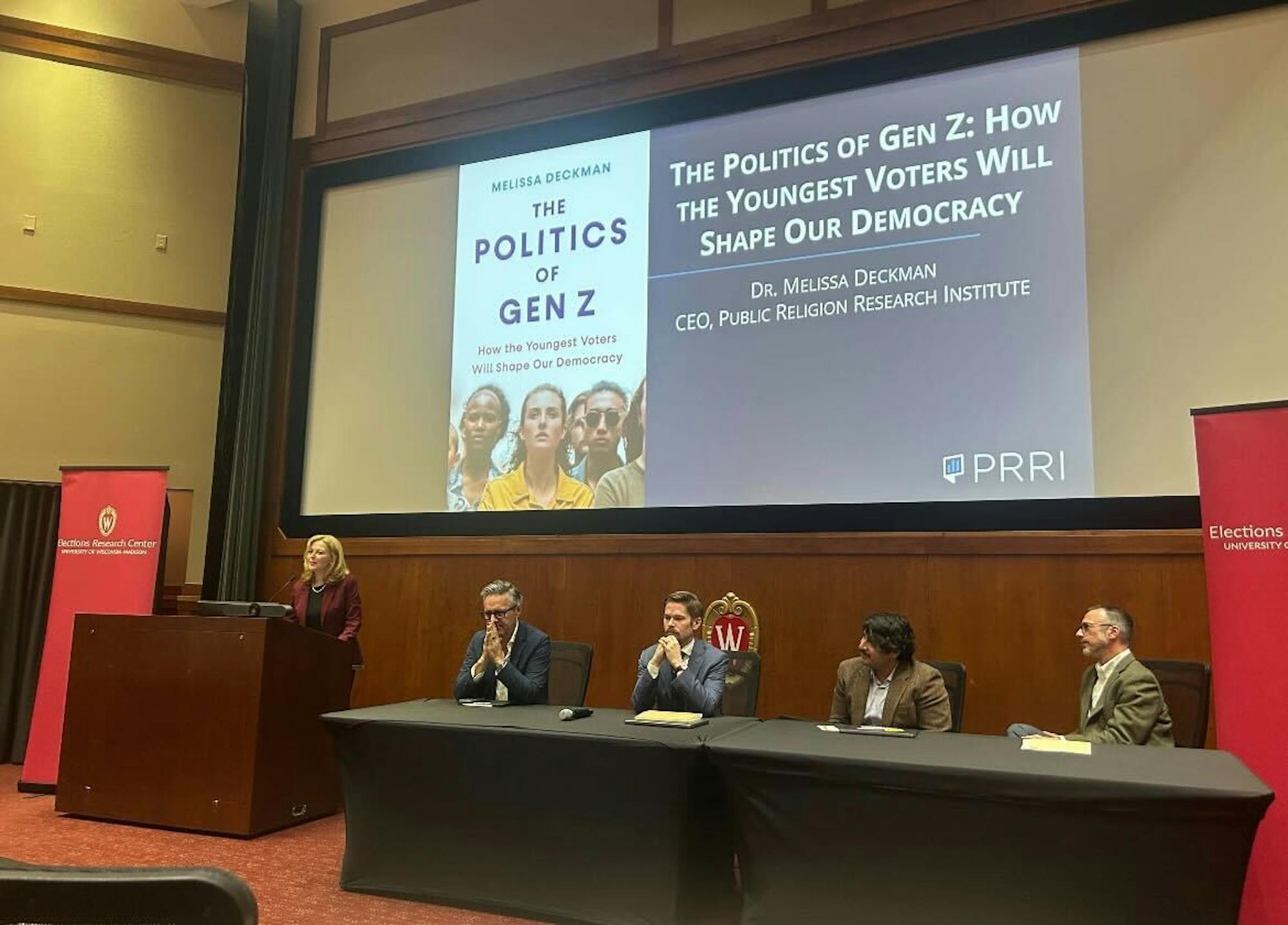
A panel of experts discussed youth voting trends and the future of Generation Z voting patterns Thursday at the Fluno Center.
The “Evolution of the Youth Vote: Changing Gen Z Politics” panel was hosted by the University of Wisconsin-Madison’s Elections Research Center and moderated by Prof. Barry Burden, the center’s director. Panelists included scholars, polling experts and journalists.
Burden highlighted the importance of the panel, saying there was “no better time or better place” for this talk than UW-Madison. He said Wisconsin is one of the top places where young voters can make an impact, citing Tufts University’s Youth Electoral Significance Index tool which placed Wisconsin in second for potential youth impact in presidential races.
John Della Volpe, a pollster with Harvard University’s Kennedy Institute of Politics, broke modern youth voting into four distinct eras: the early to mid-2000s, the Obama era, the transition between the Obama and Trump administrations, and the current economic struggles of the post-pandemic era.
“After 9/11 people could see the difference between Democrats and Republicans,” Della Volpe said. “Through that, we saw a double-digit change in efficacy of political engagement.”
Today, Gen Z voters see the traditional political system as outdated and unaccommodating to the issues they face in trying to build a better life, according to Della Volpe.
“Most political, institutional strategies today are built for a previous era,” Della Volpe said.
Matthew Nelsen, political science professor at the University of Miami who works closely with the GenForward Survey, which represents the voices of young minority voters, said that leading up to the 2024 presidential election, “economic anxiety” was at the forefront of young voters’ minds, especially young Black Americans. He noted that affordability will also be important for young voters going into the 2026 midterm elections.
According to Nelson, many young Black voters chose to elect Donald Trump in the 2024 election because of Kamala Harris’s failure to address affordability.
“They did not trust Trump. They were well aware that Donald Trump had made racist statements,” Nelsen said. “At the same time, they’re saying he is spending more time talking about the economy than Kamala Harris, so I’m going to take the chance to cast a vote for him.”
Nelsen said that while the issue of affordability isn't new, politicians and policymakers need to be ready to address it with a comprehensive and diverse response that appeals to more than just white Americans.
“This idea of affordability is a necessary precursor to participating in democracy,” Nelsen said. “Distrust toward politicians and political parties reflects this longstanding frustration with government's either inability or unwillingness to address longstanding affordability.”
Melissa Deckman, CEO of the Public Religion Research Institute, a nonprofit organization dedicated to researching the crux between religion, politics and culture, addressed what she called the “reverse gender gap” — research finding Gen Z women are more likely to be politically active and more progressive than Gen Z men.
Deckman said in the wake of Trump’s first term, women became more politically involved than men “for the first time in American history,” according to research done for her book “The Politics of Gen Z: How the Youngest Voters will Shape Our Democracy.”
“A lot of young women I spoke to who were engaged in politics were really alarmed that Trump had been elected over the nation's first major party female candidate, Hillary Clinton,” Deckman said.
She said that increased engagement manifested itself after the 2022 Dobbs v. Jackson Women's Health Organization decision removed federal abortion protections.
Deckman also pointed to Gen Z’s religious resurgence.
Deckman said it’s too early to tell whether increased participation in religion is an actual upward trend, and in using PRRI surveys from 2013 to 2025, she’s found that religious “unaffiliation” has stayed consistent for men and increased for women.
Christian Paz, a Vox reporter, expanded on the potential religious resurgence in Gen Z Americans, agreeing with Deckman that it is too early to tell if a trend is forming among young Americans.
“J.D. Vance is being forced to talk about faith and talk about the administration. and also trying to set up a kind of more religiously oriented future for the Republican Party,” Paz said. “Will he find an eager audience among young people who are joining or who are part of the GOP or who are perhaps converting?”
Paz said many of these Christian conservatives may now use the rise in Christianity to promote conservative beliefs, something that the greater electorate will have to reap the consequences of.
“It’s not just gonna be something for 2025, 2026. It’s gonna be something that determines the future of our parties for the next at least 10 years,” Paz said.
A majority of young people disapprove of both major political parties, according to GenForward Survey results, and these young voters feel as though both parties are not listening to their concerns.
Della Volpe attributed the results of the 2024 election to the Democrats’ lack of understanding of what youth voters want.
“You need to establish trust,” Della Volpe said. “By showing up in places, by listening, by connecting those experiences to policy.”
Staff writer