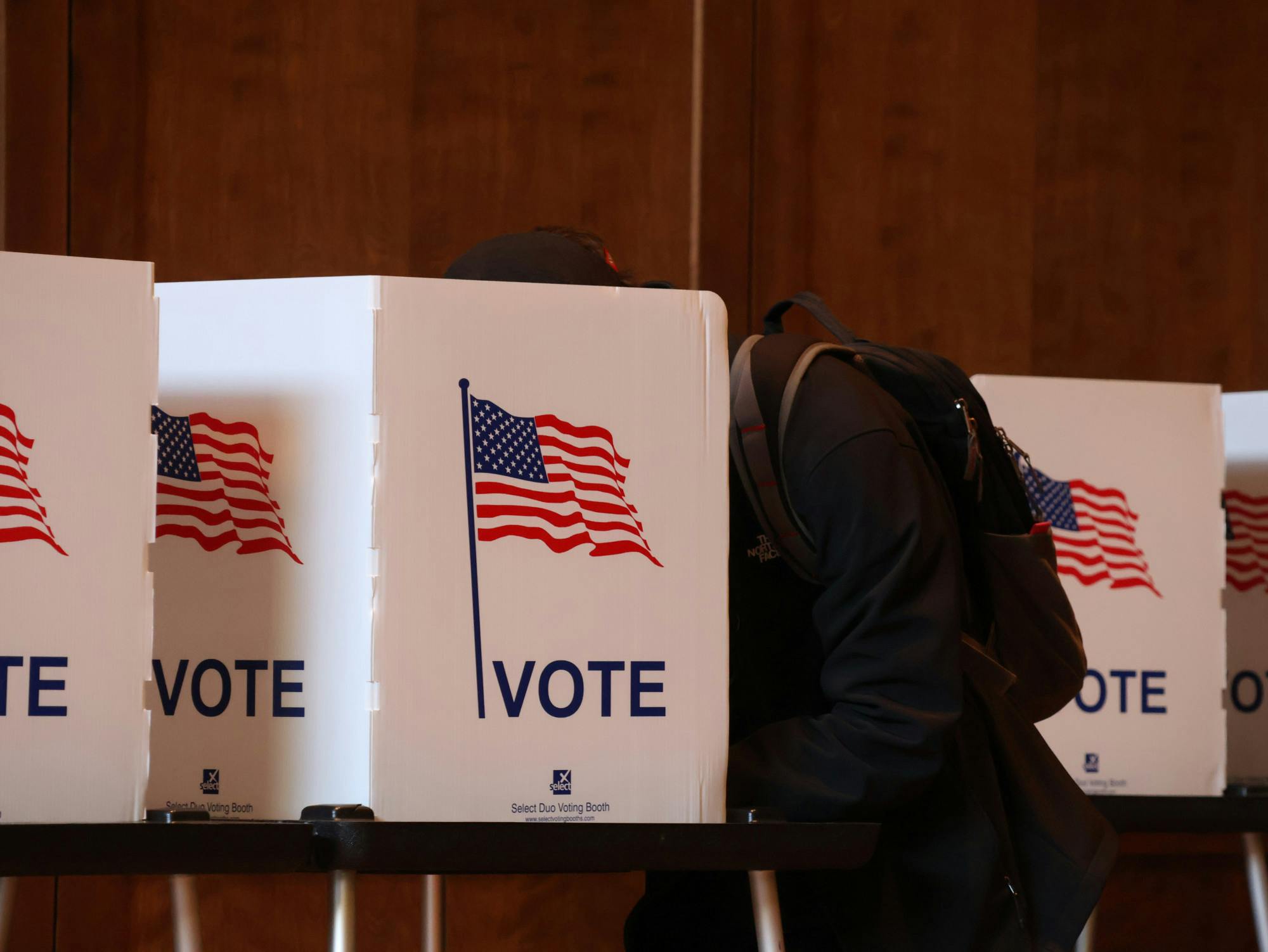
When Madisonians headed to the polls April 7, many stopped short of completing their ballots. While 9,666 Madison residents voted for the Supreme Court race in districts with a contested alder race, only 7,753 cast a vote for Common Council seat — meaning about 20% of Madison voters skipped the alder race when both the local and state-wide race was contested.
Wisconsinites elected Justice Chris Taylor in a landslide victory over Court of Appeals Judge Maria Lazar. But with many eyes on the high-profile statewide election, many local elections struggled to capture the same level of engagement.
The trend, referred to as “roll-off” voting, highlights a persistent gap between turnout in high-profile statewide races and local contests.
The University of Wisconsin-Madison is home to districts 2, 4, 5, 8 and 13, which include University Housing, State-Langdon, Capitol Neighborhood and other popular off-campus housing neighborhoods such as Eagle Heights.
Across those districts, the Supreme Court race drew 19,491 votes this year compared to 7,167 votes for alder races.
One reason for this may be that many local races are uncontested. Only one campus-area race — District 8 — was contested, yet it still drew just 2,098 votes in the spring election. District 8 notably saw minimal roll-off,, with nearly every voter casting a ballot for both Supreme Court and Common Council.
By comparison, the 2025 spring election between Crawford and Schimel saw higher engagement. Those same districts cast 32,056 votes in the Supreme court race, while contested alder races across all districts received a combined 25,685 votes.
MGR Govindarajan, the outgoing District 8 alder, told The Daily Cardinal he believes turnout is affected by how active and visible the campaign is. “The main difference is just how much awareness there is about a campaign happening,” he said.
Supreme Court races typically see an uptick in young, first time voters, where a heightened focus on issues like abortion and immigration often mobilize them. According to a 2026 Pew Research Center poll, adults aged 18-24 believe abortion should be legal in higher numbers than any other age demographic.
Supreme Court races also tend to generate more media buzz and discourse, especially when prominent figures such as Elon Musk spend millions in support of a candidate. Musk handed out million dollar checks to voters who signed his petition against “activist judges,” including Green Bay resident Scott A. These donations gained traction on X, where Musk promoted the awards and announced the winners.
In 2025, Madison voters cast 138,188 votes in a Supreme Court race that determined the ideological balance of the court. That same election saw 115,591 votes from all 20 Common council districts — a smaller but still relatively strong showing compared to 2026. Still, even in high-turnout elections, some voters leave local races blank.
“A lot of people went out to vote for the first time, to vote for Susan Crawford,” Govindarajan said. “There was a lot of awareness about Susan Crawford and how much her winning the Supreme Court race would help turn the state blue.”
Govindarajan said roll-off voting is especially pronounced among young voters.
“There are certain demographics that vote for local government no matter what, and then there are other demographics that vote only when they are given a reason to vote. The latter is students.”
As a result, local elections often skew older.
“The effect of those demographics changes is when older people [consistently vote] that means older people will get elected and more conservative people will get elected,” Govindarajan said. “If I ran in any of the suburban parts of Madison, I would have a really hard time, purely because of my age and because I wouldn’t have enough young people to turn out for me.”
Govindarajan ran uncontested in 2025, but 70% of Madison’s districts had two or more candidates on the ballot.
This year, the campus-area alder seat was contested, with UW-Madison sophomores Ellen Zhang and Bobby Gronert running. Additionally, only two other Common Council districts in Madison had contested elections.
Govindarajan recounted the 2023 spring election where he won for the first time, saying the race was very active and that he doesn’t believe there was “as big of a drop off” in voters.
In 2023, Madison wards located in District 8 cast 5,027 votes for Supreme Court and 4,531 votes for Common Council.
Campaign spending
Flooding TV screens with ads and suburbs with yard signs, campaign fundraising has long been an essential part of politics. That was no different in the race between Taylor and Lazar.
Despite a lower profile race, Taylor’s campaign and her supporters outspent Lazar’s nearly 9-to-1. Taylor backed nearly $8 million compared to Lazar with just under $1 million.
Still, this year’s contributions pale in comparison to last year’s record-breaking spending of over $100 million. This year’s spending only makes up around 5% of 2025’s final numbers.
“The beyond underwhelming fundraising by the WisGOP and Maria Lazar shows that their grassroots donors and base are depressed by the GOP’s lackluster candidate and the party’s repeated losses,” WisDems Chair Devin Remiker said in a Feb. 9 statement.
Local races receive significantly less funding with Govindarajan’s campaign receiving just over $3,000 in the 2023 pre-election cycle.
“This might be one of those scenarios where there’s more awareness happening about the current district race happening between Ellen Zhang and Bobby Gronert,” Govindarajan said.
According to spring pre-election documents, District 8 candidate Ellen Zhang received $8,262 in donations, with opponent Bobby Gronert raising $2,298. Gronert received notable endorsements from the UW-Madison Young Democratic Socialists of America, where he is a member. YDSA also co-sponsored some of Gronert’s events. Zhang's notable endorsements include Madison Mayor Satya Rhodes-Conway and the Democratic Party of Dane County.
Senior staff writer