The University of Wisconsin System has undergone a striking series of leadership changes over the past few months. In February, University of Wisconsin-Madison Chancellor Jennifer Mnookin announced her departure for Columbia University. A couple weeks ago, the Regents terminated President Jay Rothman, and most recently, Athletic Director Chris McIntosh announced his exit.
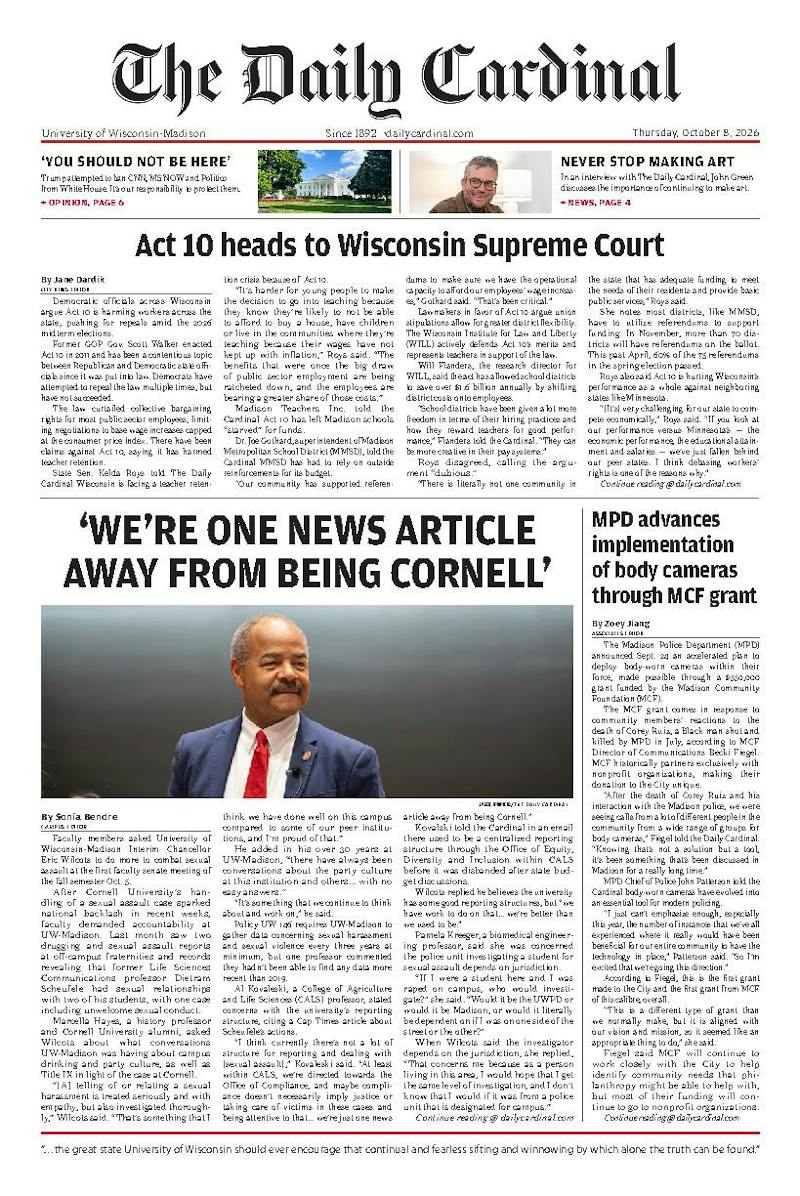
Eric Wilcots, dean of the College of Letters & Science, will step in as interim chancellor, tasked with leading UW-Madison during a period of mounting uncertainty.
Leadership turnover, while disruptive, is not always catastrophic, and with these changes, the UW System has a unique opportunity to reevaluate the values guiding one of Wisconsin’s greatest institutions.
Future leaders of UW System campuses will have no easy task, facing decisions around artificial intelligence and rising distrust in higher education institutions.
On the ground, students are looking for answers, not only about who will lead the system, but about what priorities will shape their education: how AI will be integrated into classrooms, how environmental and budgeting concerns will be addressed and how leadership plans to rebuild trust with faculty and students after a period of instability.
AI
Looking forward, leaders on the Board of Regents emphasized the need for a visionary rather than reactive leader. Regent President Amy Bogost attributed Rothman’s ouster to policies and priorities shaped by immediate pressures like budget constraints.
Rothman’s slow approach to defining a systemwide AI policy became a sticking point for regents. They publicly criticized the lack of guidelines or guardrails on AI, and student Regent Desmond Adongo warned unequal adoption across campuses risked creating a two-tiered educational experience depending on whether a professor or campus had the resources to engage with the technology.
In the last few years, AI has become entrenched in students’ daily lives. While initiatives like the new College of Computing and Artificial Intelligence signal institutional investment, they fall short of addressing the pace and scope of the change.
There is no clean, simple answer for how universities should integrate AI into the classroom or research, especially coupled with environmental and academic concerns. But uncertainty from leadership makes inaction more consequential.
Wisconsin ranks near the bottom in the country in a metric on AI revolution preparedness, creating a stronger need for clarity.
In an op-ed, Rothman addressed concerns, stating, “Our approach is simple: innovation must be paired with integrity.” However, this does not meet the root of the issue. Without consistent standards or direction, AI use across UW remains fragmented, reinforcing the perception of an institution reacting to change rather than shaping it.
To move forward, leadership must be more transparent and intentional about the research and investments they make in AI. Just as importantly, the university needs to create space for ongoing, meaningful conversations with students, faculty and stakeholders across the state about what they actually need from these technologies.
At every step of the process, UW needs to keep student, faculty, environmental and statewide concerns at the heart of its AI approach, while also ensuring their work protects the integrity of a public higher education.
Faculty, students & funding
Recent leadership has struggled to clearly define, not just in rhetoric, but in action, who UW is for. By many administrative standards, Mnookin’s tenure as chancellor of UW-Madison was successful: launching Bucky’s Pell Pathway, expanding financial aid through the Wisconsin Tribal Educational Promise and elevating UW-Madison’s research standing. Similarly, Rothman helped guide the system through financial strain, eliminating structural deficits across all campuses ahead of schedule.
But these successes all existed upon one persistent critique: leadership that felt distant, reactive and insufficiently transparent.
Students and faculty alike often described Mnookin as inaccessible, with engagement that felt structured but limited in substance. Whether in response to protests, labor concerns or student outreach, the perception was less of an administration in dialogue with its campus and more of one managing issues from above. That same dynamic appeared at the system level under Rothman, whose “top-down” leadership style and reluctance toward open communication were cited by the Board of Regents as one of the key reasons for his removal.
Taken together, these critiques reveal more than individual leadership flaws. They reveal an institutional pattern in which decisions were made without a clear communication.
The Wisconsin Idea — the philosophy that education and research at UW should improve people's lives beyond the classroom, directly benefiting the state, nation and world — is a valiant and inspiring goal. Yet, with recent leadership, this principle was too often used to operate as branding rather than a true governing framework.
For many students, especially those from rural and working-class Wisconsin backgrounds, that gap is significant. UW-Madison represents more than just a research institution or a secondary education. It is a pathway to opportunity for the state.
The next chancellor and system president need to be people who understand the university’s role as a public steward in the state of Wisconsin. This goes far deeper than administrative experience. It requires a leader who sees the Wisconsin Idea as integral to how the state operates beyond campus boundaries, recognizing UW-Madison as a public institution of trust and its ties with Wisconsin’s identity.
Without that shift, leadership changes will continue to feel like resets rather than progress. With it, UW has an opportunity to rebuild trust and realign itself with the people it was built to serve.