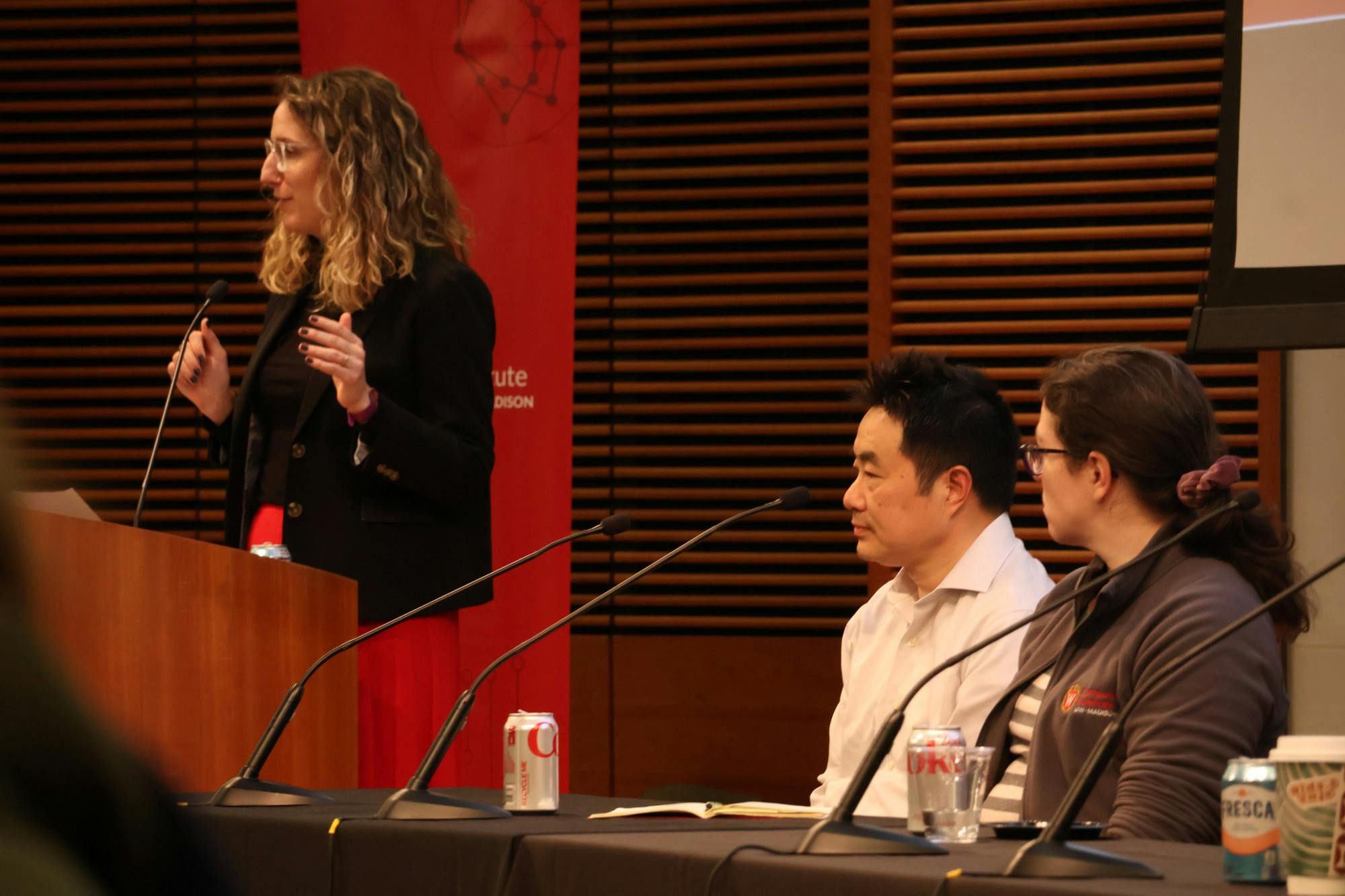
The University of Wisconsin-Madison Data Science Institute and Digital Scholarship Hub hosted a two-day series of presentations Tuesday and Wednesday exploring how the rise of artificial intelligence is reshaping the job market as many students enter it.
The series “AI and the Workforce” brought together economists, professors, advisers, recruiters and employers, each with their own insight into the evolving age of AI and how students can adapt to get ahead. They discussed whether AI is shrinking job opportunities, saying things are uncertain and there is no clear answer.
A June study from Pew Research Center found that half of American adults are concerned about the rise of AI and its potential impact on jobs, especially among young workers and students.
Additionally, a recent study from AI company Anthropic highlighted this anxiety and identified occupational categories that are most exposed to large language models. According to the study, computer and math related fields — some of UW-Madison's largest majors — have the highest exposed occupations. Management, business and finance occupations also showed high exposure.
Experts cautioned against drawing simple conclusions, highlighting a question that still remains: what jobs are actually most exposed? UW-Madison Data Science Institute associate professor and event organizer Anna Haensch said that’s a question left unanswered.
“That is the question that everyone wants an answer to, and we just don't have,” Haensch told The Daily Cardinal. “We have measurements of which jobs are most exposed. Which jobs, in principle, could be handed off to AI most easily. Things like business administrative work, translation services and anything that's like computers talking to computers — those are the jobs that are most highly exposed.”
She explained how Anthropic uses two different measurements in their paper: jobs that can theoretically be replaced by AI and jobs that are currently using AI. “What we know is that those two things don't match up in any kind of correlative way,” Haensch said.
Lee Tucker, an economist at the Center for Economic Studies for the Census Bureau, discussed how difficult it is to accurately measure the extent of AI in the workforce and how it affects broader trends.
“It’s actually a really hard thing to measure technological change at all,” Tucker said. He noted that trends often attributed to AI may instead reflect broader forces like interest rates, tax policy and post-pandemic overhiring.
“These are all very preliminary measures, and we should take that with a particular grain of salt,” Tucker said.
He also said companies may be slowing hiring because of AI uncertainty rather than replacing workers outright. Tucker said they’re using a “wait and see” approach, where companies won’t hire new people to try and retain current employees.
Despite employment concerns, panelists at Tuesday’s second event, “Planning for Your Career in the Age of AI,” remained optimistic, giving advice for how students can stand out.
“I think one thing I've come to understand more as I've been looking into AI and careers, is I don't think it will replace jobs, it’ll augment performance,” graduate program manager Beth Karabin said. “So much of what humans do on a daily basis is still informed and grounded in humanity.”
She said AI isn't as likely to steal your job as it is to make it more efficient, saying it will likely streamline automated tedious tasks.
Karabin encouraged students to think intentionally about how they use these tools, saying students should examine how the technology can be harnessed to improve performances and also the problems they may face.
Panelists agreed that employers want to see students utilize AI, not rely on it — to create contributions and solutions for real world problems. Brandon Salzman, a recruiter at Epic, explained how, beyond grades and GPA, recruiters search for experience and results on resumes. They want to see a candidate's ability to achieve goals and tasks.
During increasing hiring difficulties, Karabin and Haensch said they see students turning to a mass application approach. Haensch described a “scattershot approach” for applications, in which students apply for a vast number of job postings.
“I’m going to apply to as many jobs as it takes…but that results in students applying for like 300, 400, I’ve heard somebody tell me 1,000 jobs,” Karabin said. “It breaks my heart.”
Haensch noted how exhausting, and sometimes unsuccessful, it is to apply for jobs. She emphasized how important personal networks are today, saying the best way to get a job is to communicate, network and “make yourself known.”
“The standard GPA and resume stuff is not adequate anymore. You have to really demonstrate things like creativity, lateral thinking and good colleagueship. Stuff like that is hard to quantify, but these really human things need to be communicated [to employers] somehow,” Haensch said.
Presenters recommended a more intentional approach, highlighting that enthusiasm and passion for projects often leads to candidates making it further in the hiring process.
The experts agreed that technical ability alone is not enough, as communication, problem-solving and interpersonal skills remain critical. They discussed that it's becoming more important for students to prove their adaptability and efficient use of AI while maintaining the human elements and uses, stressing the value of critical thinking and passion — something employers value.