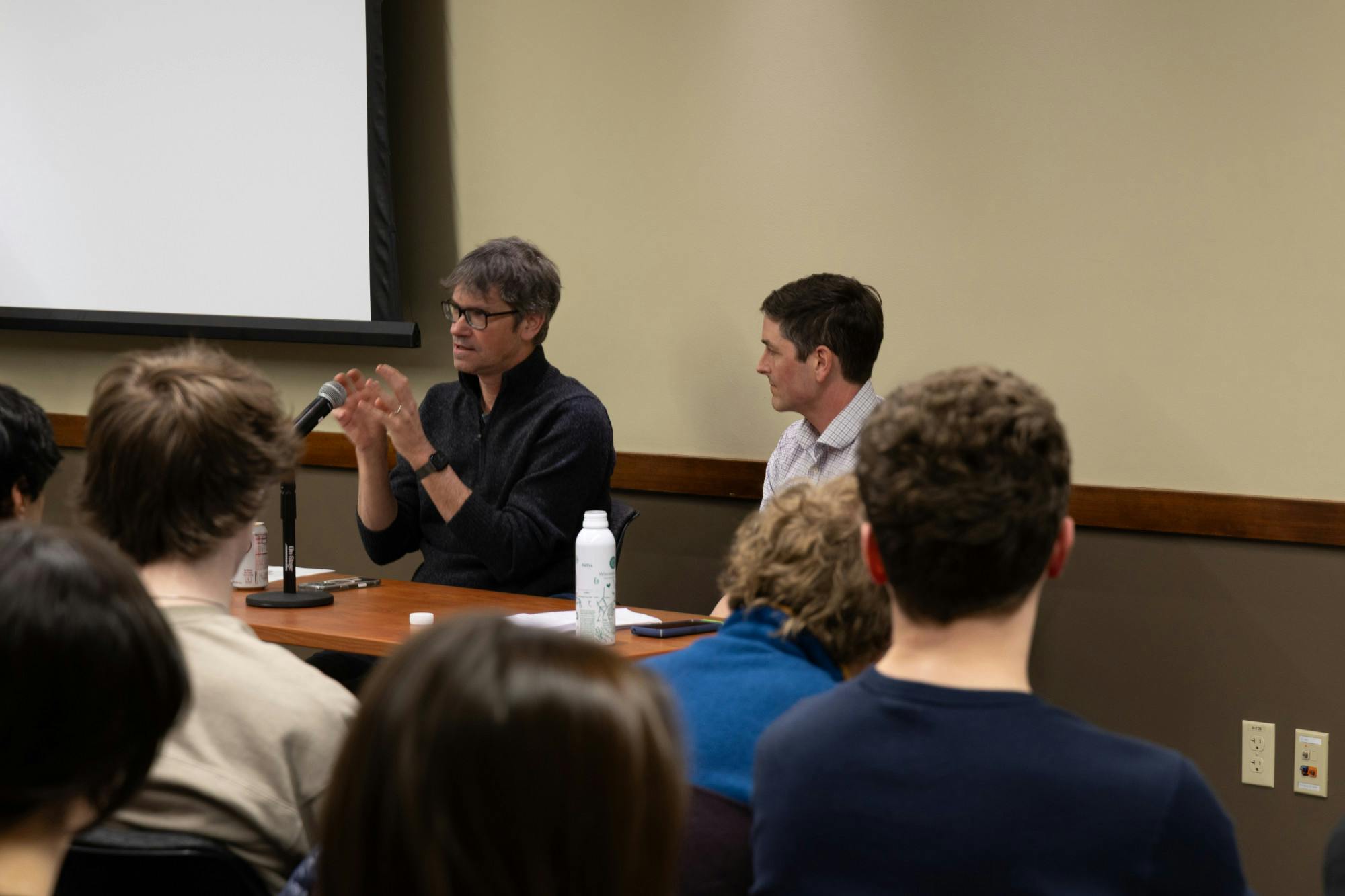
Political science professors Jon Pevehouse and finance professor Scott Baker analyzed the potential impact of President Donald Trump’s tariff policies and the subsequent U.S. Supreme Court ruling which blocked them, at a Wisconsin Union Directorate Society and Politics Committee event Monday.
The conversation began with common misconceptions on tariffs. Pevehouse —whose research deals with international relations and state-level trade agreements — said people are often confused about who pays for tariffs.
“Tariffs are paid by the recipient country and by the firm importing the good,” he explained. “This is not something other countries pay.”
This means U.S. manufacturers and their consumers, not foreign countries, are facing higher costs. He went on to explain the concept of tariff pass-through, the rate at which firms pass down the costs of import taxes onto consumers, pointing out that consumers with lower incomes are hurt the most.
“The bottom line is, tariffs are [an] aggressive tax’’ Pevehouse said. “They affect people who are on the lower socioeconomic strata even more than they affect wealthy people.”
The discussion turned to how tariffs have become an executive weapon under the Trump administration. At the beginning of his second term, Trump imposed increased tariffs on all global trading partners. The power to tariff is delegated to Congress, yet Trump cited the International Emergency Economic Powers Act, along with others, in order to obtain the power to regulate trade while in a “national emergency.”
“There's always been tariffs that have been imposed, but they've usually been relatively limited,” Baker said. “There hasn't really been in many decades this kind of very widespread imposition of a tariff, kind of across the board.”
When aggressive tariffs are placed on other countries, the process to put them into place is usually long and involves intense litigation. Usually, “the presumption is free trade,” Pevehouse said.
Baker added, “free traders default to the idea that…trade across nations, just like trade across U.S., states should be relatively unburdened by [regulation] and tariff barriers and the U.S. has been one of the biggest proponents.”
When the U.S. strays from the norm of free trade and escalates the usage of taxes against friends and enemies, uncertainty rises and trust in the U.S. weakens.
“Historically, the U.S. has been a country pushing for more open markets and more open trade,” Pevehouse said. “[The tariffs have] countries feeling like the grounds are shifting under their feet.”
Pevehouse also highlighted the fact that with the U.S. no longer a reliable trading partner, other countries are stepping into that role.
“We've encouraged folks to go to someone who's not placing a lot of tariffs on goods, which is China,” he said.
Pevehouse added that the World Trade Organization has become nearly ineffective in this era of retaliatory tariffs. A lack of judges on its appellate body, in addition to a decrease in countries taking cases to them, has made the number of cases being heard by the WTO plummet.
With the lack of action taken by the U.S. when it comes to the WTO, U.S. influence on trade and trust from foreign nations decreases.
On Feb. 20, around seven months after tariffs were first implemented, the Supreme Court declared Trump’s usage of the Emergency Economic Powers Act unconstitutional, striking down his sweeping tariffs.
“[The Supreme Court] said, ‘This legislation does not give you the authority, this does not constitute a national emergency, and you do not necessarily have the power to tariff,’” Baker said.
The conversation ended with the recent strikes on Iran and what a war with them could mean for trade. Baker noted that the short-term effects on oil prices have been minimal.
“So far, I think the effects have been relatively muted,” he said. “Oil is up a few dollars a barrel. There were a lot of attempts at front running and stockpiling over the past few weeks.”
Baker then spoke about what some of the longer-term actions from Iran could look like.
“Missile attacks on Gulf oil production or refining capabilities, those are kind of more permanent or harder to kind of rebuild in the short run.”
Pevehouse echoed that sentiment.
“We're okay. I think on the energy side, okay-ish, but other countries might not be,” he said. “Could you imagine a set of events whereby other parts of the global economy, especially as this drags on, start to get dragged down, and then that kind of rebounds back to the U.S. in some way? It creates a kind of global problem.”