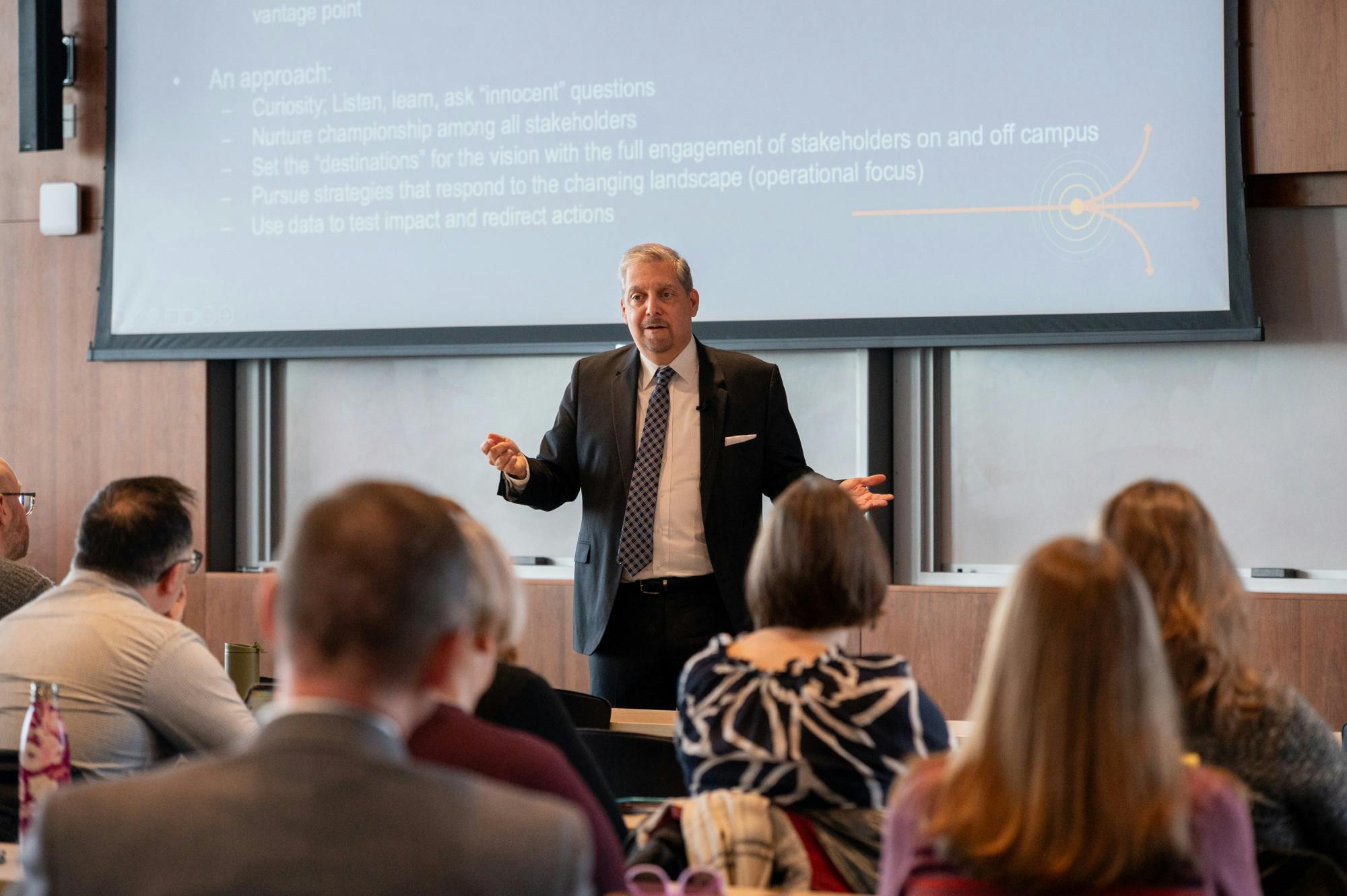
The three finalists for the University of Wisconsin-Madison’s second-highest academic position — the provost — presented their visions for the role and the future of campus to an audience of faculty, staff and students alike last week.
Following the departure of former Provost Charles Isbell Jr. last summer and Chancellor Jennifer Mnookin’s planned departure this May, the new provost will be challenged with addressing academic policy during a transitional period at UW.
From current interim provost John Zumbrunnen, to the University of Texas-Austin’s Charles Martinez Jr. and the University of Georgia’s Anna Stenport, campus faculty and students heard from those with a wealth of experience in Bascom Hall to those with fresher, outside perspectives.
All three finalists were asked one question: what are the most pressing issues and opportunities facing a large research university like UW-Madison, and how would you deal with them as provost?
Anna Stenport — University of Georgia
The first of the three finalists to present their visions for the role was Anna Stenport, dean of the University of Georgia’s Franklin College of Arts and Sciences, who went Monday.
Stenport began with an overview of her background. Her Swedish upbringing, she joked, would not only allow her to enjoy a Wisconsin winter, but has also impacted her views on the relationship between higher education and the public.
“Where I grew up is a civic culture, where public institutions were understood as shared democratic communities,” Stenport said, “where education was seen as infrastructure for social mobility, for confirming innovation and public trust.”
Stenport, a communications and global studies scholar, said she has spent her career looking into the “intersection between technology, human experience and social transformation.”
Her vision focused heavily on the idea of the ‘ampersand’ and bringing different disciplines together. At Georgia, she said there had been a perceived fragmentation across the more than 50 departments that made up Franklin College. Throughout her tenure, she worked with the community to reframe the College’s identity and launched the Office of Academic Innovation, where students could develop multidisciplinary degree programs, as well as explore online master's degrees.
“The ampersand symbolizes conjunction rather than consolidation or competition, chemistry and ethics, geology and art, computing and plant biology, health sciences and humanities,” she said. “Some initially feared [groups would be excluded] through this process, instead, we gained clarity and strengthened identity as a comprehensive college, the engine of the university.”
At UW-Madison, she hopes to do the same. She mentioned plans to integrate AI — she currently co-leads Georgia’s new school of computing with their dean of engineering — and applied computing into the academic fabric of the university, as well as following a ‘one health’ approach with research, working “from the molecular and genomic to the societal.” This, she said, will be vital in ensuring that Wisconsinites and Americans can all benefit from UW-Madison’s health research.
Of the three candidates, Stenport spoke the most about graduate students, calling them the “intellectual glue” of UW-Madison’s ecosystem.
“They drive discovery, support undergrad instruction, strengthen [research and development], public intellectual engagement and industry as they take on leadership roles across sectors,” she said.
UW-Madison’s new graduate student enrollment dropped by 9% last year amid budget challenges and reduced openings.
Stenport finished by circling back to the ampersand and the idea of connectivity and collaboration she would emphasize as provost.
“The strengths of a comprehensive flagship lies in the ampersand,” she said. “The Wisconsin idea is in itself an ampersand of excellence and service.”
John Zumbrunnen — University of Wisconsin-Madison
Current UW-Madison interim Provost John Zumbrunnen was the second provost finalist to present.
Zumbrunnen mentioned his Missouri upbringing, where he said the University of Missouri meant a lot to his family.
“There was a kind of reverence for it and what it meant to the state of Missouri and the world,” he recalled.
Zumbrunnen studied political theory at Missouri State University before moving on to the University of Minnesota for his PhD in the same discipline. After a brief stint teaching political science at Union College in New York, he arrived at UW-Madison in 2008 “through a stroke of outrageous fortune.”
Zumbrunnen is the only finalist already working for UW-Madison, a fact he used to crack jokes about shared frustrations while in a room of familiar faces.
“This place has given me so much,” he said. “It has literally given me the world.”
In the past few years alone, Zumbrunnen has witnessed UW-Madison climb in the rankings and in national and international relevance. But, he argued, the university should always be looking to do more.
“Never be content” was the theme of Zumbrunnen’s vision, stemming from former Chancellor Charles Van Hise’s 1905 statement of the Wisconsin Idea, where he said he would “never be content until the beneficent influence of the University reaches every family of the state.”
“Those words, to me, suggest that the Wisconsin Idea is not just a principle. It's not just a pride. It is a challenge to us,” Zumbrunnen said. “It is a challenge to us to do everything we can to have UW-Madison be a force for good in the world that will never be content.”
These goals will not be achieved instantaneously and should instead be looked at with a long-term vision, he said, instead asking “what can we do by 2031?”
In terms of undergraduate education, Zumbrunnen recognized UW-Madison as a “hot school,” though he said UW should not become complacent.
“It's not about ‘will we attract 8,500 students here?’ It's about what students do we want to attract here, and what experience do we want them to have?” he said. “That question of whether we want 8,500 or 9,000 incoming students is partly dependent on whether we get a residence hall at some point or not.”
Zumbrunnen did reference funding struggles with the state legislature that have prevented UW-Madison from receiving bonding authority for a new residence hall and led to unpopular deals that have frozen DEI positions and created new workload requirements for faculty.
“It is absolutely true that there are political actors out there who are pursuing agendas that raise really deep, sometimes existential questions from higher education, and we have to stand up for our values and our sense of mission and purpose,” he said. “There is a thorough absence of trust with a variety of stakeholders outside of the university. In the long term, we’ve got to look for places to build relationships of trust as well as disagreement.”
Those funding struggles have notably impacted graduate and professional programs, where the Trump administration terminated $27 million in federal research grants to the university.
“We have long been a leading producer of PhDs,” Zumbrunnen said. “At this moment in time, it's worth asking whether more is necessarily better… can we momentarily decouple their role as students from their role as employees, and ask what our strategy is for PhD education in the professional space.”
Having served in the role for nine months, Zumbrunnen has more hands-on experience at UW-Madison than the other two candidates. He is handling UW-Madison’s response to new faculty workload requirements and the dissolution of the diversity division, spoke to shared governance groups and helped lead the creation of UW-Madison’s new AI-focused college. If selected, he would likely begin serving immediately.
“Part of what I love about the provost role is it is this wonderful mix of strategy and operations,” he said. “On the strategic level, the provost doesn't have all the answers. Isn't supposed to have all the answers. If you had a Provost who said I know all the strategic answers, you should run from them. The job of the provost is to make sure that campus is asking the right strategic questions, and then to convene and facilitate and help guide a shared sense, a shared search on the operational level.”
Charles Martinez Jr. — University of Texas-Austin
The final candidate of the three was Charles Martinez Jr., the current dean of Education at the University of Texas-Austin. He began by recounting the story of his family’s immigration to the United States from Mexico and the work they did to build their lives in California. Martinez said he was the first in his family to attend college, and his father worked three jobs to raise him and his siblings.
“I know what [universities] are here to do,” he said. “They are door-openers, not gate-keepers.”
With that, he hopes to uphold a UW-Madison that serves the state, just as the Wisconsin Idea pictured.
“We can't just sit on campus,” Martinez said. “We can't just write papers that ten people read. We can't just get grants to get more funding to do more work. At the end of the day, that potential is realized in what we deliver, in the dissemination of that work in service to our states, in service to the region, our country and the future.”
Martinez highlighted his time in Texas, a majority-Republican state, and the feedback he’s received about a declining trust in higher education institutions.
“The reasons for the lost trust in higher ed are actually malleable,” he said. “They're not fixed, they're things we can do something about.”
Martinez argued that affordability, rather than perceived liberal indoctrination, is the biggest reason many are straying from higher education. Worries over whether degrees are worth their price tags, whether students are being developed into helpful members of society and whether they will be able to graduate in four years are at the forefront of why so many parents may be straying away from college.
“Being good at those three things and remaining good at them becomes the most important thing we can do,” Martinez said.
Ultimately, Martinez said he saw an opportunity to capitalize on the specificity of excellence at UW-Madison, asking what UW can do that no one else can.
“The opportunity here is to channel that momentum into places that can really live up to the Wisconsin idea and some of the niches you already have,” he said. “Focus on impact tied to the Wisconsin Idea; changing the world starts in Wisconsin.”
Annika Bereny is the campus news editor for The Daily Cardinal. She previously served as the special pages editor. As a staff writer, she's written in-depth on campus news specializing in protest policy, free speech and historical analysis. She has also written for state and city news. She is a History and Journalism major. Follow her on Twitter at @annikabereny.