Former Regent Bob Atwell reflected on the last decade-long tuition freeze that ended in 2023 amid renewed calls for a freeze.
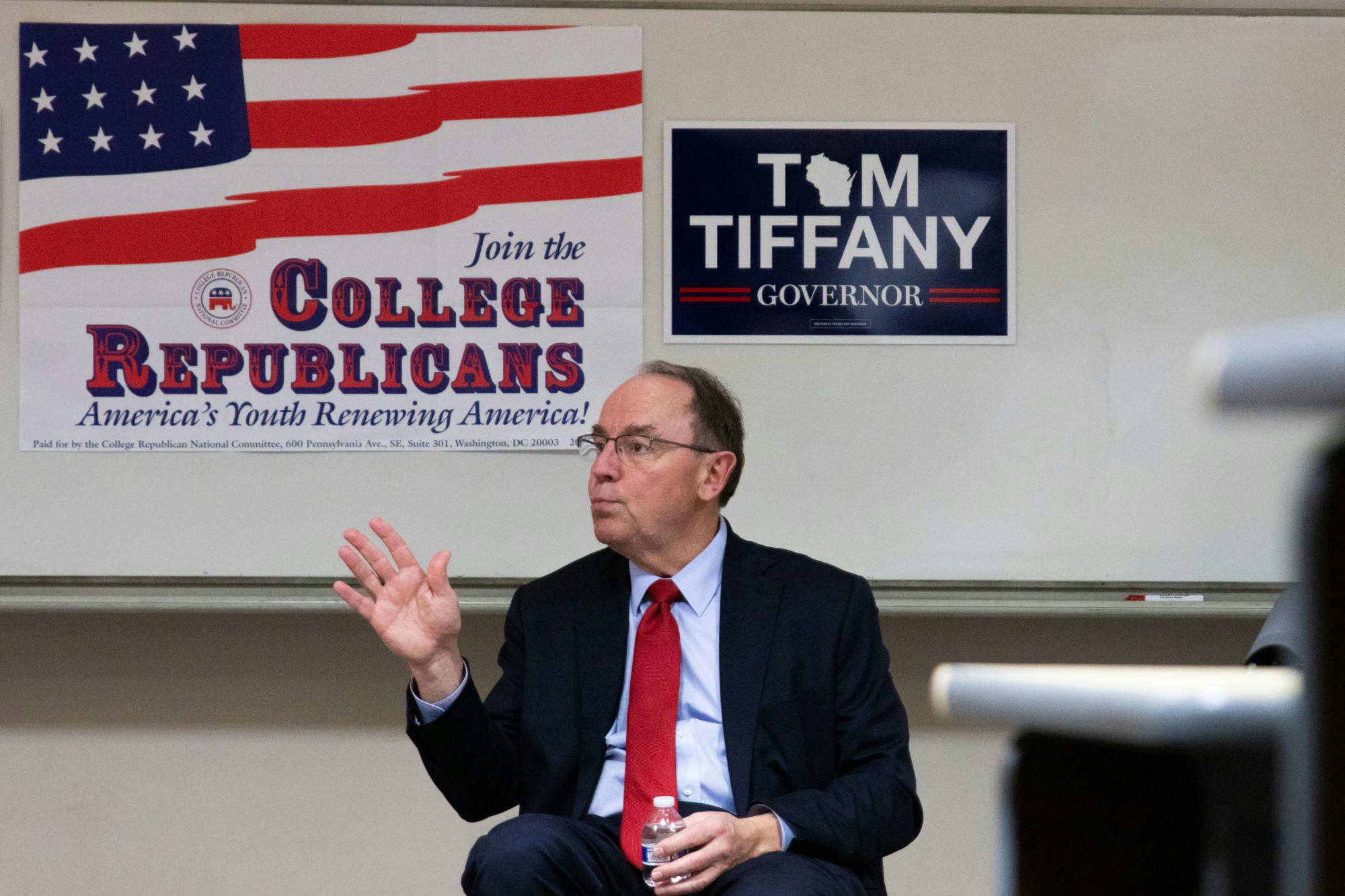
Republican gubernatorial frontrunner Tom Tiffany announced plans to renew the state’s tuition freeze during a University of Wisconsin-Madison campus visit on Feb. 19.
Tiffany, who currently serves as a U.S. representative for Wisconsin’s 7th congressional district and is the only Republican left in the governors race, said the freeze is in response to a planned 5% tuition increase for the 2025-26 academic year and the $256 million funding increase the University of Wisconsin System received in the last state budget cycle.
The last UW System tuition freeze came in 2013. The legislature and former Republican Gov. Scott Walker made the move in response to the UW System reaching $1 billion in reserves, a historical precedent, while continuing to raise tuition above the rate of inflation.
Atwell, who was appointed by Walker in 2017, told The Daily Cardinal the tuition freeze was “ineffective” and an “unhelpful effort that really constrained what everyone could do on campus.”
“I just think a tuition freeze is a bad way to make decisions. It's kind of like refusing to address the underlying issues and refusing to communicate about them,” Atwell said.
Atwell further theorized the tuition freeze may have incentivized the University of Wisconsin-Madison in particular to enroll more out of state and international students, whose tuition is not subject to the freeze, compared to in-state students, who were restrained to only paying the frozen amount of tuition.
“They had strong financial incentives to minimize the amount of in-state enrollment,” Atwell said. “But that's a complicated topic… I think there was always a concern with respect to Madison, that Madison doesn't admit as many Wisconsin students as it should, whether that's the case or not.”
The freeze lasted a decade, with the Board of Regents voting to extend it multiple times and Democratic Gov. Tony Evers supporting a continued freeze in his first state budget. The freeze eventually ended in 2023.
Atwell recalled the original intent of the tuition freeze, saying it stemmed from a lack of cooperation between the UW System and legislature.
“I think the tuition freeze is a reflection of legislative frustration at the attitude of the system, and frankly, the governor's office toward legislative concerns that are, in my opinion, quite valid,” Atwell said. “What happens when you don't address the conflict that needs to be addressed is you get bad policy like tuition freezes.”
Throughout the freeze, the legislature tightened UW’s budget. Without the ability to raise tuition to keep pace with inflation, campuses across the UW system cut programs and laid off faculty.
Funding trouble, in conjunction with the tuition freeze, sparked criticism from Democratic lawmakers.
Sen. Chris Larson, D-Milwaukee, Senate minority leader at the time of the first funding freeze, said he believes the cuts were not about affordability but rather weakening the UW System. Larson said he would support reduced tuition or a tuition freeze — though he would prefer higher education be free — if the state were willing to allocate more taxpayer money to support universities.
“The state should redouble its efforts to go back and fund the university at the same value that they had in the 1970s, you know,” Larson told the Cardinal. “If they want to go back to that, then sure, then we can have a tuition freeze or reduce the cost, but until the state actually funds it, it's not actually caring about the future of the kids who are trying to attend.”
Republican Senate majority leader and assistant majority leader at the time, Scott Fizgerald and Glenn Grothman, who are now both U.S. Representatives, did not reply to the Cardinal’s request for comment.
Once the freeze was lifted, the Regents voted to raise tuition three consecutive years, including a 5% raise for the 2025-26 academic year.
Edmund Manydeeds III, who was appointed for a 7-year term to the board in 2010 and again in 2019, said recent tuition increases were necessary to make up for lost funds over the previous decade. While a step in the right direction, he said the increases are not enough to cover current needs.
While on paper, the Regents have the ability to set tuition, the legislature can override the Regents either by directly freezing tuition through the state budget or by capping how much tuition can increase in a given year, as it did during the 2013 freeze.
Campus College Editor Annika Bereny contributed to this story.