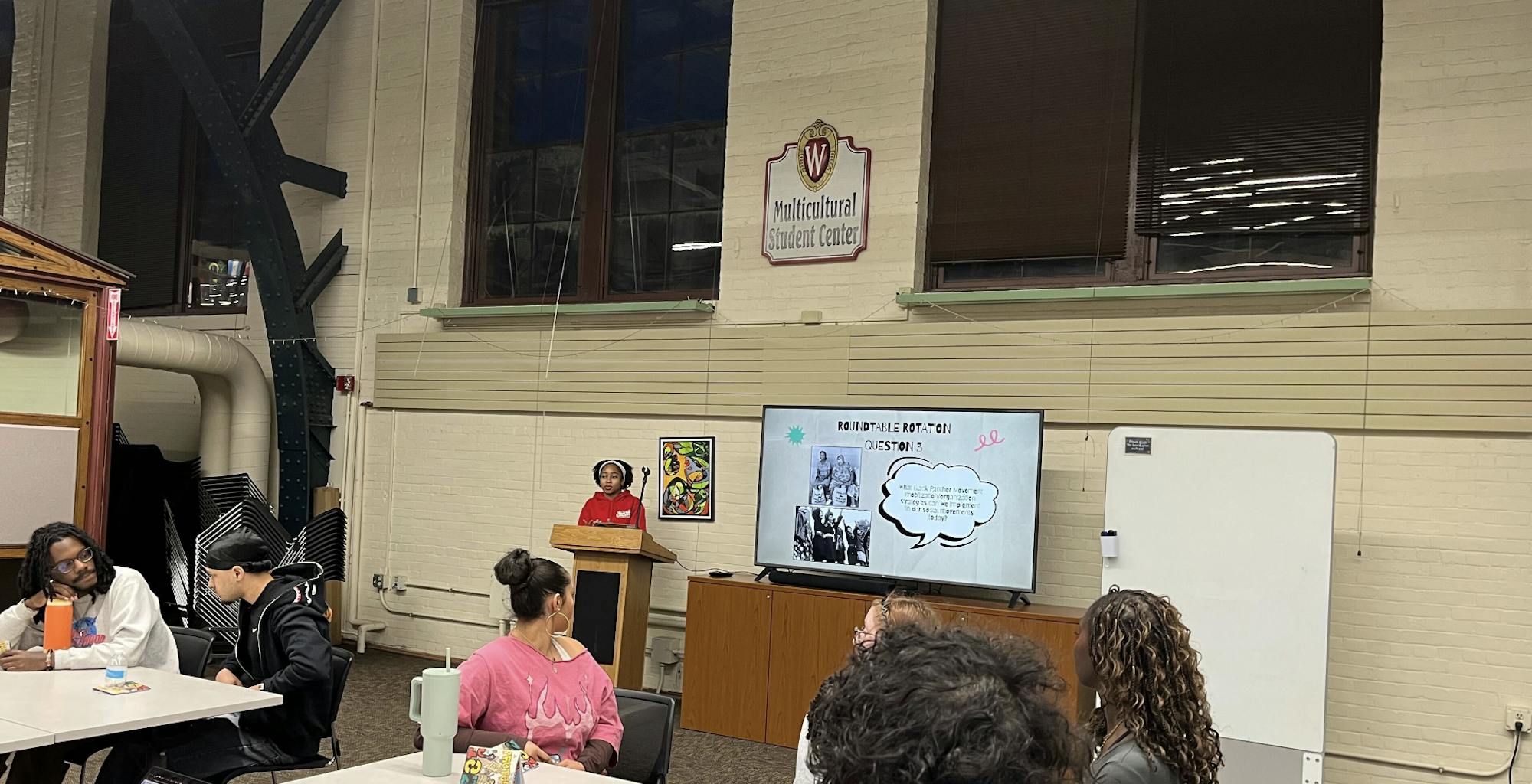
The Blk Pwr Coalition and non-profit organization Leaders Igniting Transformation reflected on the Black Panther Party’s historical activism and current political challenges at an event Wednesday at the Multicultural Student Center.
Members shared a presentation highlighting the Black Panther Party’s legacy, held a group discussion and ended the night with Black Panther Party themed jeopardy to commemorate the legacy of the Black Power movement.
Evan Epps and Madison Hird, University of Wisconsin-Madison sophomores and event coordinators, said BPC wanted their attendees to gain background on demonstrations and educate them on the Black Panther Party, saying it's critical to understand the group’s historic role in African American history. They said it was especially important to discuss that history because schools “don’t scratch the surface” of social movements or organizations like the Black Panther Party.
“You get to understand that you have a lot more control than you think you do, especially in this political climate that is very disabled and polarized, you can feel kind of uncertain,” Epps told The Daily Cardinal. “Knowing that there are other people in this space, in this campus, that are really working toward a common goal, and even though you don’t always see that, I think having that visibility even for a moment can be reaffirming.”
Hird said that the event was also appropriate in light of the current political environment and BPC’s involvement in recent protests.
“Although they [the Black Panther Party] were very radical, they could be somewhat modeled and used now for a lot of the things that are going on in today’s society,” Hird told the Cardinal. “A lot of student orgs here are very politically active and have a goal set on advocacy. Just knowing exactly what routes to take, what people to talk to, if that is something that someone is so inclined to be a part of and also just honoring the past so we could reclaim the future.”
In the presentation, they shared the history of the Black Panther Party, highlighting specific moments when the group fought for equality for Black communities.
The party was founded in 1966 by leaders Huey Newton and Bobby Seale to defend Black neighborhoods, combat police brutality and social inequalities. The organization believed nonviolent protests could not truly liberate the Black community in the United States, so in response, the Black Panther Party would come up with tactics such as “policing the police” — holding law enforcement accountable for abuse of power — and creating survival programs to give children free school breakfast. Additionally, Newton and Seale created a list, the Ten-Point Program, demanding equality, justice and self-determination for Black communities.
BPC also discussed the role zines, small hand-made booklets filled with art, played in social injustice demonstrations.
LIT provided a handmade Black Panther Party themed zine to attendees with each page providing protest resources including laws in the United States that help protect protesters, an incident report form and other political activist student organizations at UW-Madison.
Although the overall theme of the zine was to show Black joy, there were some references to historic Black empowerment moments, such as African American sprinters Tommie Smith and John Carlos demonstrating a silent protest on the podium at the 1968 Olympic medal ceremony. The gold and bronze medalists wore black gloves and silently raised their fists, a Black power salute, during the American national anthem.
According to LIT, zines originated during the Harlem renaissance in New York City but boomed in the 1970s as a creative tool for marginalized voices, activists and artists to express ideas outside the mainstream media. However, Hird said zines weren’t prominent in the Black Panther party movement because they had their own newspaper: The Black Panther.
LIT also pointed to well-known zine, the Riot Grrl collection, which originated in the 1990s and featured the white, underground feminist punk movement. However, Black women were excluded from this movement so they created their own zine called the Sista Grrl Riot.
UW-Madison freshman and event attendee Khabbab (KB) Gassikia described growing up on the southside of Chicago, saying the presentation hit him close to home when he learned about the Black Panther Party’s involvement in Chicago initiating the Free Breakfast for Children program.
“To this day kids eat for free, I guess that inspired that movement for every kid,” Gassikia told the Cardinal. “I would rely on the school breakfast and lunch because sometimes you don’t have enough time. You would come far away to go to school or just not have enough time or stuff going on at home. That’s how I got to eat.”
The event was originally promoted as an “in conversation” with a Black Panther event featuring former member Dorothy Robinson and her daughter, Shaeda Moore, but organizers had to pivot to an info session after Robinson and Moore canceled due to an illness.