When my parents attended the University of Wisconsin-Madison in the early 2000s, it was a golden age for Badgers. Back-to-back Rose Bowl wins, a Final Four run and a housing market that hadn’t yet declared war on students.
My dad lived in an apartment on Regent Street with five other guys and paid $500 a month for his own bedroom in 2000, which would be about $970 today. By 2024, the average market rent for a single bedroom near campus had climbed to $1,273, while new or recently renovated properties averaged $1,575 a month. The rent prices Badgers currently face are among the highest in the Big Ten.
Back in my parents’ day, high-rise apartments had not yet dominated the skyline. University Avenue is nearly unrecognizable from what it was 20 years ago, with new luxury fortresses seeming to pop up every year.
The idea of a rooftop pool or pilates studio in a college apartment would’ve been absurd. The humble charm of college housing is fading as we funnel into concrete palaces with stainless steel appliances, trendy amenities and all the personality of a chain hotel. These luxury developments are not just changing the look of Madison, but are contributing to high rent prices around campus and redefining student housing as a luxury rather than a necessity. As students struggle to afford tuition and groceries, landlords are shaking us by the ankles for whatever we have left.
This recent trend of luxury, high-rise apartments in college towns is known as Purpose-Built Student Accommodations (PBSA). These developments are specifically designed for students, unlike traditional college housing that adapts to student demand. PBSA developments are located central to college campuses, include communal amenities such as gyms and study lounges and charge much higher rent than traditional student housing. This type of housing now accounts for around one-third of college housing in the country.
The explosion of PBSA in Madison is a result of a number of overlapping economic and political factors that, in the end, harm the pockets of ordinary students. One of these factors is Madison’s housing shortage. A 2024 study co-commissioned by the city and university found that rentals near campus have a 98% occupancy rate. One would think that a simple remedy to this would be to build more dorms. If only the state legislature let us have it that easy.
In the last budget proposal, Gov. Tony Evers and university leaders hoped to secure authority to bond $293.4 million in state funding, which would be supplemented by UW Housing revenue, for dorm construction. After working its way through the Republican-controlled Legislature, $0 was approved for such a project.
In fact, of the $856 million funding increase Evers requested for the UW System, the Legislature approved just $256 million, further contributing to UW-Madison’s financial struggles.
It feels important to note here that Assembly Speaker Robin Vos, R-Rochester, receives a substantial amount of money from the real estate industry. In 2024, real estate was the second largest industry he received funds from, and his third largest contributor was the National Association of Realtors. Vos is also a college-town landlord himself, owning and managing 23 properties at the University of Wisconsin-Whitewater through his company Ladwig & Vos, which former tenants have described as “terrible landlords.”
This disappointment for the university and its students comes at a time where freshmen enrollment has grown by 34% since the construction of the last dorm in 2013, and dorms are functioning at 115% of their designed capacity, converting doubles into triples and study lounges into quads.
Faced with this lack of funding, the university has turned to other sources of revenue. This includes higher tuition and dorm costs, larger freshman classes and an increased proportion of out-of-state and international students. Students that can afford higher costs, especially those from outside Wisconsin, are typically wealthier and more willing to pay high rent prices offered by luxury apartments. This pushes Wisconsin students seeking an affordable and quality education further off-campus, or even out of the university.
Another reason PBSA has become so dominant in Madison is the rising land and construction costs surrounding the campus. Since 2015, the city’s land costs have shot up by 77%, and the Construction Cost Index has jumped by 65%, nearly double the rate of inflation. This makes it much harder for small, local landlords to build new properties close to campus. Thus, large, corporate real estate developers and management companies have controlled new construction and ownership.
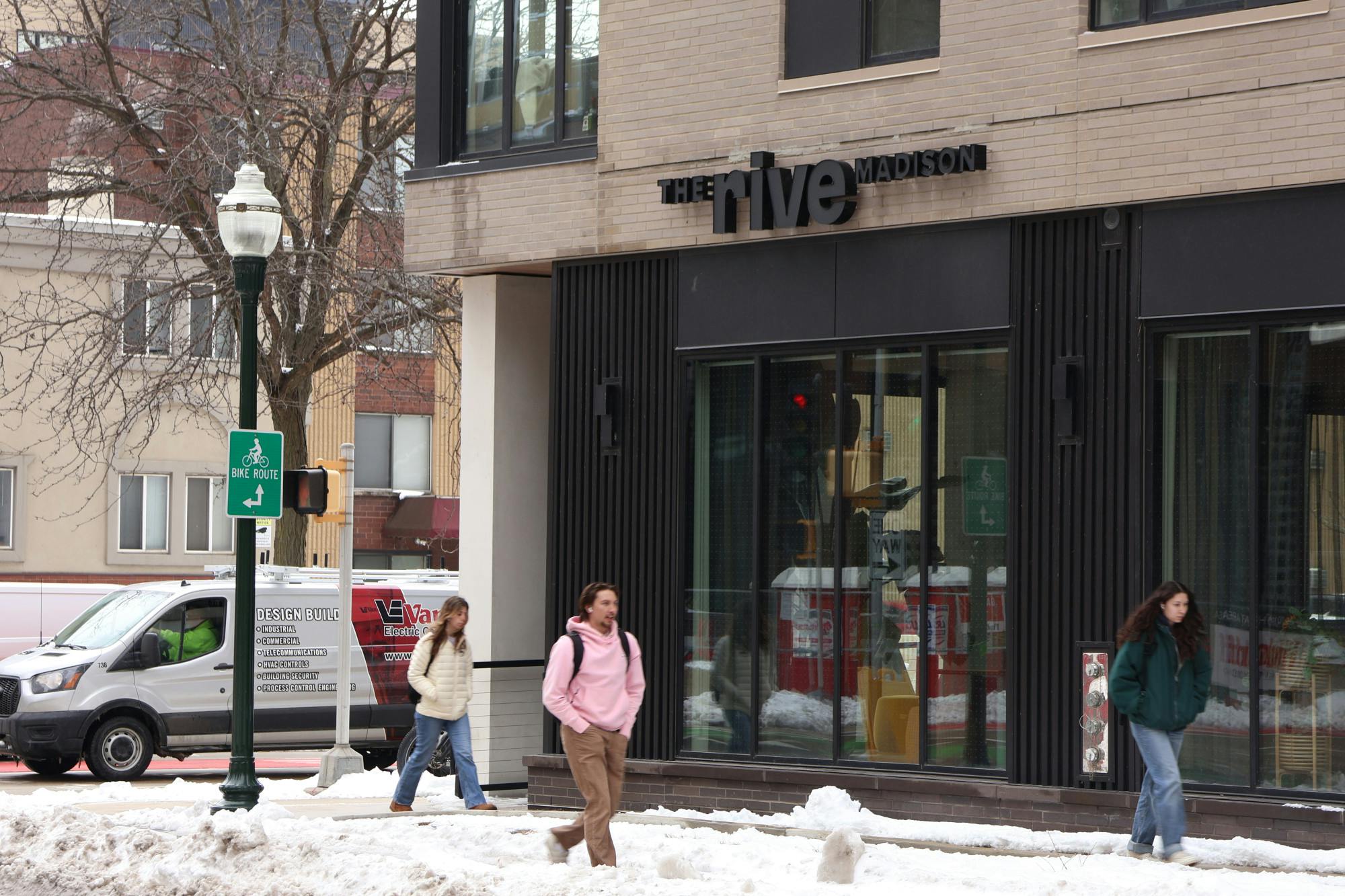
The new Hub Bassett, which opened in August 2026, is owned by Core Spaces, a Chicago-based company that also owns the Rive, Oliv and the Hub, whose current luxury “On Campus” location towers over one of the most active corners of State Street. Core Spaces owns and operates 81 luxury student apartments across the country. The James is owned by American Campus Communities, a Texas-based company that owns hundreds of college housing properties nationwide. Palisade Property, based in Madison, owns Palisade Apartments, Waterfront Apartments, 700 East Apartments and recently acquired The Aberdeen. A small number of large, wealthy corporations are increasingly consolidating power over Madison’s housing market, increasing barriers to entry for smaller landlords and developers and tightening their grip on student housing prices.
Some argue PBSAs are signs of growth and modernization on college campuses. But ultimately, students do not benefit from housing that treats basic shelter like a boutique lifestyle product. As apartments with Ritz-Carlton-level amenities become the norm, so do the prices that come along with them. Even students who aren’t interested in these amenities still end up paying for them, whether directly in new buildings or indirectly as smaller landlords raise rents to match the market rate.
Developers see students as a vein of gold and Madison the boomtown where they can mine it. To these corporate landlords, students are not tenants, but captive dollar signs with nowhere else to go. With business models designed for temporary relationships and high turnover, they show little regard for the economic wellbeing or even the humanity of students. As these monoliths grow in power and leverage, students shrink. The result is not simply nicer apartments, but a housing system that prioritizes returns to investors over the students they claim to serve.
For many students, higher rent does not mean just paying more. It means working more hours, taking on more debt, spending more time commuting to class as ordinary students are pushed off campus and sacrificing money that would otherwise go towards groceries and textbooks. College is meant to be a time of learning and community-building. Instead, it is becoming one of financial survival.
How can the Wisconsin Idea — the foundation of our university which promises that the university’s research and knowledge should directly serve and improve the lives of everyone in the state — be true as our housing system grows increasingly exclusionary, catering towards the wealthy rather than ordinary Wisconsinites?
Madison doesn’t need any more rooftop pools or private hot tubs. We need a housing system that sees students as people to be housed rather than profit margins to be maximized. Extractive developers flourish among the political and economic factors that allowed them to take root in the first place, and these problems don’t appear to be getting any better. UW-Madison’s identity is at stake. Are we a campus where ordinary students can afford to belong, or one polished into luxury until its character and accessibility are priced out of reach?
Brady Ahler is a sophomore studying Political Science and Economics. Do you agree that student housing is a right, not a privilege? Send all comments to opinion@dailycardinal.com
Editors note: This story was updated on April 1 at 12 p.m. to correct that the Hub Basset opened in August 2026.