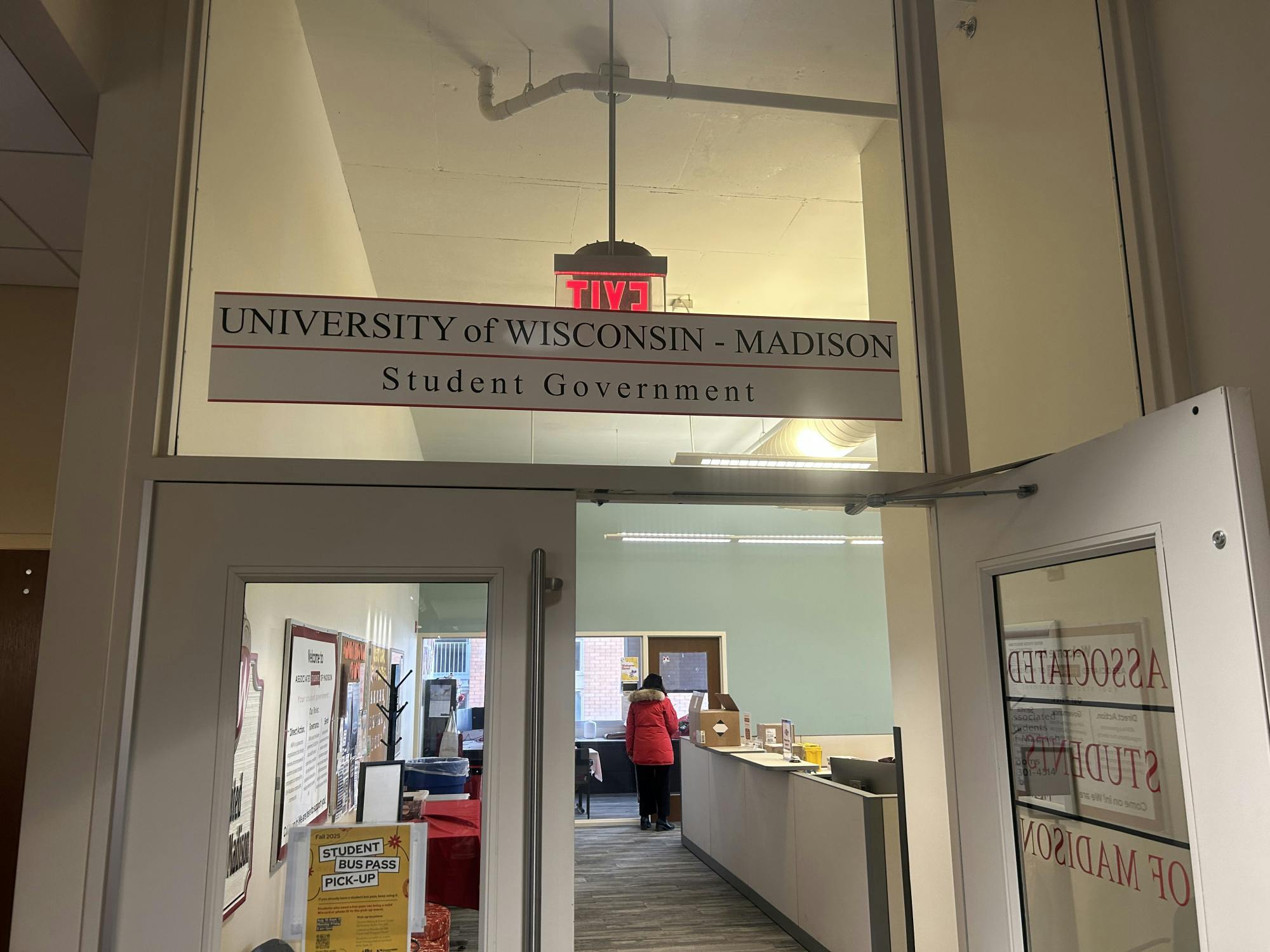
After nearly four hours of contentious debate, the Associated Students of Madison reached their meeting’s time limit Wednesday and failed to vote on a resolution which would call on the University of Wisconsin System to divest from Israel.
The meeting, which heard more than 45 students, co-sponsors and university staff speak, focused on a controversial and likely illegal resolution introduced by five ASM members that would demand the UW System disclose and divest from “companies complicit in apartheid and genocide, including Israel’s genocide of Gaza.”
The proposal, endorsed by Students for Justice in Palestine, Palestine Solidarity Committee, Young Democratic Socialists of America and over 30 other campus organizations, is the latest step in a series of campus-wide divestment efforts that most notably came to a head during the 2024 pro-Palestine encampment.
Proponents of the bill argued that while the resolution explicitly named Israel and the war in Gaza, the proposal was mainly focused on global human rights, domestic companies and student’s ability to control their tuition dollars.
“The calls for divestment are conduct based, not country based,” bill co-sponsor Roman Fritz said.
“[The legislation] highlights some of the most well documented and publicized cases of discrimination and human rights abuses in modern times,” fellow co-sponsor Andrea Christina Ruiz added.
Those opposed argued the resolution was discriminatory in nature, illegal and a largely unproductive and performative move by the student body that would alienate Jewish students on campus.
“This resolution would completely shut down the important conversations that are being had [on campus],” senior Erika Klein said in the open forum period. “Students who have connections to Israel, including Israeli students and Jews, will feel unsafe and worried to speak out for fear of social consequences.”
ASM members also called the resolution’s legality into question in the face of former Gov. Scott Walker’s executive order 261, which explicitly forbids state agencies from boycotting or supporting companies that boycott Israel.
When asked if the resolution would violate the executive order, Dean of Students Christina Olstad told ASM members that after meeting with UW-Madison’s Office of Legal Affairs, the resolution was seen “as a direct conflict” to the law.
The resolution itself cites Sudan’s Rapid Support Forces genocide during the country’s ongoing civil war, U.S. Immigration and Customs Enforcement raids, U.S. involvement in Venezuela and Iran and Israel’s war in Gaza and occupation of the West Bank as targets for divestment. Within the document, Israel is mentioned more than twice as much as other groups.
The resolution hopes to use successful past divestment campaigns from South African apartheid in 1978 and the genocide in Sudan in 2006 as a precedent and the basis for their new proposal.
In 2018, the UW Board of Regents changed their investment portfolio from being managed by the board itself, to the State of Wisconsin Investment Board, which now uses BlackRock managed Exchange-Traded Funds (ETFs) as a lump-sum means to invest.
Through the UW Trust fund, the UW System has invested over $316 million dollars into BlackRock’s ACWI Index, a curated collection of stocks which includes companies that have profited from the war in Gaza, assist in tracking for ICE raids, are connected to the attacks on Venezuela and have been involved in human rights violations across the world.
However, according to a 2024 financial review conducted by the Cardinal, these companies make up a small portion of the fund. The top 10 U.S. defense contractors made up approximately 1.1% of all investments in the index, while companies that have provided weapons to Israel encompass 4.56%.
Due to the nature of ETFs, if Wisconsin’s Investment Board were to divest, they would have to wholly remove their funding from the BlackRock index and into a new ETF or privately managed account.
During the meeting, senior Yoni Greenspan called to attention an alleged message from ASM and YDSA member Gabo Ochoa-Samoff considering not to “[extend] past the set 45 minutes” of speaker time because the “proportion of zios rises as the speakers list goes on.”
“Declaring that the speaker list is too full of ‘zios’ and because too many Jews are on it, thus colluding to not allow them time to speak is in and of itself the definition of discrimination based on religion and of ethnicity,” Greenspan said.
In an email statement after the meeting to Hillel families, UW Hillel CEO Greg Steinberger said they were in contact with the university regarding the language used and prepared to support Jewish students on campus.
“Please know that we are taking this offensive and dehumanizing language seriously,” the email said.
In a written statement to The Daily Cardinal, YDSA reiterated that Ochoa Samoff introduced the motion to allow everyone signed up to speak, allowing for almost two hours of debate.
“We want to emphasize first that Gabo is Jewish, as he later stated in the meeting,” the statement reads. “This was not a statement rooted in antisemitism.”
ASM also noted the time extension approval in a statement to the Cardinal, and urged students to reach out to their representatives if they had any concerns about the extension.
Since ASM was unable to vote on this resolution, they will vote on it during their next Student Council meeting on March 25.
Editor's Note: This article was updated at 3:20 p.m. on March 22 to correct a misspelling of Ochoa Samoff's name and include the fact that he introduced to motion to extend open forum.