The legendary flux capacitor-charged, plutonium-powered DeLorean time machine landed at Overture Center to present the touring production of “Back to the Future: The Musical” in Overture Hall from March 10 to March 15. This high-tech theatrical journey through time is a musical theater spin on the classic 1985 film, bringing the movie’s nostalgia to the stage alongside the magic of live theater in its Wisconsin premiere.
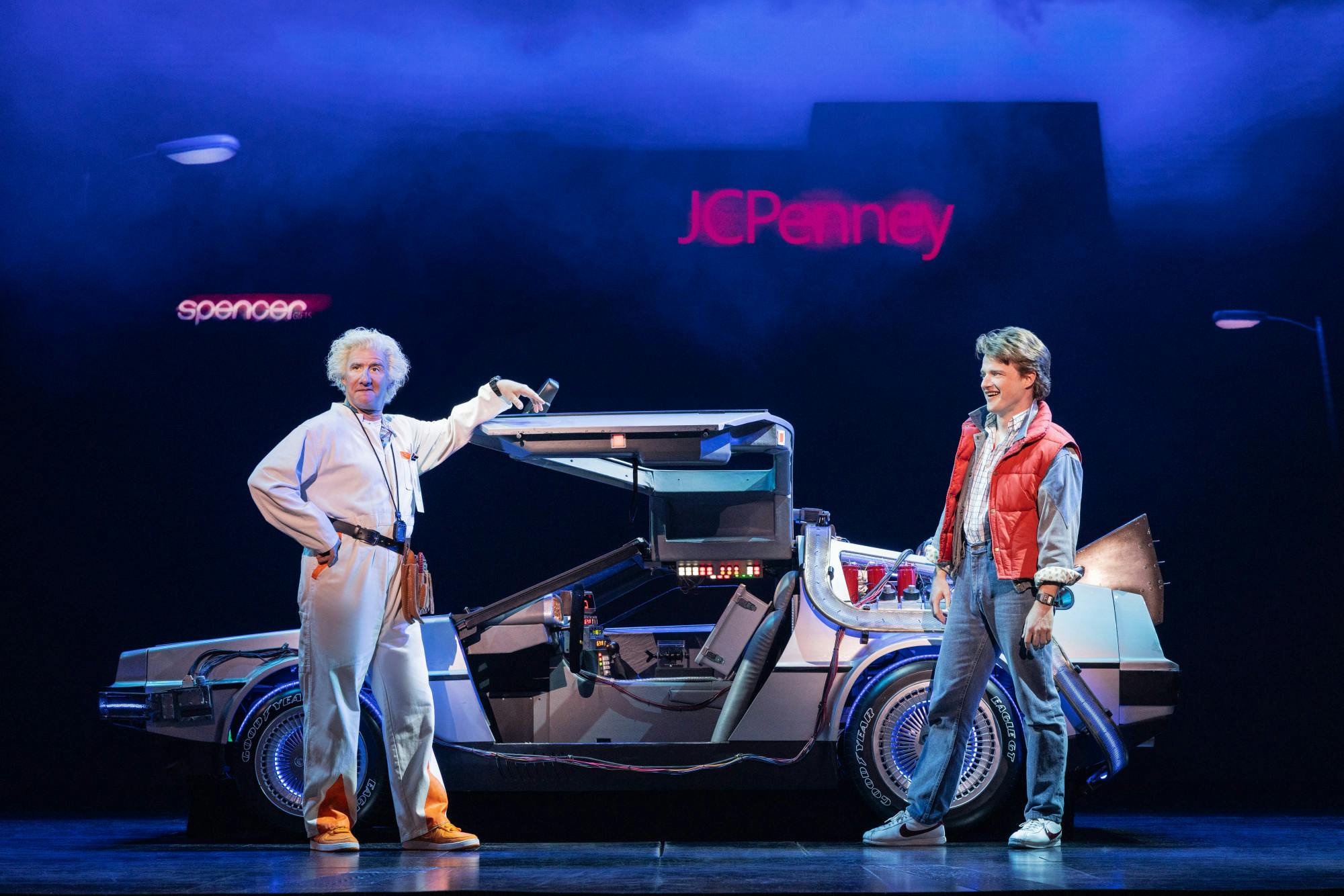
Just as the film’s story goes, “Back to the Future: The Musical” follows Marty McFly (Lucas Hallauer) through an accidental trip back in time to the year 1955, where he and the eccentric Doc Brown (David Josefsberg) must alter history after Marty disrupts his parents’ love story.
The musical adaptation’s relationship to the iconic 1985 film is complex. With an adaptation of such an iconic piece of media, high expectations were inevitable for the massive audience of fans who had spent over 40 years becoming familiar with every detail of the story.
“Back to the Future: The Musical” thus faced the difficult task of establishing a unique name for itself while bearing the name of a wildly popular existing work. The greatest disservice done to this show is its inevitable comparison to the iconic source material. The majority of the musical establishes itself as distinct from the original, even making subtle, yet valuable edits to the story’s progression, such as swapping Doc’s jarring run-in with terrorists for a case of plutonium poisoning. Still, it is doomed to be held to the original script's expectations.
This production should not be confined to the limited lens of its film predecessor. “Back to the Future: The Musical” is more of an ode to the original trilogy than a true retelling, catering to fans who crave both originality and the familiarity of a beloved work in a musical theater-based framing.
The dynamic duo of Hallauer and Josefsberg brought their own interpretations to the cherished characters they portrayed while also staying true to the figures of the film. Both actors have a knack for audience engagement, peeking through the fourth wall to always keep a smile on the audience’s faces.
Josefsberg portrays Doc with a masterful blend of ridiculousness, charm and panache that commands the stage. He captures the precise brand of lovability Christopher Lloyd crafted for the character, delivering on all expectations and taking the character to the next level.
In contrast, Hallauer’s Marty deviates from the familiar film portrayal, adapting the character for a musical theater setting with new energy and expressiveness. His distinctly theatrical presence was an entirely different direction for Marty’s character.
At its core, “Back to the Future” is a story centered around innovative, one-of-a-kind technology. Doc Brown’s high-tech gadgets — especially his DeLorean time machine — are essential to the story and to its novelty.
Unique, real-world technical innovation beyond the film’s technological focus was what best set the production apart from its source material. The detailed and advanced technical design was a rare sight to see onstage, with countless gasp-worthy moments of technical brilliance serving as a constant reminder of the magic of live theater.
Expertly utilized projection design framed each scene, smoothly transitioning to transport the audience and actors from one location to another with impressive fluidity.
The beloved DeLorean time machine is worthy of top billing right alongside Hallauer and Josefsberg for its role in the show. Even the limits of a proscenium stage do not stop the replica car from stunning the audience with its film accuracy and technical capabilities.
Alongside the uniquely spectacular design of the production, the script, falling into the unavoidable shadow of its well-known source material, blended necessary iconic lines and moments from the film with original, uniquely theatrical writing to craft a reimagined tribute.
However, the adapted material can at times feel like a parody rather than an ode — a brilliant and entertaining parody, but an exaggeration nonetheless. The characters of “Back to the Future” are already quite exaggerated figures, from the meek and nerdy George McFly (Mike Bindeman) to the tough and overconfident Biff Tannen (Nathaniel Hackmann). The musical occasionally caricatures these characters even further, disrupting the immersion created by the detailed scenic design.
This connectivity was also broken at times by the unshakeable sense that the story is set in the wrong environment. The classic musical theater style of the production’s original songs was awkwardly paired with familiar script elements and existing music from the film.
Though derivation from film consistency is the source of some of this adaptation’s greatest strengths, its shifts between accuracy and originality do not blend seamlessly. The moments and songs that are unique to the musical stood out negatively for their stark contrast to the film-faithful writing that is present in some capacity in every scene.
While it cannot live up to the sky-high standard of the film it imitates, “Back to the Future: The Musical” succeeded in providing the pure and simple entertainment factor many theatergoers seek. The dazzling design of this production created a memorable and exciting theatergoing experience that captured the magic of the beloved story, reigniting the sense of wonder that fans have been holding on to for decades.