I’ve seen “Hamilton” six times now in six different cities — New York, London, Chicago, Denver, Salt Lake City and most recently, Madison (Jan. 6-18) — enough to know this musical is both remarkably consistent and wildly sensitive to the smallest variables: a theater’s acoustics, an audience’s energy and the chemistry of two scene partners on a given night.
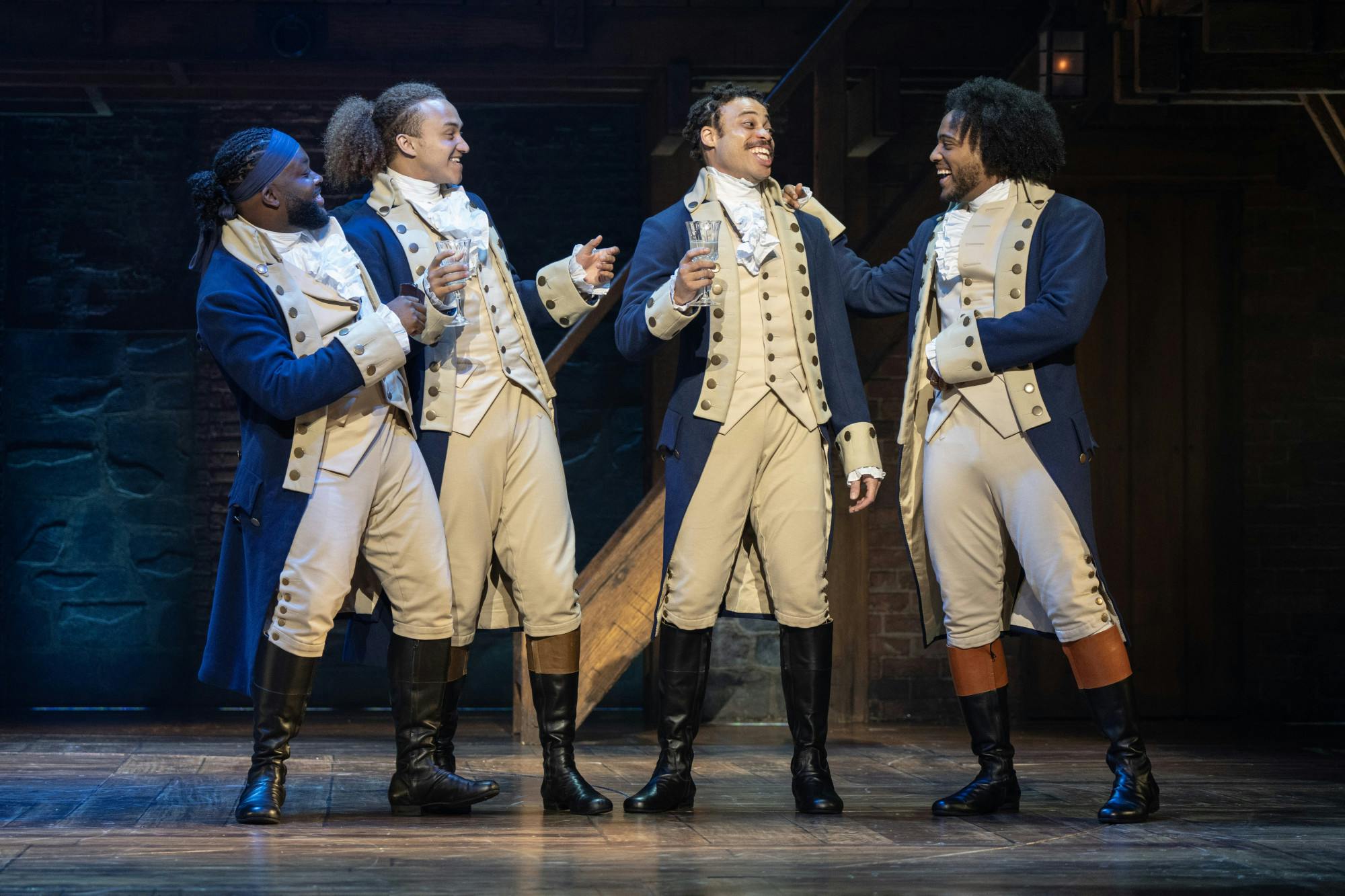
That’s what makes Madison’s stop at Overture Center, a part of the show’s Angelica tour, such an interesting case. The production arrives with the polish you’d expect from a long-running touring machine, and the storytelling remains as propulsive as ever. The opening “Alexander Hamilton” still detonates like a firecracker, and the cabinet battles still feel like history class taught through sheer audacity.
Yet in a show built on precision from its rap cadence, layered harmonies and emotional pivots timed to the beat, Madison’s performances also revealed how a few underwhelming casting decisions and surprisingly muted “major moment” scenes can flatten a musical that usually lands like a tidal wave.
Across all six cities, the show is held together with a bulletproof structure — the score does half the directing for you. Even when individual performances vary, the musical’s engine keeps pulling the audience forward. That’s the miracle of Lin-Manuel Miranda’s writing. It doesn’t merely support performance. It demands it.
In New York, that demand often reads as inevitability. The Richard Roger Theatre carries an almost ritual confidence — lines snap into place, laughs arrive in the pockets they’ve always lived in and emotional turns happen with a controlled, practiced force. London brings a different texture — a slightly cooler surface at first, then a deepening investment as the audience realizes how much this very American story is also about the universal mechanics of power, legacy and myth-making. Chicago, with its long history of big commercial runs, often plays like a hybrid: Broadway’s assuredness with a Midwestern warmness that rewards clarity and humor.
Tour stops like Denver and Salt Lake City, at their best, feel like the show being re-proved in real time, a company recommitting nightly to the idea that this story still has something urgent to say, even after the hype cycles and its ten-year run. This can make touring performances feel more alive than a “museum-quality” sit-down production.
Madison sits toward the end of my short list. It had tour-level stamina and craftsmanship, just like the shows in New York or London where the show has residency. But there were a handful of key places where the story’s voltage dipped.
The Overture Center is an excellent venue for big national tours, but “Hamilton” is uniquely sensitive to sound. The show’s language is rhythm and internal rhyme. If you miss a consonant, you miss a joke, plot point or shift in status. On Broadway, the mix often feels like it’s engineered to serve text first. In Madison, there were moments where the blend — especially in ensemble-heavy sequences — washed out the crispness that makes the writing feel like fireworks.
The audience helped, though. Madison crowds are generous, and you could feel the room wanting to meet the show’s energy halfway. When laughter and applause come readily, performers often take bigger swings. And in Madison, the comedy benefited. King George-style bits (whichever performance you caught) reliably received delighted, anticipatory laughter.
Every “Hamilton” lives or dies on the authority of its anchors. In Madison, the most noticeable weaknesses didn’t come from the romantic core, but from three roles that traditionally stabilize the show’s tonal compass: Aaron Burr, George Washington and Marquis de Lafayette/Thomas Jefferson. When these performances don’t fully land, the musical’s ideological tension — between caution and ambition, legacy and rebellion — loses sharpness.
Aaron Burr is the most precarious role in the show. At his best, Burr is restraint weaponized — patient, watchful, quietly burning with envy and self-justification. In New York and London, I’ve seen Burrs who make stillness feel dangerous, who can command a scene without ever raising their voice. In Madison, Burr’s performance leaned more neutral than conflicted. Vocally strong and emotionally sincere, yes, but missing the internal friction that makes Burr’s arc feel tragic rather than simply unfortunate.
George Washington typically functions as the show’s moral gravity. He doesn’t need flash; he needs weight. The role works best when Washington feels inevitable — someone whose presence alone can silence a room and redirect history. In Madison, Washington’s portrayal gestured at authority without embodying it, which softened pivotal moments like “Right Hand Man” and “One Last Time.” Compared to performances I’ve seen in Chicago and Denver, where Washington’s speeches land with almost presidential finality, Madison’s version felt restrained, robbing the character of the mythic stature the show relies on.
Lafayette/Jefferson, meanwhile, is a role built on contrast and charisma. Lafayette should explode onto the stage with anarchic energy, then reemerge as Jefferson with a slippery, smug theatricality that jolts the audience awake. In Madison, the technical precision was there — the accents, the speed, the physicality — but the performance lacked the spark that turns those choices into show-stealing moments.
The most surprising part of Madison wasn’t that some scenes played differently — that’s the point of live theater. It was that a few of the show’s biggest sequences felt smaller than they typically do, as if the production hit the notes but not the nerve endings.
“It’s Quiet Uptown” is where “Hamilton” earns its reputation for wrecking people. I’ve seen Denver and New York audiences go so silent you can hear the theater breathe. In Madison, the staging remained tasteful and the vocals controlled, but the grief didn’t fully flood the room. It was moving. It just didn’t feel inevitable.
Despite a clean and technically sound performance, similar gaps in tension and emotional weight could be felt throughout the numbers. When the major scenes don’t crest, the evening can feel strangely even — good, professional, impressive, but less transporting.
Madison also delivered strengths I haven’t seen elsewhere. Certain comedic beats, like King George’s maniacal loss of power, hit harder here than in more self-serious performances I’ve seen, and you could physically feel the audience’s excitement, anticipation and warmth.
And while I’ve spent a lot of ink on what didn’t ignite, the truth is that “Hamilton’s” floor is still very high. Even an “underwhelming” “Hamilton” production is often better than most musicals’ best nights. Seeing “Hamilton” in Madison reminded me why people keep going back: the show changes with the humans inside it. New York can feel like canon. London can feel like translation. Tour cities can feel like rediscovery. Madison felt like a competent, at times thrilling run that nevertheless exposed how much the musical relies on casting alchemy and scene ignition.
If this was your first “Hamilton,” Madison still offered a clear view of why the musical became a cultural phenomenon. If you’ve seen it before, then Madison may have felt like a slightly muted listening experience — the same brilliant composition, performed well, but missing the sharpest edges of its own blade.
And maybe that’s the final compliment, even wrapped in critique. Six cities later, “Hamilton” still teaches what “great” looks like by showing, night to night, how close “great” sits to merely “good.”
Alaina Walsh is the editor-in-chief for The Daily Cardinal. She formally served as the associates news editor and as the city news editor. She has covered breaking news on city crimes, a variety of state and campus issues, the 2024 presidential election and the UW-Madison budget. You can follow her on twitter at @alaina_wal4347