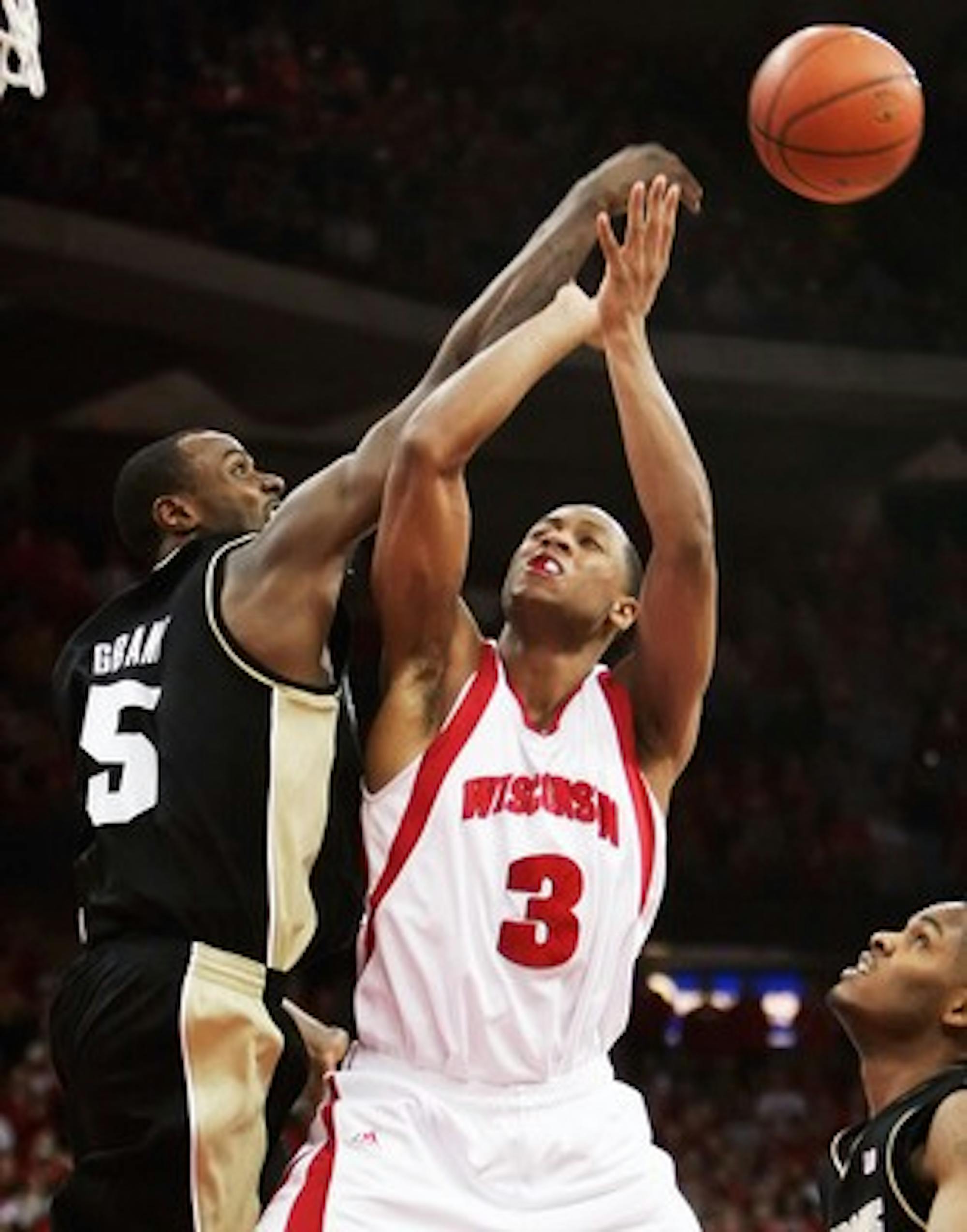
It is not often that a team can out-rebound its opponent by 22, connect on 30 of its 33 free throws while its opponent hits only 12-of-22 and still lose at home. That, however, was exactly what the Wisconsin Badgers did Saturday against the Purdue Boilermakers.
Purdue's offense spent much of the game attempting to invert the Badger defense. They forced Wisconsin's big men to close out on outside shooters and left the Badger guards to chase bigger players.
The starting Boilermaker forwards, freshman Robbie Hummel and junior Nemanja Calasan, combined to attempt 11 of the 19 3-pointers taken by Purdue and connected on five of them. Hummel was especially effective on the offensive end, leading his team with 21 points.
Overall, Purdue shot 53.1 percent from the field and 42.1 percent from beyond the arc.
Wisconsin sent out a three-guard lineup for much of the game with junior forwards Marcus Landry and Joe Krabbenhoft. That left the Badgers with a disadvantage in height at all three guard spots.
Purdue spent much of the game disrupting Wisconsin's offense by picking up guards in the backcourt and attacking passing lanes.
There was a lot of pressure out there,"" Wisconsin head coach Bo Ryan said. ""We felt we could get some fouls, unfortunately on some of the situations where we tried to probe, we lost the handle and you don't get a shot.""
The Badgers turned the ball over 18 times, two less than their season high. Landry, senior guard Michael Flowers and sophomore guard Trevon Hughes combined for 13 giveaways.
""Since [the Badgers] have such great balance and they're scoring very similar to us, with such balance ... We talk about their strengths,"" Purdue head coach Matt Painter said.
""We talk about what they are trying to do in their swing offense and each situation and how we'd like to defend it.""
""To be honest, we had a difficult time guarding them so we just pressured them and got after them to knock out what they were trying to do.""
The Purdue offense revolved around constant motion and screeners reading how the defense reacted. Their solid screens often led to cutters and shooters gaining a step or two on defenders.
""They were making good reads off of it. We were playing defense, we were hedging well off those screens. They had a guy coming around and they had some tough shots,"" sophomore guard Jason Bohannon said.
""We could have played better defense on some of them but some of them we had some let downs and stuff but I thought we picked it up a little in the second.""
The Wisconsin dominance on the glass and at the stripe could not overcome a 20 percent shooting deficit from the field and a 25 percent deficit from long range.
""It all comes down to the little things,"" Landry said. ""Some of the little things we just didn't do right.""