New museum celebrates local science
By Negassi Tesfamichael | Oct. 25, 2015The city’s longstanding ties with historical scientific achievements have a new home in the Madison Science Museum, which opened Thursday.
The city’s longstanding ties with historical scientific achievements have a new home in the Madison Science Museum, which opened Thursday.
Flaxseed, ginkgo, milk thistle–these recognizable names can likely be found at any grocery store.
UW-Madison’s scientific research has long been recognized as top-notch and paramount to the advancement of science, technology and medicine. UW-Madison is also home to some of the best scientists in the world. All of this, however, could be threatened by the Wisconsin legislature’s proposed ban on using fetal tissue for research purposes.
Amblyopia, or ‘lazy eye’, has long been thought of as a permanent feature in adults. This facial feature, where one eye is often slightly askew, is seen in both children and adults.
“We study sex in an obscure fungus,” says Dr. Christina Hull, an associate professor in UW-Madison’s biomolecular chemistry department.
I kid, of course: Silence is the last adjective one would use about climate policy, except with respect to such minor parameters as the actual benefits of various policy prescriptions and the actual evidence of climate impacts, about which more below.
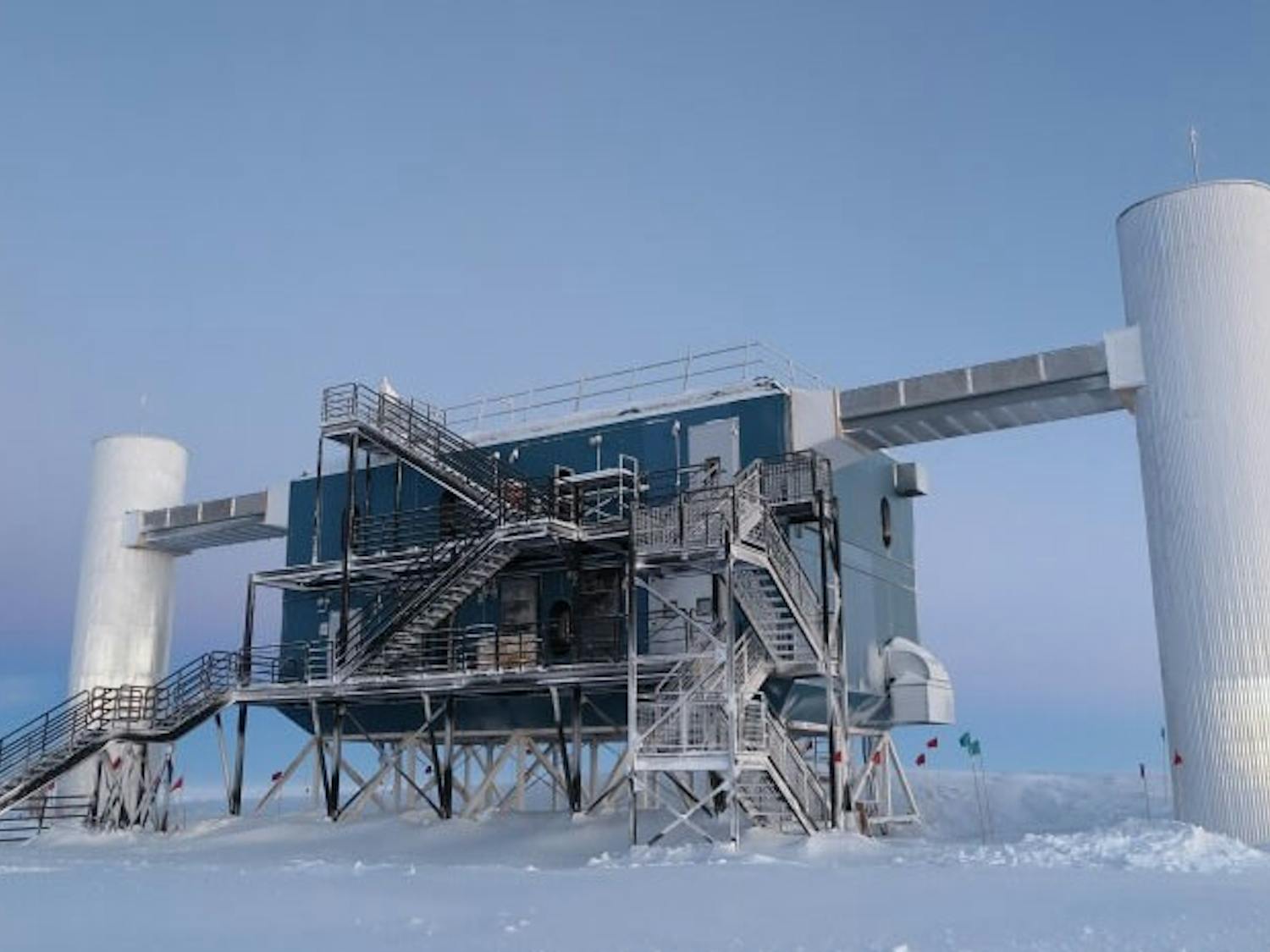
Buried almost a mile below the Antarctic ice, strands of optical sensors spread through a cubic kilometer of ice, hanging perpendicular to the horizon and stretching as deep as a mile and a half toward bedrock. Above those strands, surrounded by barren ice, is a two-story building flanked by a pair of spires and home to some 300 computers. This is IceCube, a kilometer-wide neutrino detector embedded in the South Pole. Built and operated by the UW-Madison in collaboration with universities and laboratories across the globe, IceCube has been gradually collecting data on neutrinos since 2010, six years after construction began in the Antarctic ice shelf.
From an ancient Mesopotamian plow to corroded engine parts, rusty remnants of past human life have long provided glimpses into worlds more colorful than their own reddish hue.
In a study done by the UW-Madison department of psychiatry, certain regions in the brain were discovered to be responsible for determining the likelihood of a person developing anxiety. These regions were found to likely contain genes that are the cause of genetically inherited anxiety.
Jeremy Hemberger sits at the desk of his new office and breathes a sigh of relief. “I’m so much more productive over here,” says the UW-Madison entomology graduate student, “it’s so quiet."
Recent technological advancements such as high-throughput genome sequencing and functional magnetic resonance imaging (fMRI) have allowed researchers to discover more about the human body and its inner biological secrets than ever before. Scientists are now able to uncover the sequences of entire genomes for almost any organism on the planet.
Four decades ago, wolves were added to the Endangered Species Act, and the once expulsed gray wolf trickled back into the Wisconsin wilderness. Protected by federal law, wolves were allowed to grow and spread out among the wooded north, resulting in a resurgence of a species once considered extirpated from the state.
Herodotus, a Greek historian of the 5th century BC, wrote of a magic fountain in the land of the Macrobians, which allowed them to live up to 120 years old. Centuries later in 1513, the Spanish explorer Juan Ponce de León led an expedition looking for the “Fountain of Youth.” Of course, he did not succeed.
Do you ever wonder how much energy you could save if you took the stairs instead of the elevator? Or how about if you unplugged your chargers and reduced your TV-watching time? Unfortunately, it’s unlikely that these questions have even crossed your mind. In an effort to increase consumers’ awareness of their environmental impact, Professor Nancy Wong from UW-Madison’s School of Human Ecology has created an app that allows people to track their daily energy use.
For 25 years now, the Hubble Space Telescope has hung in orbit above Earth’s atmosphere, absorbing the twinkling light of distant stars and translating an unprecedented view of the universe. Its data placed black holes at the center of galaxies and refined the predicted age of the universe, all while its cameras painted lush starscapes that colored the universe like never before.
With the lead of Lori Anderson, a faculty member at the UW-Madison School of Nursing and the American Family Children’s Hospital, a health-care system to support school nurses called eSchoolCare was created.
Claus Moberg, a founder and CEO of SnowShoe Stamp, has a message for students: You can start a technology company without a STEM major. How does he know? Because he did it. He began with absolutely zero knowledge of computer coding or 3D printing; instead, he had a big idea and some serendipitous pocket change. Now, he runs SnowShoe Stamp, a rapidly growing tech company that could very well change the consumer world.
What’s life like for real American badgers? I’m graduating after four years with a collection of pictures with Bucky, have visited the badger at Henry Vilas Zoo and yet have never wondered about the qualities that make them such a great mascot.