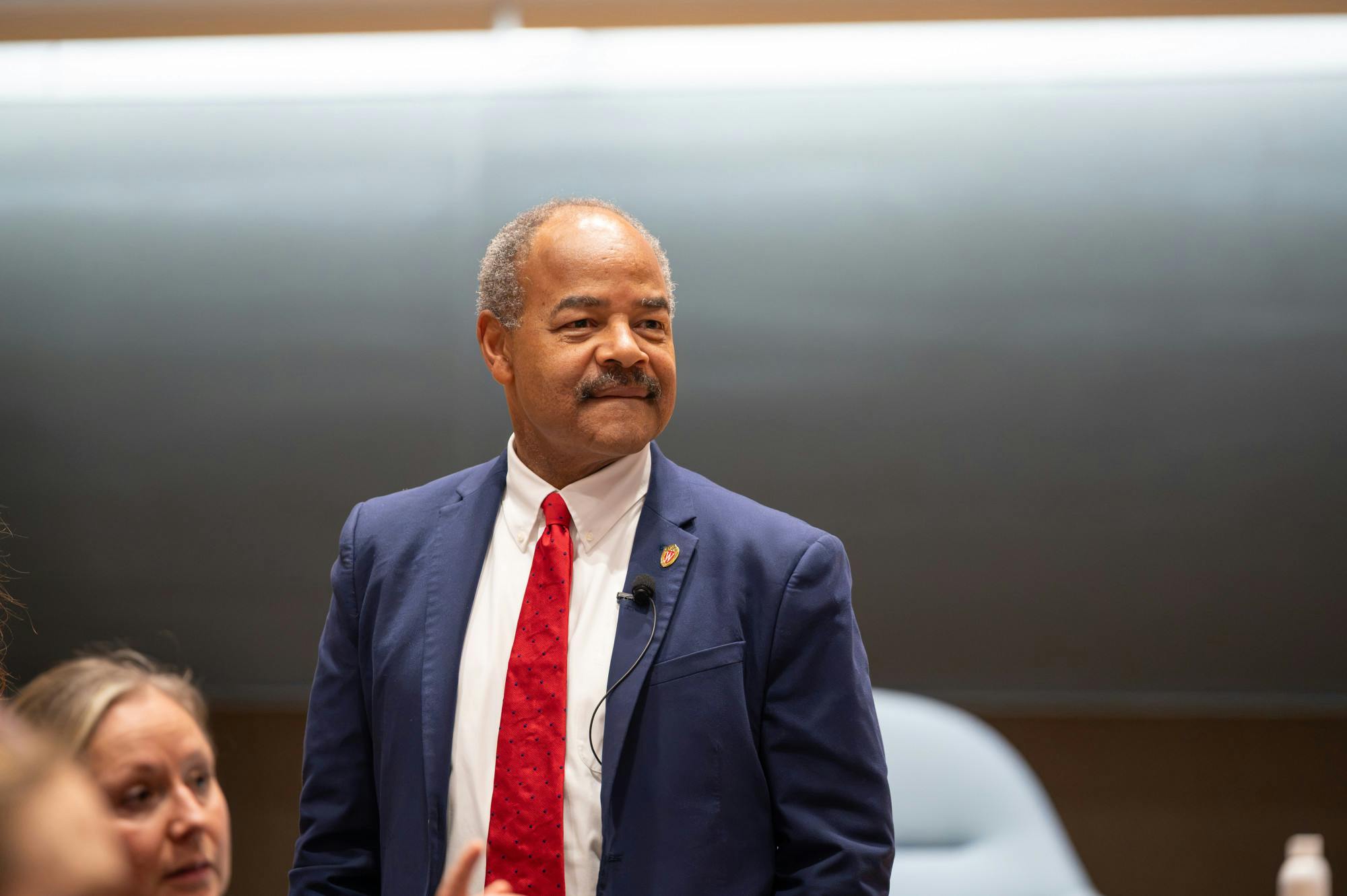
Faculty members asked University of Wisconsin-Madison Interim Chancellor Eric Wilcots to do more to combat sexual assault at the first faculty senate meeting of the fall semester Oct. 5.
After Cornell University’s handling of a sexual assault case sparked national backlash in recent weeks, faculty demanded accountability at UW-Madison. Last month saw two drugging and sexual assault reports at off-campus fraternities and records revealing that former Life Sciences Communication professor Dietram Scheufele had sexual relationships with two of his students, with one case including unwelcome sexual conduct.
Marcella Hayes, a history professor and Cornell University alumni, asked Wilcots about what conversations UW-Madison was having about campus drinking and party culture, as well as Title IX in light of the case at Cornell.
“[A] telling of or relating a sexual harassment is treated seriously and with empathy, but also investigated thoroughly,” Wilcots said. “That's something that I think we have done well on this campus compared to some of our peer institutions, and I'm proud of that.”
He added in his over 30 years at UW-Madison, “there have always been conversations about the party culture at this institution and others… with no easy answers.”
“It's something that we continue to think about and work on,” he said.
Policy UW 146 requires UW-Madison to gather data concerning sexual harassment and sexual violence every three years at minimum, but one professor commented they hadn’t been able to find any data more recent than 2019.
Al Kovaleski, a College of Agriculture and Life Sciences (CALS) professor, stated concerns with the university’s reporting structure, citing a Cap Times article about Scheufele’s actions.
“I think currently there's not a lot of structure for reporting and dealing with [sexual assault],” Kovaleski said. “At least within CALS, we're directed towards the Office of Compliance, and maybe compliance doesn't necessarily imply justice or taking care of victims in these cases and being attentive to that… we're just one news article away from being Cornell.”
Kovaleski told the Cardinal in an email there used to be a centralized reporting structure through the Office of Equity, Diversity and Inclusion within CALS before it was disbanded after state budget discussions.
Wilcots replied he believes the university has some good reporting structures, but “we have work to do on that… we’re better than we used to be.”
Pamela Kreeger, a biomedical engineering professor, said she was concerned the police unit investigating a student for sexual assault depends on jurisdiction.
“If I were a student here and I was raped on campus, who would investigate?” she said. “Would it be the UWPD or would it be Madison, or would it literally be dependent on if I was on one side of the street or the other?”
When Wilcots said the investigator depends on the jurisdiction, she replied, “That concerns me because as a person living in this area, I would hope that I get the same level of investigation, and I don't know that I would if it was from a police unit that is designated for campus.”
State and federal changes
This year could mark the period of greatest uncertainty about state leadership in over a decade.
Wisconsin will elect a new governor Nov. 3 at the first open race in 16 years, after Wisconsin Governor Tony Evers announced he will not pursue a third term. 2026 will also see a new speaker of the Wisconsin state assembly and Senate majority leader, along with a significant number of races in the legislature.
“We're building our state budget strategy without really knowing who will be in charge,” Wilcots said.
Additionally, Wilcots said universities are scrambling to keep up with the size and speed of federal government changes to the higher education landscape. UW-Madison has supported 17 cases and filed 36 declarations against federal changes since the Trump administration, Wilcots said.
Over the past 18 months, UW-Madison lost about 145 research grants totaling about $27 million, Wilcots said. He added the government is trying to “broaden the administration's ability to terminate grants and disqualify institutions from funding.”
Wilcots said the Department of Justice is also looking for “proxies for race” in admissions, which could include terms like “first-gen” or “Pell Grant,” and trying to force universities to comply with more stringent Title VI requirements. Additionally, President Donald Trump moved to withhold $70 million in Department of Education funding for international education programs Sept. 25.
“We are experiencing a fundamental resetting of the relationship between the federal government and institutions of higher education like ours, and we're also seeing an erosion of trust in higher education amongst the wider public… we should also recognize that it is highly unlikely that we will go back to how things used to be,” Wilcots said.
New federal guidelines no longer allow students to obtain internships using Curricular Practical Training (CPT) unless their degree program requires an internship experience for graduation, limiting international students’ ability to obtain internship roles in a vast majority of programs at UW-Madison.
An ECE professor stated some universities are still allowing dissertators to apply for CPT if an internship would contribute to their dissertation research, whereas UW-Madison does not. The Daily Cardinal was unable to verify this statement.
In response, Wilcots said UW-Madison, with the UW System, joined a lawsuit against the federal CPT changes. The UW System submitted shared testimony for the lawsuit, joined by universities across the nation.
Provost John Zumbrunnen added as a result of the CPT changes, the university is considering making internships a degree requirement in more programs.
New policies
The Campus Diversity and Climate Committee, Committee on Undergraduate Recruitment, Admissions, and Financial Aid and the Committee for Women in the University separately proposed removing the position of Chief Diversity Officer from their membership. The university removed former Chief Diversity Officer Lavar Charleston in January 2025 for financial mismanagement.
Charleston previously led the Division of Diversity, Equity, and Educational Achievement, which former chancellor Jennifer Mnookin dissolved in Summer 2025.
Several faculty members pushed back on the policy changes, which either remove the Chief Diversity Officer member entirely or replace the officer with appointed members.
Editor's note: This article was updated at 11:51 a.m. on Oct. 8 to include links to the lawsuit against CPT changes and UW System testimony.
Sonia Bendre is the campus news editor for The Daily Cardinal. You can reach her at sonia.bendre@dailycardinal.com.