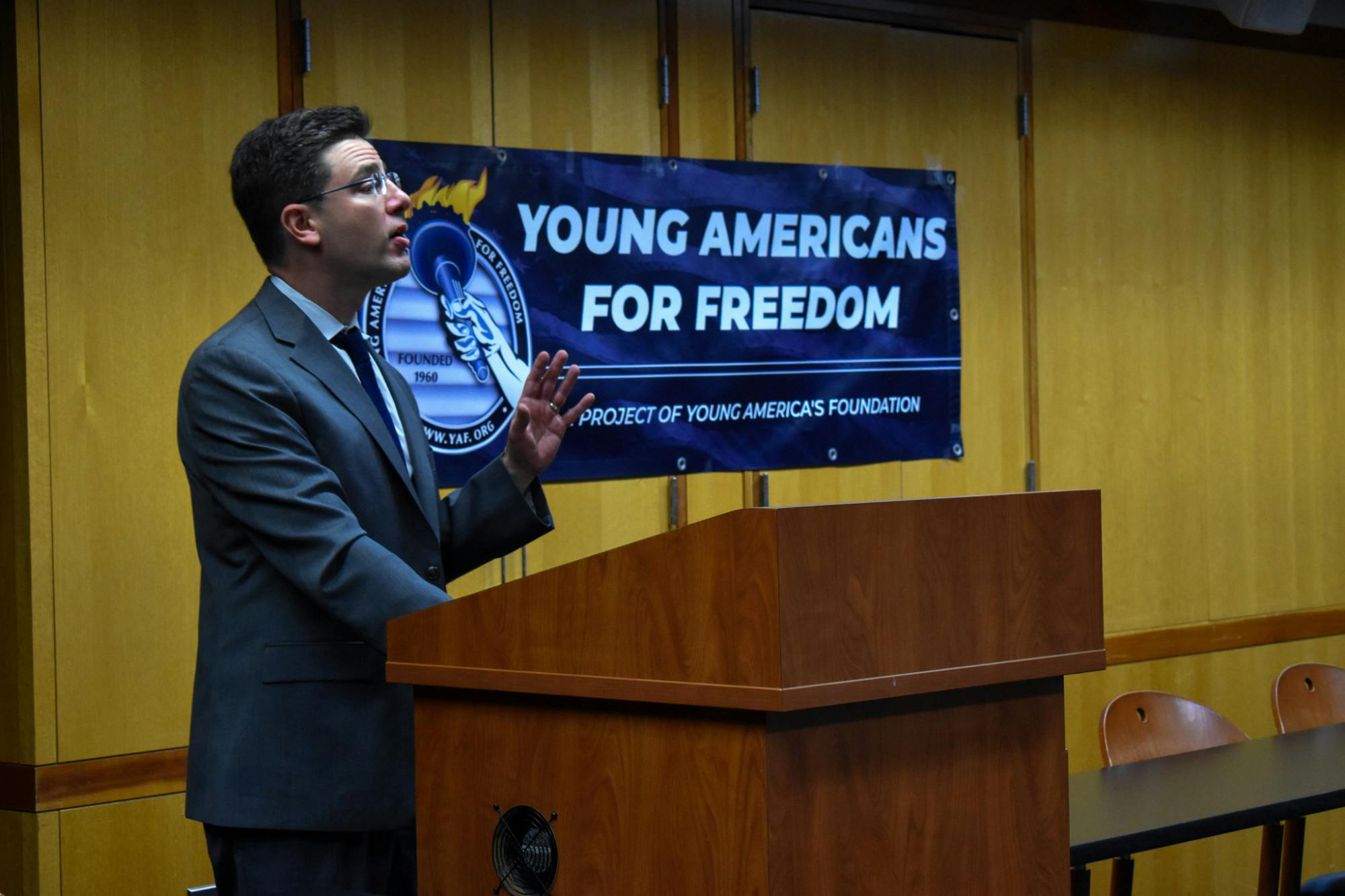
Matthew Continetti, director of Domestic Policy Studies at the American Enterprise Institute and a columnist at the Wall Street Journal, spoke about the evolution of conservative economics in the United States at the University of Wisconsin-Madison Law School Oct. 13.
In his lecture, he talked about conservative economics, pulling from Edinburgh and Adam Smith, author of “The Wealth of Nations” and pioneer of laissez-faire economics, to Washington D.C., discussing the rise of national conservatism and highlighting the impact of geography affecting conservatism.
Conservative economics now
Currently, conservatism is often associated with the Republican Party, but Continetti said the party hasn’t historically followed conservative values as we know them today.
To illustrate this distinction, he focused on rising prices, as it's a focus of the midterm elections on Nov. 3.
“[It’s] on everyone’s minds,” Continetti said. “Voters expect government to do something about prices. Ironically, because government is often the reason that prices rise.”
To highlight his point, he brought up the Perry Chart, which traces the costs of goods and services over time.
“[It] shows costs have risen most sharply in areas where government is most involved: education, healthcare, housing,” Continetti said.
Future of conservatism economics
“I think there's going to be a big debate litigated in the Republican presidential primary in 2028,” Continetti said. “JD Vance represents the views of the national conservatives … If anything, I think he's for a larger government role in the economy than even President Trump is.”
Senator Ted Cruz, Vance’s main rival, Continetti expects to “reassert the traditional conservative understanding of competition [and] trade.”
Origins of conservatism
Connetti traced the development of conservative thought by highlighting the importance of six cities throughout history.
In Edinburgh in 1776, Adam Smith’s “Wealth of Nations” came out in the same year as the Declaration of Independence, laying the foundation for limited government intervention in economics.
“[Americans] subsidized economic development through land grants and transportation networks, and they spent money on education and research, yet the federal government remained small,” Continetti said.
The modern conservative movement took shape because of opposition to progressivism, which argued for larger government regulation.
“So, during the 1930s, opponents of Franklin Delano Roosevelt's New Deal … became known as conservatives,” Continetti said.
In Vienna, economists Ludwig Von Mises and Friedrich Von Hayek provided intellectual support for conservatives.
“From the Austrians, conservatives learned of the connection between economic and political freedom, how efforts to reduce economic inequalities create political inequalities that favor government and the state over the individual,” Continetti said.
Milton Friedman in Chicago proposed the Great Depression happened due to mismanagement of credit, which led to a banking crisis, according to Continetti.
In the 1970s, stagflation — a combination of unemployment and inflation — became prominent in New York and helped spur the growth of supply-side economics.
“Supply-siders prioritized tax cutting over deficit control…[they believed] in stable monetary environment, reductions in marginal tax rates would spur savings, investment, and growth,” Continetti said.
These ideals were reflected in President Ronald Reagan's policies, which included major tax cuts and the abolishment of wage and price controls.
“The Washington consensus that followed Reagan pushed free trade, deficit control and open migration … [it] would later be described as globalist,” Continetti said. “While globalization reduced global inequality, billions lifted up from poverty for the last half-century, it also exacerbated inequalities within nations.”
Donald Trump
“[Trump] cared less about conservative theory or principle, and more about the political sentiments that he had formulated as a young man,” Continetti said. “He singled out immigration, NAFTA, trade with China, endless wars in the Middle East and the threat from Iran.”
Although not a conservative himself, Trump’s fire on globalization and challenge to the Washington Consensus opened the door for national conservatives.
“NatCons draw more heavily from the traditional wing of conservatism, a large group of American conservatives who emphasize authority, order, religious belief, individual virtue, rather than individual freedom,” Continetti said.
National Conservatives reject the ideas of Friedman and Hayek, according to Continetti.
“Rather than draw on the insights contained in the philosophy of freedom, I fear we're moving into a world where populist rhetoric fuels the growth of the state and the diminishment of our future,” Continetti said.