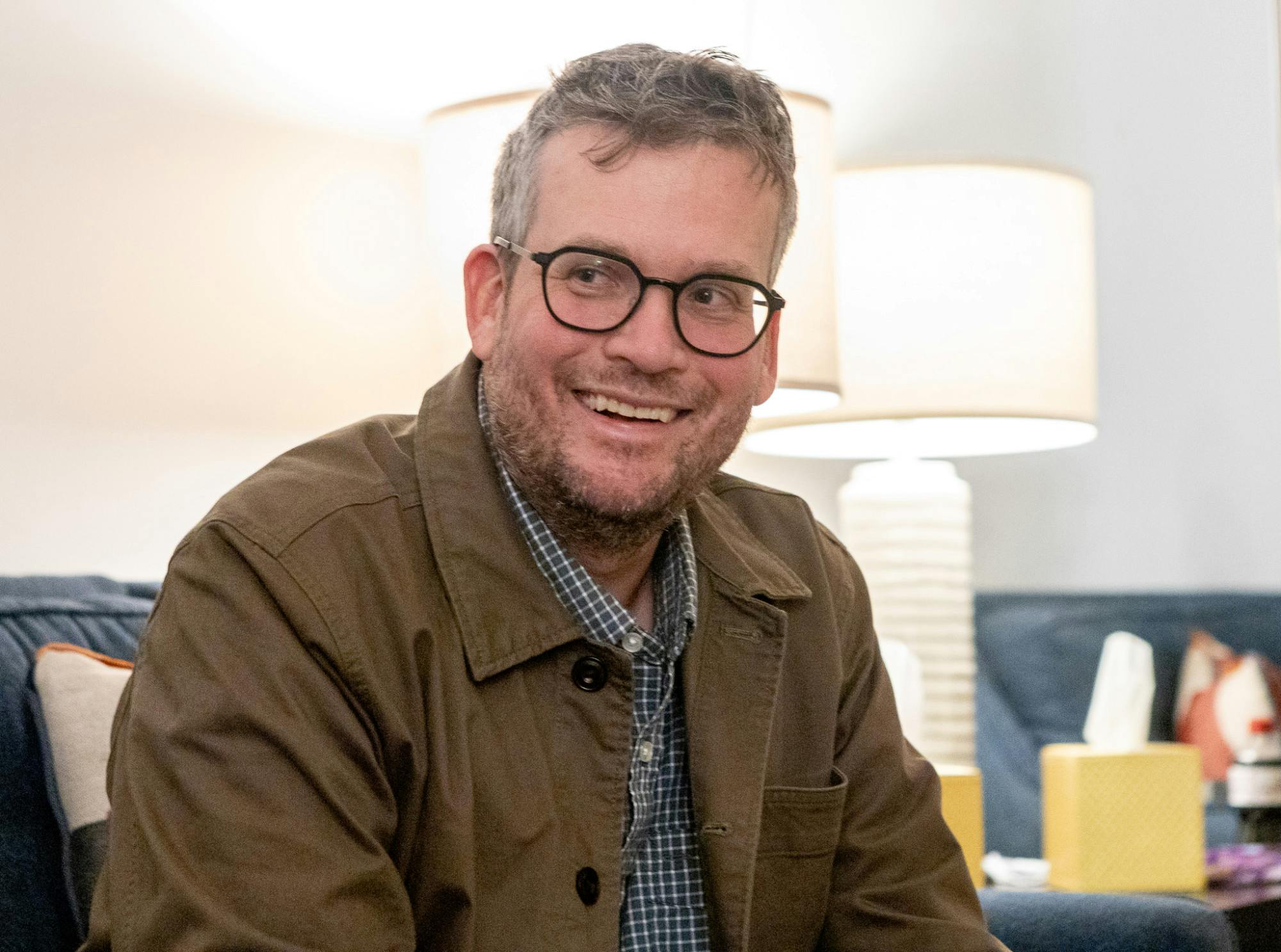
I interviewed John Green in an unassuming room tucked behind the Capitol Theater at the Overture Center for the Arts. The room was just offstage from where Green would soon perform and out of sight of the line of fans eagerly entering the theater.
In contrast to the impressively accomplished resume Green carries, he appeared before me looking quite commonplace, shaking my hand and saying simply, “Hi, I’m John.”
Podcaster, creator of Crash Course, bestselling author, self-proclaimed “divinity school dropout.” Green has donned many hats, but his rise from fame to generational notoriety occurred seven years after his first book release, with the 2012 YA novel, “The Fault in Our Stars.”
Green’s brief stop in Madison was the 10th event on his 20-stop tour for his first foray into adult fiction writing, “Hollywood, Ending,” released on Sept. 22. The novel is his first work of fiction in nine years.
In collaboration with the Wisconsin Book Festival and A Room of One’s Own Bookstore, the event stop was Green’s only stop with free admission. Additionally, every attendee received a free, signed copy of “Hollywood, Ending.”
The event was first come, first served, but by the start, all 1,089 seats were filled, with over 800 hopefuls turned away, according to a nearby Overture Center employee.
As book lovers and Green buffs alike filed into the theater, I sat next to Green (or, as I now called him, “John”) on a gray couch, trying to keep my cool and forget the prominence of my interviewee.
Like many of his novels, “The Fault in Our Stars” explored deep themes, woven together with meticulous characterization and a constant ambience of humor. Not only did the groundbreaking novel connect with readers of all ages, but it particularly struck a chord with young readers who connected deeply with his characters.
Somehow, in Green’s words, an “innocuous middle-aged dad in Indianapolis who makes educational content” made readers feel hopeful and seen in a world frequently plagued by despair.
“I didn't know what it was like to be a teenager when I was a teenager; I certainly don't know what it's like now, but I think a lot of those experiences are universal,” Green told The Daily Cardinal.
He explained that, although he’s never felt completely in tune with younger audiences, the shared experiences of love, grief and trauma help guide his writing. He feeds off of his young audiences and listens to the attendees at his events, many of whom are from younger generations.
Fans also frequently relate to the profoundly complex relationships Green explores, which unabashedly promote the importance of love.
Green graduated from Kenyon College with a B.A. in English and Religious Studies. Although he spent his time in college joyfully hanging out with friends and reading, the years after brought him a sense of dread common to many graduates.
For a long time, Green didn’t know the answer to the constantly asked question, “What are you going to do with your life?” In part, he said, because he believes it’s an idiotic question.
“It's stupid because you're going to do more than one thing with your life, and it puts a lot of pressure on you when you're 21,” Green said. “The actually interesting question is who you're going to do life with.”
Green didn’t originally envision himself as a writer, but now his writing is as much of a personal need as it is a job.
“I've always written to escape,” Green said. “The whole problem with being a person is that you're stuck the whole time you're here inside of one consciousness, and writing is as close as I can get to being free from that.”
Along with his personal connection, Green acknowledges the deep connection of his readers’ own experiences to the vulnerability in his art.
“When you make art, you have to make yourself vulnerable to it,” Green said. “You have to bring your deepest self to the story, or the painting, or the YouTube video, or whatever you're making, because you know that the people who are engaging with that art are also going to bring their deepest self to it.”
After thanking Green for his time and ending with a discussion about his tour necessities (grape Uncrustables and Diet Dr. Pepper), I returned to my own seat in the theater to hear Green discuss his novel.
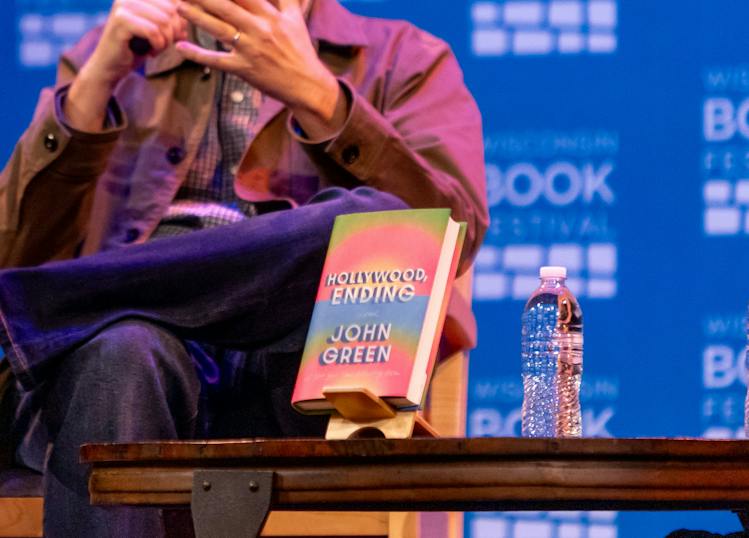
Hollywood, Ending
Told from the dual perspectives of young actors Juniper and Kai, “Hollywood, Ending” follows the pair from the early days of filming the fictional movie, “Andy Warhol Never Gets Old,” to the subsequent launching of their high-profile careers into super-stardom.
Green’s vulnerability is ever-apparent and woven throughout his characters, world-building and plot points.
Inspired, in part, by his time spent on movie sets during the adaptations of his bestselling novels, Green explores the weird, shared experience that happens on movie sets and his love-hate relationship with the film industry.
This relationship is a combination of a love of movies but a strong dislike for the newly created attention economy amplified by Hollywood and the idea that private experience is increasingly turned into public discourse, an idea he revisited throughout his book talk.
Before the show even began, the joy was palpable. While a few were wearing paraphernalia from the Green Universe, many were holding their new copies of “Hollywood, Ending.” Some were already nose deep in the pages of Green’s latest novel.
The lights dimmed, and the show began, captivating the attention of those in the audience. Even the mass of turned-away fans were still with us. An audio version of the talk was streamed into the lobby, and those listening were quickly dubbed the “audio-only people” by Green.
“I just want to say to the audio-only people, you're missing literally nothing,” Green said, poking playful fun at himself. “All you're missing is my corporeal form — a skin-encased bacterial colony that isn't as young as it used to be.”
The night included a brief book reading, a conversation with YouTuber and musician Craig Benzine, a mini press junket, a chemistry read and a brief song. Every moment felt sprinkled with tidbits of Green knowledge, a compilation of information gathered through his years of experience as a student of the world.
Green’s continued relevance is a result of his ever-important core messages: that we create art despite all of the bad, and what remains is a shared love and a lasting hope of a better tomorrow.
This is the note Green left with his audience at the conclusion of his talk.
“We make art to ease each other's burdens, to visit rooms in our mind that are otherwise inaccessible to us, and to express what is hardest to express,” Green said. “We make art because every human voice matters.”
Green is a renowned author and a brilliant speaker, but most of all, he’s an example of his own message.
By bringing together 1,089 book lovers (and all of the audio-only people tuning in from the lobby) on the same night, Green’s art built a community with enough shared love to withstand it all.
With humble care, Green ended the night to a standing ovation and these words:
“If you knit or paint or write or in any way transform the raw materials of the world into creative expression, I want to say thank you,” Green said. “Art is worth it, just as life is worth it.”
Liset Zacker is one of two arts editors. She enjoys writing movie reviews, artist profiles and covering local Madison events. You can find her on Letterboxd at @dailycardinal.