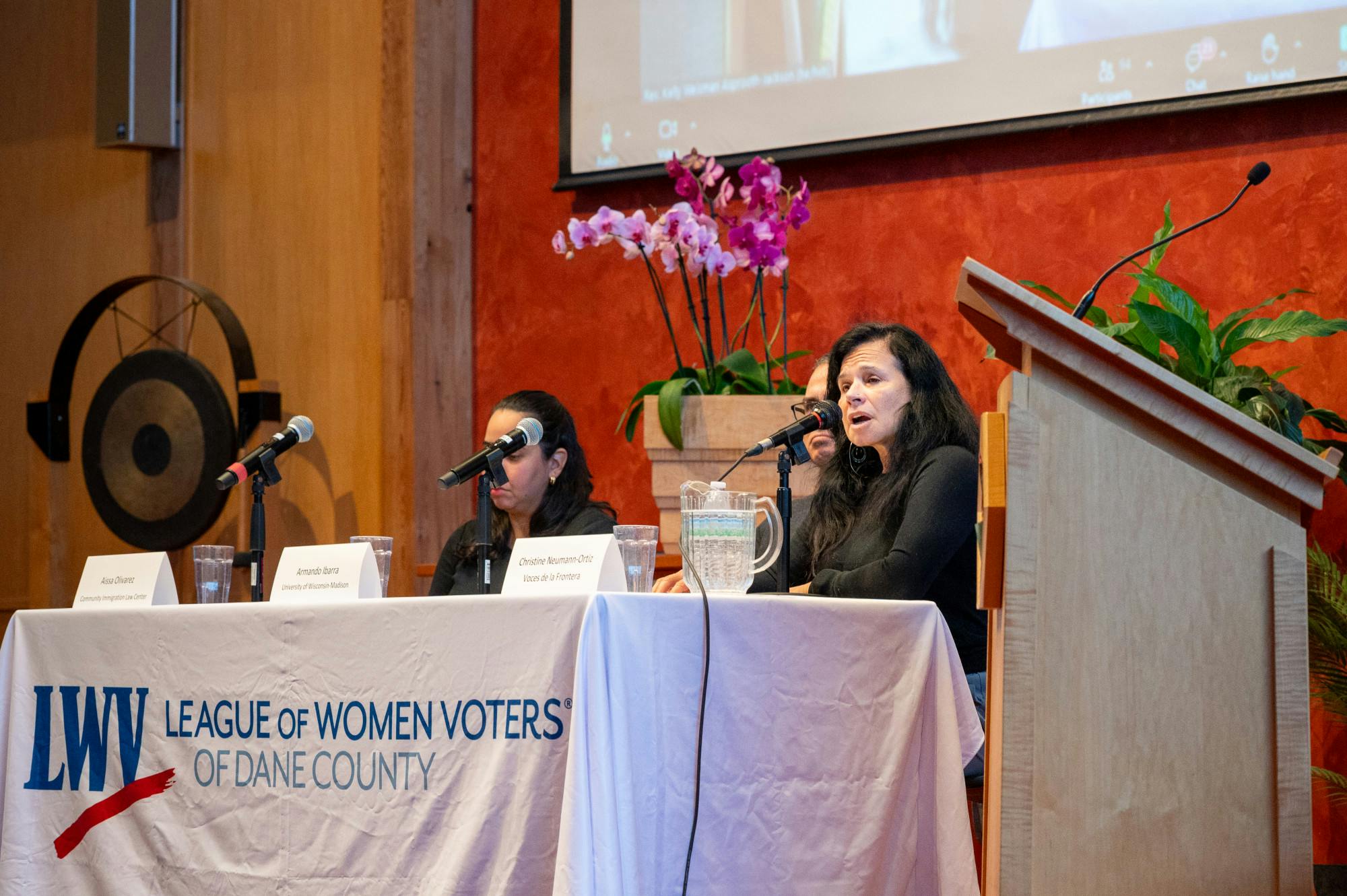
Dane County election officials and voting advocates gathered at a League of Women Voters panel Sept. 29, to explain the safeguards behind local elections and how voting access, transparency and public participation contribute to confidence in the electoral process, ahead of the Nov. midterm election.
WISC-TV anchor Sarah Carlson moderated the discussion between three panelists — Scott McDonell, Sam Liebert, Barb Feeney — framing the conversation around the importance of understanding the election process rather than simply being told it is secure.
The question of how a vote is protected formed the basis of Dane County Clerk Scott McDonell’s presentation, which traced the safeguard in place from election preparations through the verification of results after Election Day.
Wisconsin’s decentralized election system divides responsibilities among county and municipal officials, creating multiple levels of oversight, according to McDonell.
Wisconsin’s elections are administered by more than 1800 municipal clerks across the state, with county clerks responsible for additional parts of the election process. That local structure means election procedures are carried out across thousands of jurisdictions rather than through a single centralized election office.
Election equipment is tested before election day, election coding takes place offline and election materials are tracked through chain-of-custody procedures.
Every Wisconsin vote has an associated physical paper ballot, allowing election officials to hand-count votes and compare them with electronically reported results during recounts and post-election audits.
“That is the ultimate security feature,” McDonell said. “There is a printed ballot with the names you voted for.”
Beyond the paper record, McDonell said the system is designed around multiple safeguards rather than relying on any one security measure. Equipment testing, encryption, physical security, public observation and post-election verification provide checks at different stages of the process.
“It’s not one silver bullet,” McDonell said. “It’s layers and layers and layers.”
While McDonell focused on the safeguards already built into elections, All Voting Is Local Wisconsin State Director Sam Liebert turned to how proposed policy changes could affect the balance between election security, voter access and practical demands placed on local clerks. All Voting Is Local is a nonpartisan organization focused on voter access and election administration at the state and local levels.
Liebert approached those proposals with a central question: “What problem are we solving?”
One proposal would allow election workers to begin processing absentee ballots the Monday before election day while keeping results confidential until polls close.
The proposal comes as Wisconsin officials continue to debate how to handle the large volume of absentee ballots received during major elections. Because those ballots require several steps before they can be tabulated, processing them alongside Election Day voting can add to the workload facing local election workers.
Liebert said earlier processing could reduce worker fatigue and allow results to be reported sooner, but would require secure storage, documented chain-of-custody procedures and clear rules for observers.
Liebert also stressed the importance of considering voting accessibility for people with disabilities who may be unable to privately complete a paper absentee ballot without assistance.
“They lose their privacy. They lose their independence,” Liebert said. “They lose the secret ballot that we’re all promised.”
The final portion of the panel moved beyond election administration and policy. League of Women Voters of Dane County Member Services Chair Barb Feeney focused on what residents themselves can do to strengthen trust in democratic institutions.
She encouraged attendees to verify their voter registration, follow local issues and become more involved in their communities.
She also urged residents to think about political participation as more than voting, describing politics as “doing the business of the community.” Feeney pointed to attending local meetings, joining community organizations and volunteering as ways people can form stronger connections with those around them.
Feeney explained trust in polling places, election clerks and political institutions is connected to the relationships people build within their communities.
“There are extraordinary things being done by very ordinary people,” Feeney said.