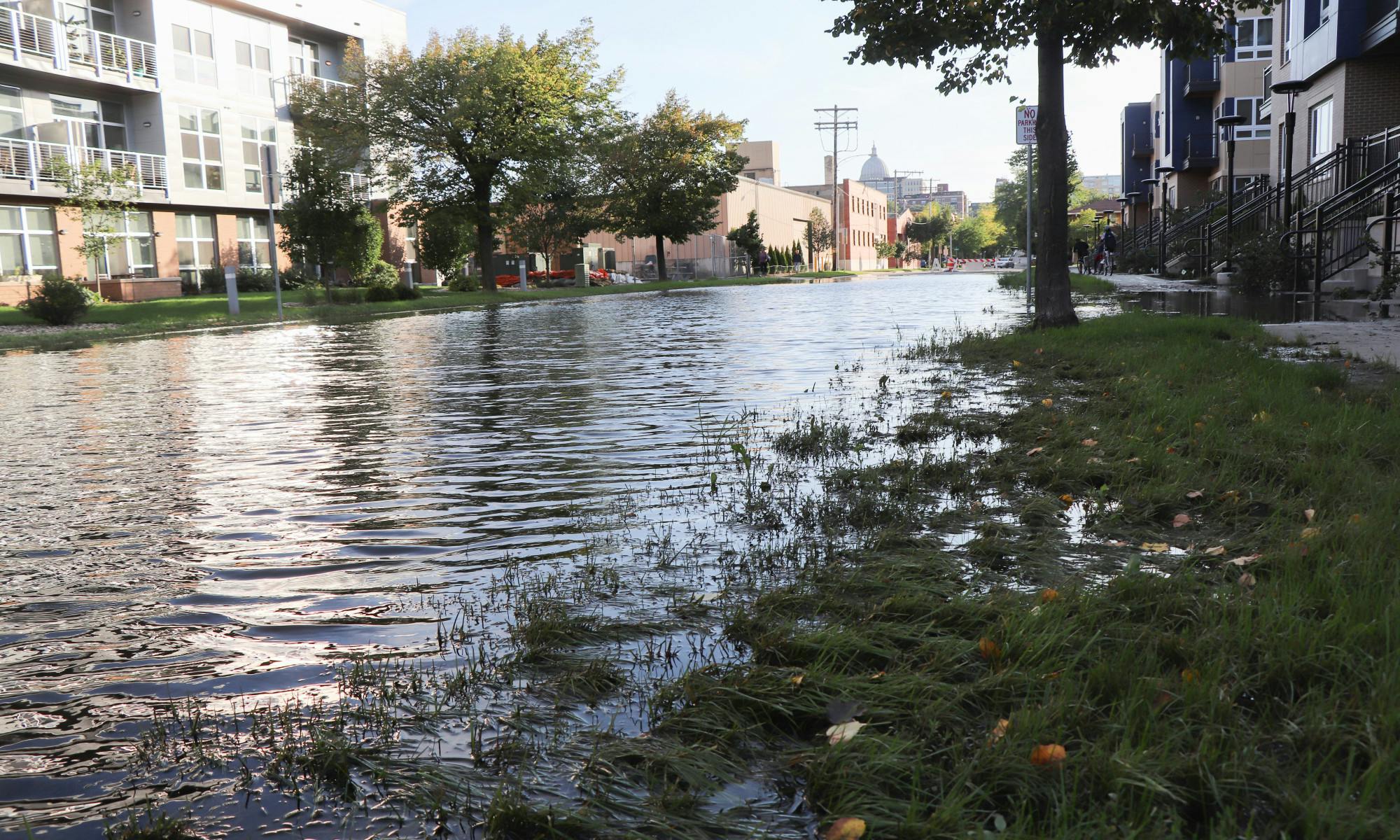
Madison’s proposed 2027 budget includes millions of dollars for flood mitigation as the city works to address drainage problems, but officials argue it will still not be enough.
The executive capital budget proposes $8.35 million in stormwater utility capital spending including $6.06 million for citywide flood mitigation.
Rainfall has fluctuated greatly year to year, with 50.7 inches of rain recorded in 2018 and only 29.8 recorded in 2023. In 2024, Madison saw about 48.5 inches of rain, and 2025 saw 37 inches.
Dane County’s annual average precipitation has increased at a rate of nearly 1 inch per decade since 1950, Josh Bendorf, a climate specialist at the University of Wisconsin-Madison, told The Daily Cardinal in an email. Bendorf also noted that seven of the county’s 10 wettest years since 1895 have occurred since 2000.
“A warmer atmosphere is a key driver of the increase in precipitation,” Bendorf said. “Warmer air can hold more water vapor versus cooler air, and more water vapor means more moisture available for precipitation.”
The trend has caused problems for Madison, where intense rainfall can overwhelm stormwater infrastructure. On Aug. 20-21, 2018, more than 11 inches of rain fell on Madison’s west side in 24 hours, making it a once in 1,000 year storm, according to Bendorf.
The storm killed one person and left the city with over $21.4 million in reported property damages.
The flooding prompted the city to conduct assessments of flood risks throughout Madison.
“After the big 2018 flood event, Madison decided to investigate all 24 of its primary watersheds and modeled them mathematically, graphically, to look at what could be done to increase the city’s resilience, assuming we’re going to continue to have major rainstorm events,” District 19 Alder John Guequierre told the Cardinal.
One major project planned is the expansion of West Towne pond on Madison's west side, which is intended to increase stormwater capacity and reduce peak flood levels in the surrounding area.
Other stormwater projects scheduled for later years have been moved to the city’s Horizon List. This list consists of projects that meet a clear community purpose but are not ready to formally schedule and fund, since Madison’s flood control needs extend far beyond what can be addressed in a single budget year.
Madison’s stormwater Section Manager and Principal Engineer, Janet Schmidt, told the Cardinal in an email the city’s geography makes preventing floods particularly challenging.
“Madison, and the isthmus in particular, were built on areas of filled wetland,” Schmidt said. “These areas are inherently low compared to the lake and river levels, and providing infrastructure to serve them is challenging.”
Schmidt noted the intensity and duration of a storm can make a significant difference in how much water the system can manage.
“A storm that produces two inches of rain in three hours is way different than a storm that produces the same rain over 12 hours,” she said.
The consequences were clear during the 2018 floods. Guequierre described the severe flooding in his district, where several homes had water reaching the second floor. Residents also faced sewage in their basements and major repair costs.
“The streets were impassable, and emergency vehicles couldn’t get through the intersection of Old Sauk and High Point,” Guequierre said.
As the city prepares for future storms, officials must determine which areas need protection most urgently and which solutions are practical and affordable. Madison has identified flooding problems across many of its watersheds, but addressing them requires decisions about where to invest first, according to Schmidt.
“For prioritizing these projects we look at many things, including budget, outside funding, feasibility, demographics, environmental concerns and more,” Schmidt said.
The neighborhoods built on filled wetland are especially hard to address, according to Schmidt.
“There are just some areas that really have no viable solution for flooding, so we provide guidance as new buildings are constructed on how to protect against flooding when it does happen,” Schmidt said.
Guequierre said three watershed studies in District 19 are essentially complete, including studies of Pheasant Branch and Spring Harbor — neighborhoods that experienced serious flooding in 2018, along with recurring problems.
The West Towne pond project, which was included in the 2027 flood mitigation plan, intends to create improvements to increase the area’s capacity to hold stormwater. The surrounding area has experienced development, increasing the number of residents and businesses that could be potentially affected by flooding.
Guequierre explained addressing flooding requires looking at the entire drainage system rather than treating each problem independently.
“If we enlarge the pipe under Mineral Point until we handle the other restrictions, we’d actually worsen the flooding in the Crestwood neighborhood and in Long Meadow Avenue,” Guequierre said.
Schmidt also noted the difficulty and complexity of flood prevention.
“One real issue is that the infrastructure is costly and is intended to last 100 years. We have a lot of infrastructure that is older than that.” Schmidt said. “Replacing an entire system is just not something that happens quickly.”
Even when the city identifies possible solutions through their watershed studies, paying for them remains a major obstacle.
“There are hundreds of millions of dollars that would be required to meet our flood targets and those will take decades to achieve,” Schmidt said.
The stormwater utility is funded through fees charged on municipal bills. The revenue supports infrastructure projects, system maintenance and staff, and the city must also meet water quality requirements while keeping utility rates affordable.
“The infrastructure is really very expensive and lately costs have gone up,” Schmidt said. “Keeping the Stormwater utility rates affordable is challenging. This is why projects take a long time to budget and implement.”
The cost of individual projects can also determine when they are built. Schmidt said larger pipe projects often depend on street reconstruction schedules because completing the work separately can exceed what the city can afford.
Guequierre said some flood mitigation measures can be completed within the city’s budget limitations, while others are too expensive to address immediately.
Increasing the capacity of an existing pond can provide more space to hold stormwater before it reaches nearby intersections and buildings.
The city’s proposed budget also reflects the reality that not every project can move forward immediately. The Warner Park Relief Storm Sewer project is scheduled for funding in 2028 and 2029 rather than 2027, while Lower Badger Mill Creek Pond and Warner Lagoon dredging have been moved to the city’s Horizon List.