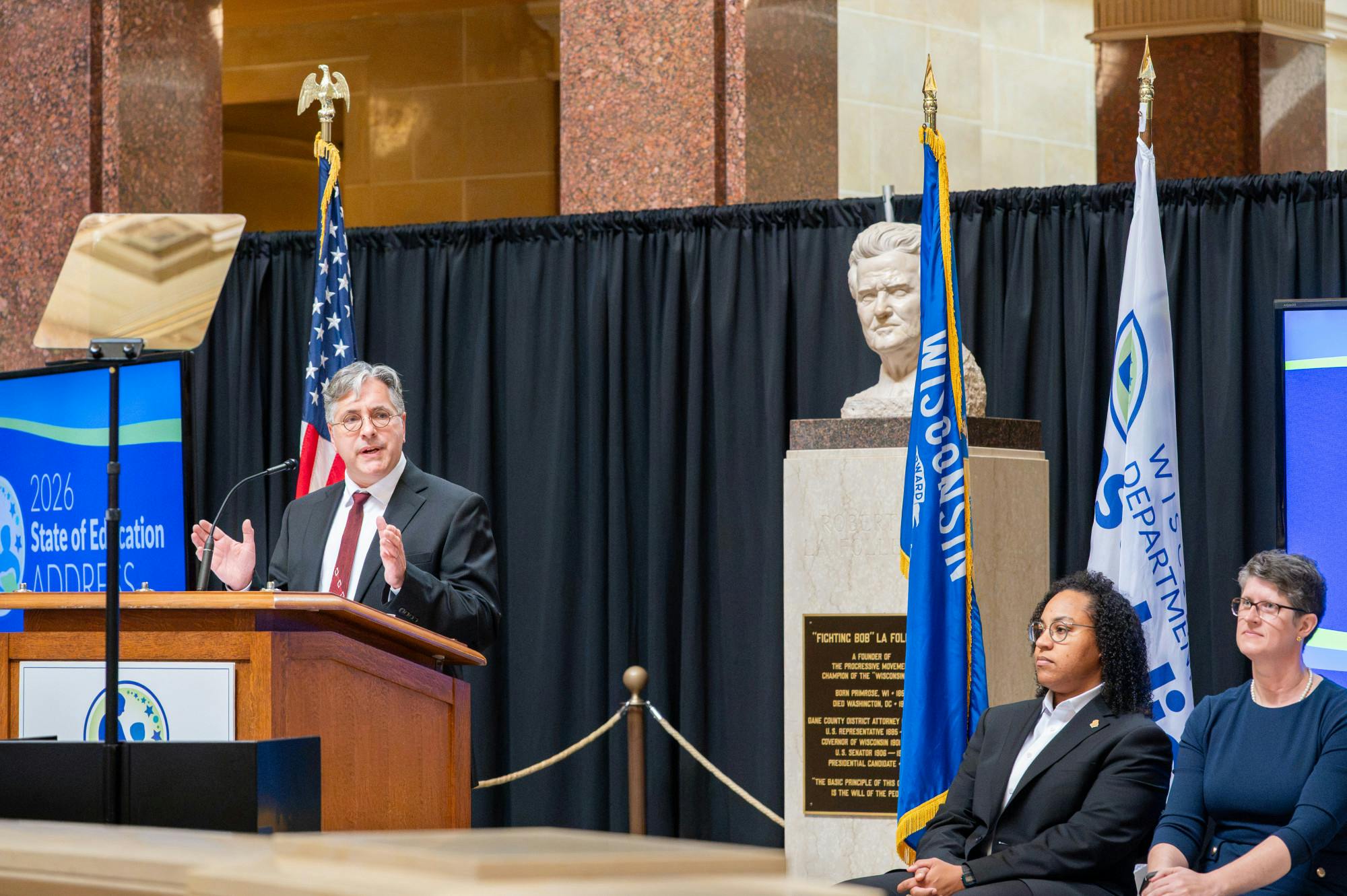
School can often be seen like a Shakespeare play. A comedy of errors, world defining events and the quest to discover your true identity all confined inside the walls of classrooms and lunchtime. It’s fitting then, that during Wisconsin’s annual State of Education address, among the many performances put on by students, high school seniors Lilly Goodwin and Charlie Holtman performed Shakespeare’s “12th Night,” a comedy of mistaken identities and love.
The performance was not only a homage to school’s great complexities, but also “a celebration of our students, our educators and the opportunities that we create together for every learner in Wisconsin” Tacara Lovings, the executive director of the Wisconsin Department of Public Instruction’s Office of Strategic Initiatives, said at the event.
Teachers also got their share of honors, with five Wisconsin educators receiving a “Teacher of the Year” award during the ceremony for their exemplary impact on students and education.
While the event celebrated the achievements of students and teachers alike, it also hung in the shadow of declining education budgets, school closures and the upcoming midterm election.
Jonathan Etter, a University of Wisconsin-Madison graduate and recipient of a 2026 “Teacher of the Year” award, was the first to touch on the issue.
Between encouraging teachers to be stewards to their students and the growing complexities of teaching in an age of social meda and AI, he also highlighted the growing divide between national policies and teachers.
“I would like to think, unlike in Prometheus’ case, spreading kindness and wisdom is not a crime,” he said. “But as I listen to the rhetoric of some prominent figures in American society and read in the national news about book bans, attacks on academic freedom and laws and policies that deny the rights and identities of some of our students, I fear it might be.”
This was a sentiment also echoed by State Superintendent Jill Underly, who highlighted the declining funding for schools and urged Wisconsinites to support pro-public schooling candidates during the midterm elections.
“For far too long, Wisconsin’s public schools have been forced to do more with less. And let me be clear: this was not an accident, and it was not inevitable,” Underly said. “The financial pressures schools face today are the direct result of years of deliberate political choices.”
Political choices, Underly said, like Wisconsin Act 16, which introduced limits to the amount of funding public schools could receive through state aid and property tax in 1993, and the decision to stop giving annual funding adjustments for inflation in 2009 which have limited the amount of funding schools can receive.
Both of these policies have helped force over 90% of schools in the past nine years to set referendums asking residents for budget increases, Underly said.
Something not every community has been willing to do, with referendum approval rates falling from 70% in 2020-2025 to 61% this past year.
This April, Hustisford School District failed to receive approval for a $3.75 million referendum from voters, forcing the district to cease operations and relocate nearly all of its 230 students to a neighboring school district.
Underly pointed to the closure as a severe case of schools becoming “casualties of partisan politics” and feared more closures might come if some politicians and voters continue to mistrust public schooling.
“Our schools are not the problem. Our teachers are not the problem. Our students are not the problem,” Underly said. “The problem is that we have asked them to carry the weight of decades of political decisions — and then blamed them when the burden becomes too heavy.”
Along with referencing the recent legislation on public schooling, another key theme of her address was the connection between America’s founding and public education.
“Wisconsin has always been a pioneer in public education," Underly said. “And that’s all because our founders understood, nearly 250 years ago, that public education is the infrastructure for democracy.”
170 years ago in 1856, Wisconsin became the first state to house a kindergarten within its borders, becoming the pioneer Underly referred to. Now over 3.4 million children are enrolled in kindergartens nationwide.
Yet Underly said public education infrastructure, without proper funding or democratic involvement, would start to unwind the very binding of the U.S.
“When public education is undermined, the institutions that helped keep our democracy strong for 250 years are weakened,” Underly said. “If we continue this, we won't have another 250 years of democracy… Democracy does not work without an educated public.”
Tying the two together, she ended her speech with a call to action for voters to stay informed about what candidates really support during the upcoming midterm elections and to “Look at their record. Not the campaign promises.”