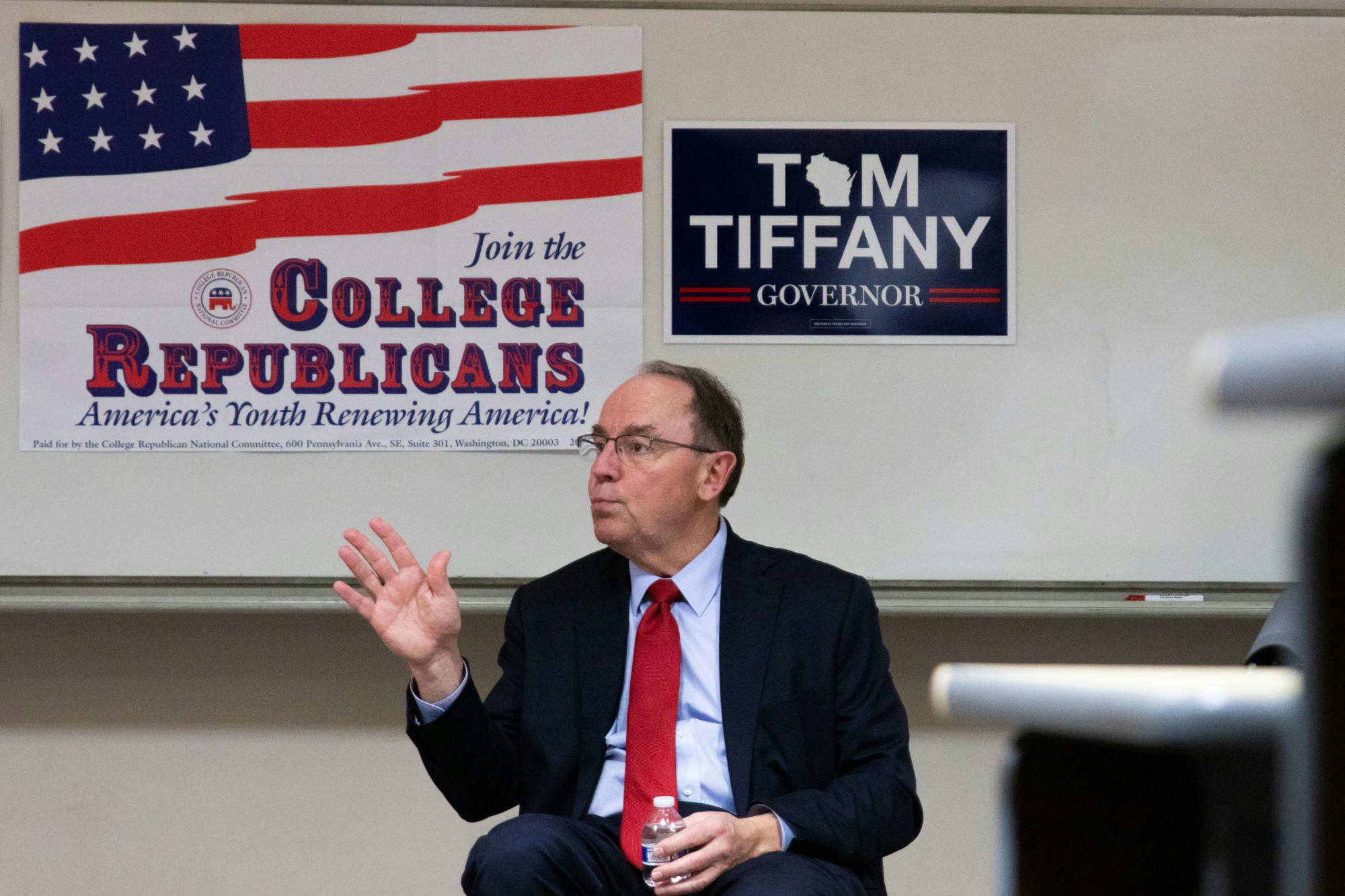
Republican gubernatorial candidate Tom Tiffany presents himself as a folksy, flannel-wearing populist running on a “common-sense” platform.
The home page of his campaign website reads, “As governor, he will fight every day for families, for farmers and for the hardworking people who make this state great.” As a former dairy farmer and current small-business owner, it seems Tom Tiffany is looking out for the little guy.
Yet the deeper one looks into Tiffany’s campaign finances, the harder his persona becomes to maintain. Despite claiming he will “take on the powerful,” Tiffany’s campaign has largely been funded by just three conservative billionaire megadonors.
The first of these megadonors is Diane Hendricks, who has given $9 million to the Wisconsin Republican Party this year, as of August. Hendricks is the owner of ABC Supply, one of the largest roofing supply companies in the U.S. With a net worth of around $24 billion, Hendricks is America’s richest self-made woman and the largest political donor in the state of Wisconsin.
The other two are Richard and Elizabeth Uihlein, the owners of Uline. As of August, the duo has donated a combined $28 million to the Wisconsin Republican Party in 2026. Together, they are the sixth-largest political donors in the 2026 midterm cycle, with $70 million total being donated to various political action committees and organizations.
One may wonder how it is legal for these individuals to donate such large amounts of money to political candidates. A 2014 U.S. Supreme Court ruling generated suspicion surrounding a Wisconsin law capping yearly political donations at $10,000, triggering Republicans to rewrite the state’s campaign finance laws.
Despite remaining caps on individual political donations in Wisconsin, a new loophole was created. Individual Wisconsinites are now allowed to donate unlimited amounts of money to political parties, which can thus direct the money to candidates.
Of the $16.8 million in contributions the Tiffany campaign has reported thus far, a little over $10 million has come from the Republican Party of Wisconsin.
From a small-d democratic standpoint, such large political contributions are incredibly concerning. If individuals can “buy” politicians and ensure they win, it follows that those politicians will reward their donors through policy implementation to “pay their debts.”
In other words, corruption.
Coincidentally, Hendricks and the Uihleins have benefited from policies enacted by candidates they funded — what are the odds?
In 2017, Ron Johnson, whose 2016 campaign was funded by the Uihleins, threatened to vote “no” on a Republican tax bill unless the tax cut for “pass-through” businesses was fattened. A “pass-through” company is one where profits flow through the owners, allowing profits to be taxed at the individual tax rate rather than on the corporate level — the exact structure of Uline.
Similarly, Hendricks has pushed Republican politicians to enact policies benefiting her business.
A clip from 2011 shows Hendricks asking then-Governor Scott Walker, “Any chance we’ll ever get to be a completely red state and work on these unions? And become a right-to-work? What can we do to help you?”
Clearly, the issue must have weighed heavily on Walker, as in 2015, he signed legislation making Wisconsin a “right-to-work” state, banning mandatory union membership and dues at privately owned businesses — such as ABC Supply — significantly weakening unions in the state.
Even if politicians are not specifically promising to enact policies that benefit individuals or their businesses, the existing campaign-finance laws create an environment where corruption can occur. If politicians wish to receive ongoing support from uber-wealthy individuals in their re-election campaigns, they are incentivized to help out their “friends" through their official actions. Wisconsin Republicans’ paths to power run straight through megadonors like Hendricks and the Uihleins.
More concerning is how the policies benefiting rich donors often come at the detriment of ordinary citizens who can’t give millions of dollars to politicians who will fight for them.
Every dollar that the Uihleins saved from the 2017 tax cuts was money that could’ve gone to SNAP or Medicare, or even tax cuts for the working and middle classes. The right-to-work legislation, pushed by Hendricks, weakened the bargaining power of unions, limiting their leverage to fight for better conditions and worker benefits.
The overwhelming presence of money in politics creates an extreme imbalance of power between the average voter and wealthy individuals. An ordinary person can tell their friends and family to vote a certain way, volunteer for a campaign and make a small donation. A billionaire can provide the entire financial foundation of a candidate’s campaign and pay for political ads that reach millions of people.
These wealthy activists are engaging in politics at a scale completely out of reach for regular people.
So when Tiffany says he will “take on the powerful,” can we believe him? The majority of his funds come from some of the most powerful individuals in the country. It seems implausible that, as governor, he will take action contrary to the wishes of his puppetmasters.
If he wins the governorship this fall, Tiffany will wield immense influence over the state budget, tax policy, business regulations, union rights and issues that concern all Wisconsinites — not just a few wealthy individuals. When decisions are passed by Tiffany, we are left to wonder if he acted to help Wisconsin or the small group of billionaires who carried him across the finish line.
Voters need to judge Tiffany, not by the character he plays in his ads, but by the people who made those ads possible. If our governor is to be a champion of the people, they can not be beholden to the interests of unelected plutocrats. By accepting contributions from billionaires, Tiffany likewise accepts their influence.
Wisconsin voters do not need to accept a government in which political power belongs to whoever can buy the most of it.
Brady Ahler is an Opinion Editor. He is a junior studying Political Science and Economics. Do you agree that politicians are corrupted by billionaire donors? Send all comments to opinion@dailycardinal.com