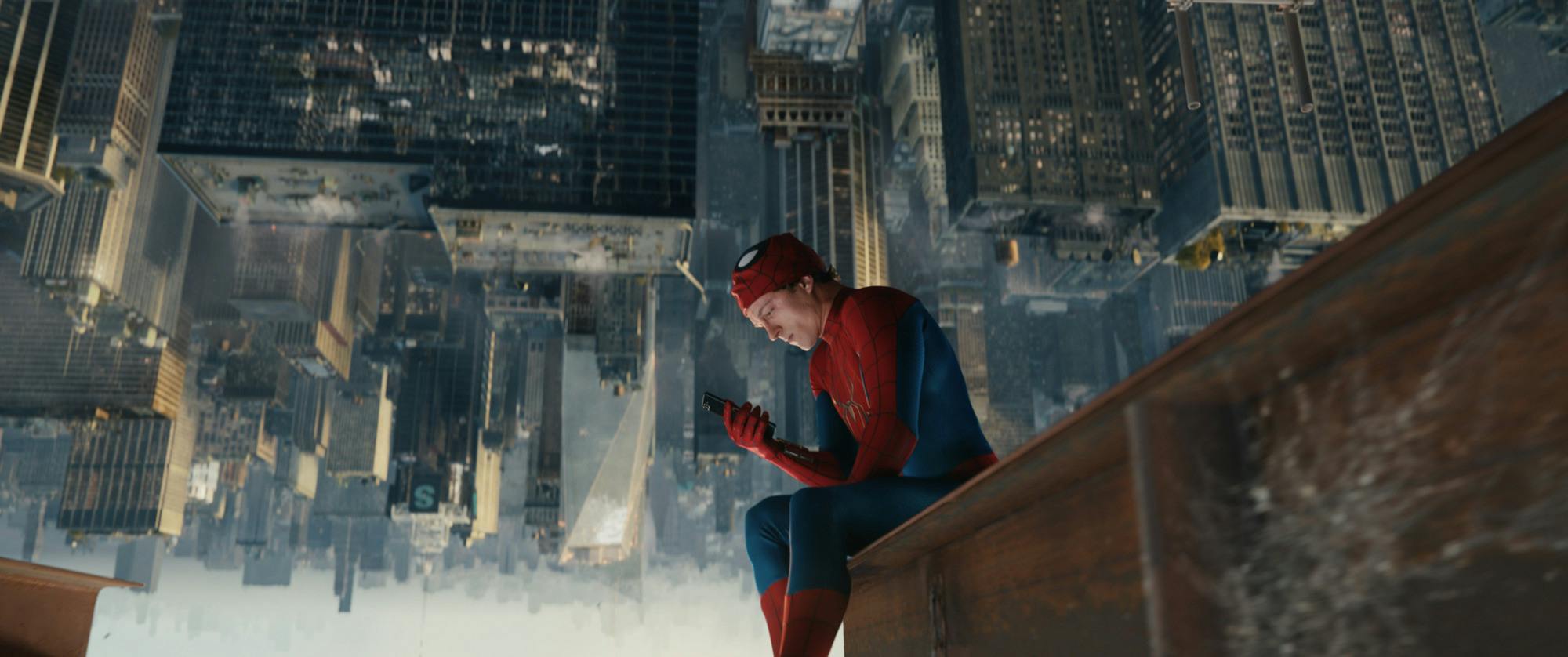
“Spider-Man: Brand New Day” is one of my favorite movies of the year so far. As I wrote in my review, it excels in its action, cinematography and acting. Not many things hold it back from being my favorite Spider-Man movie.
What I did not discuss was the movie’s inclusion of surveillance technology.
About halfway through the movie, Spider-Man is able to photograph the unknown — and until then, faceless — villain. Once he identifies the villain as Jean Grey, he hacks into every camera in New York City and runs a facial recognition algorithm to locate her, effectively engaging in mass surveillance.
This subtle moment quickly earned Spider-Man nicknames like “Palantir Parker” and “Peter Thiel Parker,” on social media. Palantir and its co-founder, Peter Thiel, have an ongoing relationship with the Department of Defense based on its AI software.
Upon my first viewing, I did not think much of it. It’s the most logical way for Spider-Man to track down Grey before she causes any more danger. But with everyday monitoring via companies like Palantir, Anthropic and Flock Safety only increasing reports of individuals improperly using the technology, Spider-Man’s blind acceptance and usage of mass surveillance was unacceptable.
“Spider-Man: Brand New Day” isn’t the first Marvel movie nor the first Spider-Man movie to contain some form of surveillance. Iron Man’s multiple AI assistants have access to the technology; his E.D.I.T.H sunglasses seen in “Spider-Man: Far From Home” give the user access to an entire satellite and the S in S.H.I.E.L.D might as well stand for surveillance.
Marvel’s previous reliance on surveillance has become somewhat of a blind spot for the studio, as they ignore the underlying issues that come with recording data. Some communities in Wisconsin have terminated contracts with Flock Safety because of growing concerns that the cameras were being misused, opposition to possible usage from the Immigration and Customs Enforcement agency and a feeling that “the company had been misleading about the capabilities of the technology.”
The University of Wisconsin-Madison is also reevaluating its use of surveillance technology; the university said they would not renew their contract with Flock Safety after their contract ended June 26.
The most dangerous aspect of mass surveillance is it eliminates any privacy in public spaces. When out in public, systems that can store facial recognition data allow government institutions and private companies to know what you are doing, where you are and who you are with. This technology is also subject to abuse and, when combined with AI systems, can lead to false arrests.
While Marvel has continuously leaned on and embraced mass surveillance, DC’s “The Dark Knight” from 2008 delivered a statement against it.
At the end of the movie, Batman uses every cell phone in Gotham City to create a complete sonar map of the city and its people to locate Joker. CEO of Wayne Enterprises, Lucius Fox, is against the technology the moment he sees it, citing that it is “wrong” and “too much power for one person.” His disapproval for the system is ultimately why Batman chose him to operate it and then destroy it. Both Batman and Fox knew how unethical it was, and it was only to be used as a last resort.
Although brief, “Marvel’s Spider-Man 2” from Insomniac Games does have a condemnation of surveilling New York City. When Spider-Man is given the blueprints for a drone used for receiving messages from citizens for the Friendly Neighborhood Spider-Man App, he condemns the use of the drone for any possible spying on New Yorkers.
“The Dark Knight” and “Marvel’s Spider-Man 2” allowed me to think about something I’ve never usually questioned. The ethical dilemma of mass surveillance is never brought up in “Spider-Man: Brand New Day” or any other Marvel movies when it should have been.
Thankfully, the MCU still has an opportunity to explore the problem in the future.
With Spider-Man creating a universal inhibitor that stops mutants from using their power, I could see an X-Men movie using the inhibitor and mass surveillance to hunt and imprison mutants similar to what is done in “X-Men: Days of Future Past.” A project like this would flip how Marvel has viewed mass surveillance, and it would draw connections to how ICE uses surveillance technology to determine immigration status.
When it comes to surveillance, “Spider-Man: Brand New Day” should’ve taken notes from “The Dark Knight” and “Marvel’s Spider-Man 2.” The MCU Spider-Man needed to be more like the Insomniac Spider-Man. This version of Spider-Man is someone who relies on both his allies and his community to learn about what’s happening in their city. The MCU’s Spider-Man is more than capable of doing this, but he takes a shortcut instead.
As Insomniac Spider-Man asserts, “We don’t spy on people.”
Andrew Holton is a junior studying journalism. Do you agree surveillance technology is becoming too prominent? Send all comments to opinion@dailycardinal.com