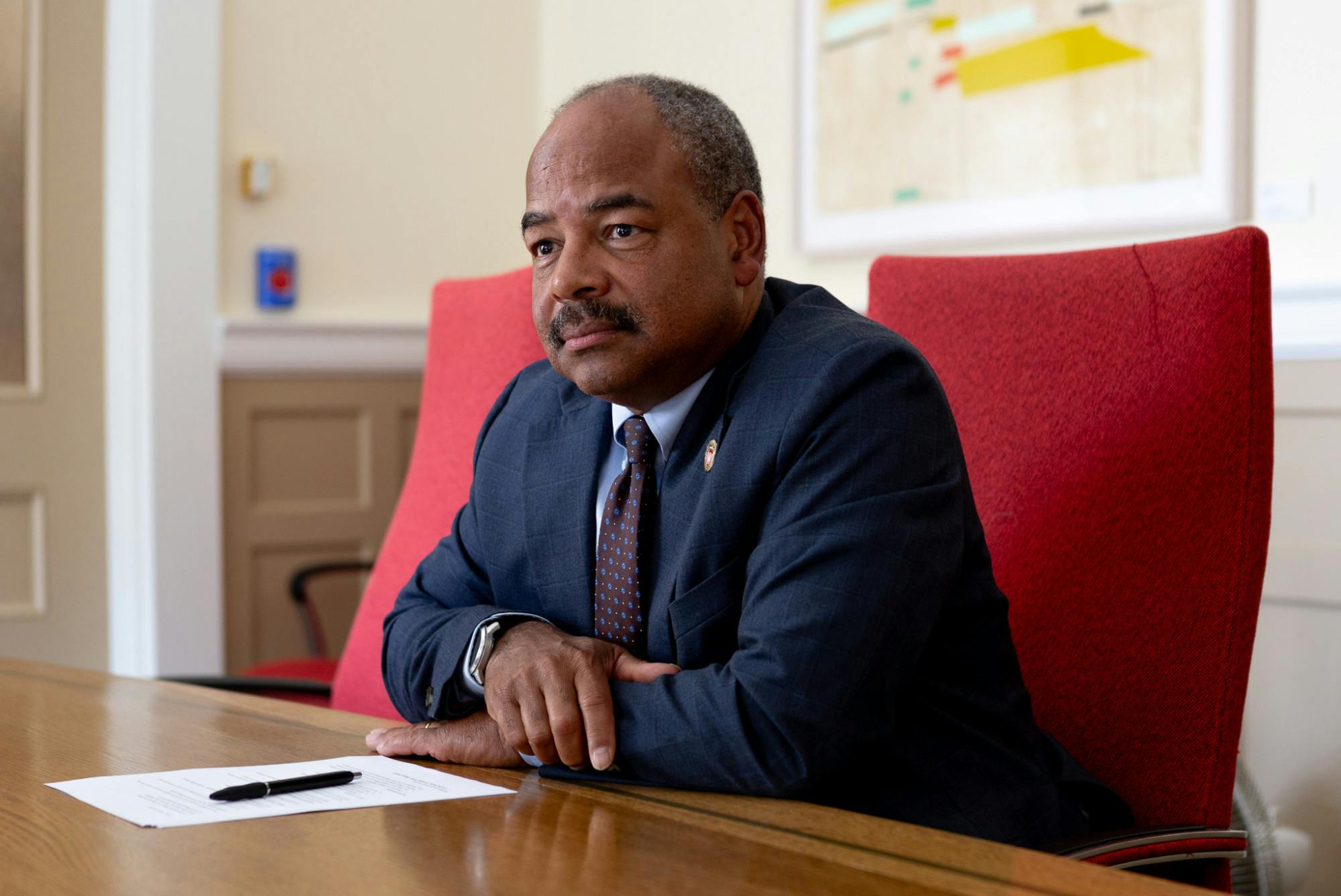
University of Wisconsin-Madison Interim Chancellor Eric Wilcots and Vice Chancellor of Student Affairs Lori Reesor discussed federal funding pressure, artificial intelligence and an update to the Wisconsin Exchange at a media roundtable on Bascom Hill August 27.
Wilcots spoke about how federal funding changes, international student visa changes and AI are affecting university operations. He promised an “unrivaled” student experience at UW-Madison with the university’s newly-announced “Forward Together” strategic framework.
Reesor, who oversees many of the student services programs on campus, talked student affairs — including refocusing the Wisconsin Exchange towards skillbuilding.
Federal budget cuts present challenges to university leaders
UW-Madison spent $1.93 billion on university research activities in the 2024 fiscal cycle, placing them fifth in the nation in research spending. Despite the increase in research expenditure, federal funding uncertainty for university research programs still remains a significant challenge, Wilcots said.
The total number of grants awarded to the university dropped 30% in 2025, and the university faced a 17% decline in federal funding in the same period — prompting a 5% campus-wide budget cut for all schools and colleges and a 7% cut to non-academic administrative units.
Wilcots said the university is “faring better than we feared,” but some trends — like seeing fewer, larger and more frontloaded grants from the National Institute for Health, the National Science Foundation and the Department of Energy — were “disturbing.”
The new federal behavior also means funds can’t go to as many projects because they're offered less often, tying up funds in a fewer number of projects and limiting research diversity. And though recent grants tend to be larger, the university is still receiving less money overall than it used to from the federal government.
“If you get an award, congratulations: you’ve gotten a grant from your agency,” Wilcots said. “It’s now carrying you for the next four or five years.”
Wilcots said leadership is paying close attention to funding and university congressional delegates are advocating the “importance” of federal support to Congress.
“We’ve got to make sure that we bring in the resources we need to do the work that we’re doing,” Wilcots said.
The cuts come as UW-Madison and the Universities of Wisconsin system are searching for a new chancellor and president, respectively, after the departure both earlier this year.
At a state level, the Senate president, Speaker of the House and governor’s position will change hands in the November election. The new state leadership will make decisions on the Board of Regents’ 2027-2029 budget request, which includes funding for a new UW-Madison residence hall and the Mosse Humanities demolition.
Wilcots said the upcoming shifts in leadership were “challenging” in part because of the unknowns associated with the “priorities” each new leader will have.
“We don’t know who the governor is going to be,” Wilcots said. “We don’t know, necessarily, what priorities that individual is going to bring… I think the system administration, the Chancellor [and] the Regents have a common commitment to higher education to advance the state of Wisconsin.”
Federal immigration challenges
In August, the Department of Homeland Security (DHS) published an across-the-board “duration of stay” rule, limiting international students to four years of study in the US. The rule is slated to come into effect September 15. UW-Madison is part of the Presidents’ Alliance, a group pursuing legal action against the DHS in an attempt to halt the rule change.
“It’s something we are against, and supporting legislation to try to target,” Wilcots said. “It’s something I’ve advocated with our congressional delegation as well — this is just not going to be good for the university.”
The interim chancellor said he “supports” international students, faculty and staff, adding the rule will have a “tremendous” negative impact not just for students, but also for the university’s ability to advance knowledge and support the local economy.
“We have to respond if it, in fact, gets put in place to best support our international faculty, staff and students,” Wilcots said. “We’re doing that work, and at the same time pushing back against [the rule].”
AI, community commitments and the student experience
In addition to coursework, Wilcots stressed experiential learning: “recognizing that not everything you do is in the classroom.”
This includes AI in education, which is changing the way students interact with course material both inside and outside the classroom every day.
Wilcots said “45 to 48%” of UW-Madison students participate in undergraduate research, and campus research could be a way for students to have a hand in how AI is “advancing different technologies and different domains.”
“There’s going to be folks from astronomy, into the creative spaces, to medicine and everything in between who are using AI to advance discovery,” Wilcots said.
A working group of university leaders have been studying AI “competencies” — looking to address how AI is used throughout the university.
“My hope is that by doing that fully, we become a leader in this space and [AI] is just part of who we are as an institution,” Wilcots said.
Wilcots said he himself does use AI on occasion — calling the technology a “useful tool” in research settings.
Wilcots also discussed the Badger Way Strategic Framework, a campus-wide initiative aimed to help UW-Madison administration find shared goals, challenges and a university mission. Rather than a concrete plan, campus leadership called it a guide for campus work.
“We want to make sure we’re doing research that has a positive impact — both in, not just some of the direct work that we do, where you have a discovery and it immediately has some use out in the world — but also thinking about some of the work that we’re doing in the humanities and the social sciences that fundamentally can just be inspirational,” Wilcots said.
Vice Chancellor of Student Affairs Lori Reesor said a new focus of the Wisconsin Exchange — the overarching UW-Madison initiative "committed to fostering vigorous discourse” — will aim to teach students respect, relating to one another and collaboration.
Under the strategic framework, the university plans to encourage students to respect, relate and cooperate with one another, pillars Reesor said UW-Madison borrowed from Interfaith America’s mission.
“We had a number of staff that went to Interfaith America — which is a national program that started from helping people understand differences across religions and faiths,” Reesor said.
Reesor said the change will place a greater emphasis on skill-building and allowing students who don’t want to engage in “political” conversations — such as immigration or abortion — to “learn how to have hard conversations about things that may not be controversial or political.”
“Take that in the residence hall or take that in your classroom — that you may think, ‘oh, this person I don’t agree [with], but if we can respect each other, we can still work on a class project together,” Reesor said.
Reesor said the program could address political topics in nature — but wants it to help students build “life skills” that she says could make them “more marketable when they go out for jobs,” potentially culminating in a certificate.
“Political science majors love this stuff,” Reesor said. “But we want it to be broader than that, because again, if you’re a nurse, if you’re a teacher, all these things are going to impact whatever your world is.”
Ted Hyngstrom is a staff writer. He formerly served as the Podcast Editor, and has covered a variety of city and campus issues. You can follow him on X at @NuffTed.