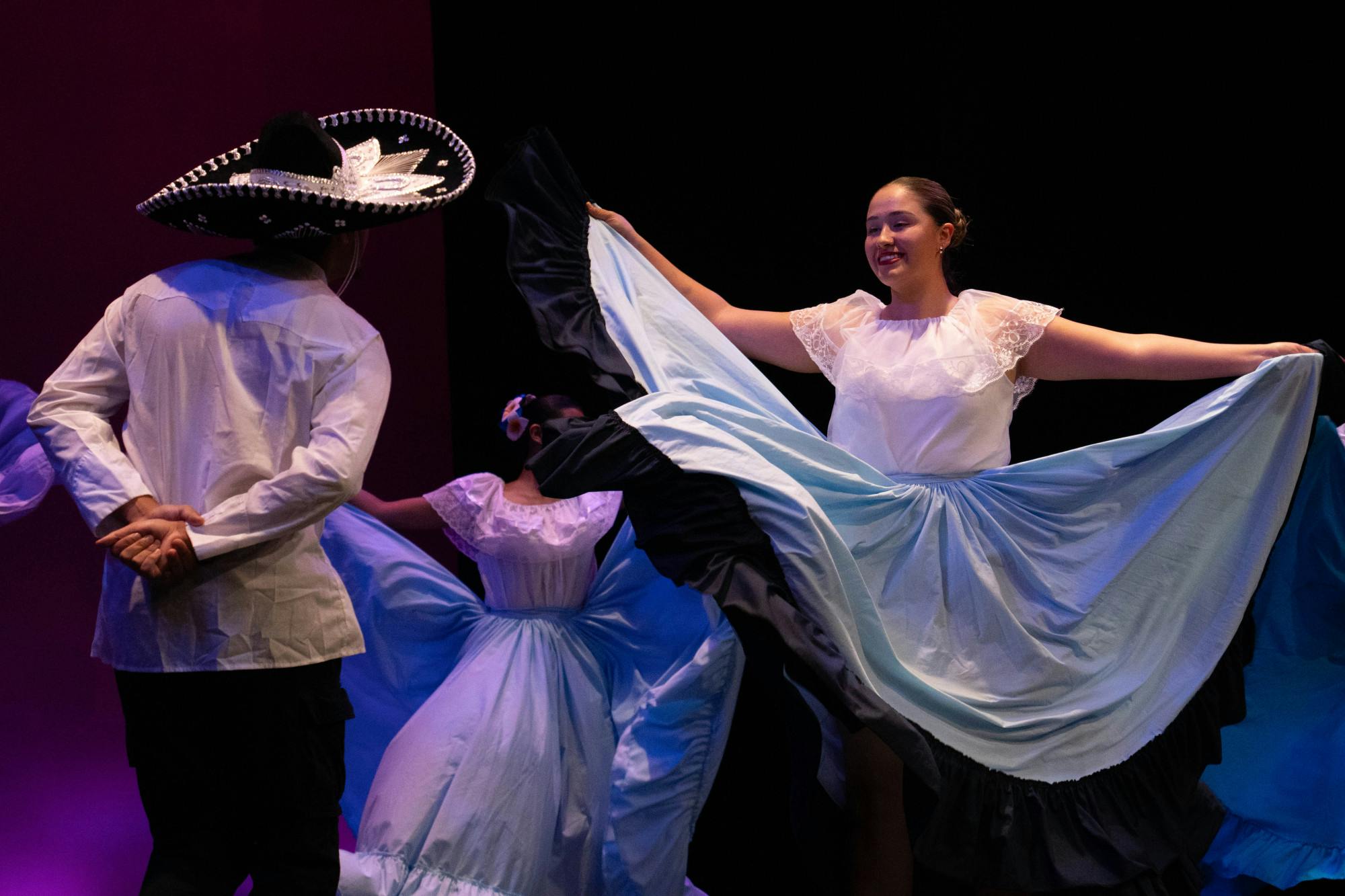
Twenty-one multicultural dance groups and Greek organizations performed at the University of Wisconsin-Madison’s 44th annual Multicultural Orientation and Reception (MCOR) festival to a crowd of hundreds in Shannon Hall Friday evening, showing off dance covers, original skits and hip-hop dances to bass-boosted Bollywood songs.
The cultural showcase is the Multicultural Student Center’s (MSC) largest event and a Welcome Week campus fixture. This year, Wisconsin Union sponsored the event, Claudia Guzman, Director of Programs for the Center for Student Success and Belonging, told The Daily Cardinal.
“What I say about MCOR is if you build it, they will come,” Guzman said. “We create this infrastructure, and really it's just a platform for all of these student organizations to be able to be in the spotlight. We obviously could not do it without them, and every year it comes together really beautifully.”
Multicultural Greek organizations made up around half of performing groups, while others included Wisconsin School of Bhangra, K-pop cover groups VIVID Dance Crew and KASPER Dance Crew and the Vietnamese Student Association.
Sigma Psi Zeta Sorority members matched in bright red jackets for their step and stroll performance, a percussive dance rooted in HBCU sorority and fraternity culture. Aadya Deshpande, stroll captain, told the Cardinal MCOR is one of the largest events of the semester for the sorority.
“Whether you're performing or you're just coming to watch, [MCOR] is a great bonding opportunity,” she said. “I think everyone should come to at least one of them in their time here.”
Many of the student groups organized their performances on a tight runway of one to two weeks, waiting until their members returned to campus from summer vacation.
“It's a big time crunch,” Deshpande said. “Also, making sure the sorority sisters are hyped and ready, excited to do it and not stressed out. I think having those skills to bring up the energy of a group is really important. I feel like I've gained that through [MCOR].”
African Students Association (ASA) Dance Team members wore high school uniforms for an energetic part-skit part-dance performance, which included the Scuba move, boys and girls dance-offs and drawing their “teacher” into their final dance.
Kofo Aminu, an ASA member who helped choreograph the dance, told the Cardinal the performance pays homage to the African diaspora.
“We want to appreciate our homeland… but we also wanted to shout out the cultures that were pioneered by Africans enslaved around the world,” Aminu said. “There was a little bit of Scuba, a nod to our African American cousins; a nod to our cousins in Latin America with our salsa moment. We just wanted it to be a big shoutout to Africans and Black people globally.”
While choreography is new to her, Aminu said she’s been doing African dance for most of her life.
“It's a huge part of our culture to dance,” she said. “That’s how we were able to put together this team of super talented dancers, because so many of us grow up with it that it just becomes par for the course, almost an everyday thing.”
Elizabeth “Lizzy” Santos, captain of the final act Fuego Dance Crew, told the Cardinal she assembled the list of songs over the past year. The team danced to a collection of songs, including the reggaetón remix “Fuera del Planeta” by Eloy and Randy Nota Loca.
Santos has been dancing since she was seven years old and choreographing since her junior year of high school. She explored several dance organizations her freshman year, and eventually chose Fuego Dance Crew because she enjoyed their performances and “tight-knit community” where “everyone just kind of clicks instantly through dance and through our identity — a majority of our team members are of Latino background.”
“[MCOR] is one of our biggest performances of the year, so being able to make our presence known on campus right from the start of the semester is super important to us,” Santos said. “We want to let people know that there is a space for them if they're of Latino background, if they're not, if they just love to dance [or] if they want to learn how to dance.”
UW-Madison formed MSC in 1988 as the result of a committee group’s recommendations to improve campus race relations. The center principally focuses on students of African-American, American Indian, Chicano, Asian American and Puerto Rican descent, according to its website.
Guzman said that the over 100 student organizations affiliated with MSC are “dual-affiliated” with MCOR and can apply in the summer to perform in the festival. Student groups are required to submit a brief video of a past performance.
“We always like to start with a big splash, end with a grand finale,” Guzman said. “For the most part, I would say just about everybody who applies does get confirmed.”
Every organization submitted an audio file, selected their stage lighting and participated in a six-hour dress rehearsal the day before the performance.
Michelle Drane, an operations intern at MSC, manages the front desk of all of the centers in the Red Gym. She’s been working with MSC for three years: “I enjoy how I feel in the spaces and the people I meet there,” she said.
“As somebody that comes from a marginalized identity, it was very hard to find a place where I belong on campus, especially being one of the only minorities on my floor in the residence hall,” Drane said. "I'm from Milwaukee… I've always interacted with very diverse communities. Coming here, it was just kind of limiting.”
Throughout the next few months, MSC will host staggered student welcomes for minority groups, according to Drane.
Since 2025, the MSC has fallen under the Center for Student Success and Belonging, which also includes the Asian Pacific Islander Desi American Student Center, Black Cultural Center, Disability Cultural Center, Gender and Sexuality Campus Center, Office of Inclusion Education, Indigenous Student Center, Center for Interfaith Dialogue and Latine Cultural Center. The centers have tabled together at outreach events for the past two years, according to Darcy Wittberger, a UW-Madison spokesperson.
“It's another way that we can expand our access to people by collaborating in existing other departments on our campus,” Drane said.
Since the organizational shift, MSC has shared its staff across centers, Wittberger said: for example, staff at the Black Cultural Center also work for the Disability Cultural Center and Center for Interfaith Dialogue. Wittberger added that some student services under the Center for Student Success and Belonging, including First-Generation and Limited-Income Services, the McBurney Disability Resource Center, and University Veterans Services continue to table separately to "connect students with their specialized services and resources."
Wittberger said MSC's event programming could change as a result of the organizational shift, continuing to support "student learning, engagement and community-building" while incorporating "more opportunities for intercultural education, leadership development, dialogue and community engagement."
“UW-Madison is a [predominantly white institution], and so when we get to come together as people of color and show who we are and what we're made of and how we contribute to the fabric of this community, it's everything,” Aminu said. “I'm just very grateful.”
Sonia Bendre is the campus news editor for The Daily Cardinal. You can reach her at sonia.bendre@dailycardinal.com.