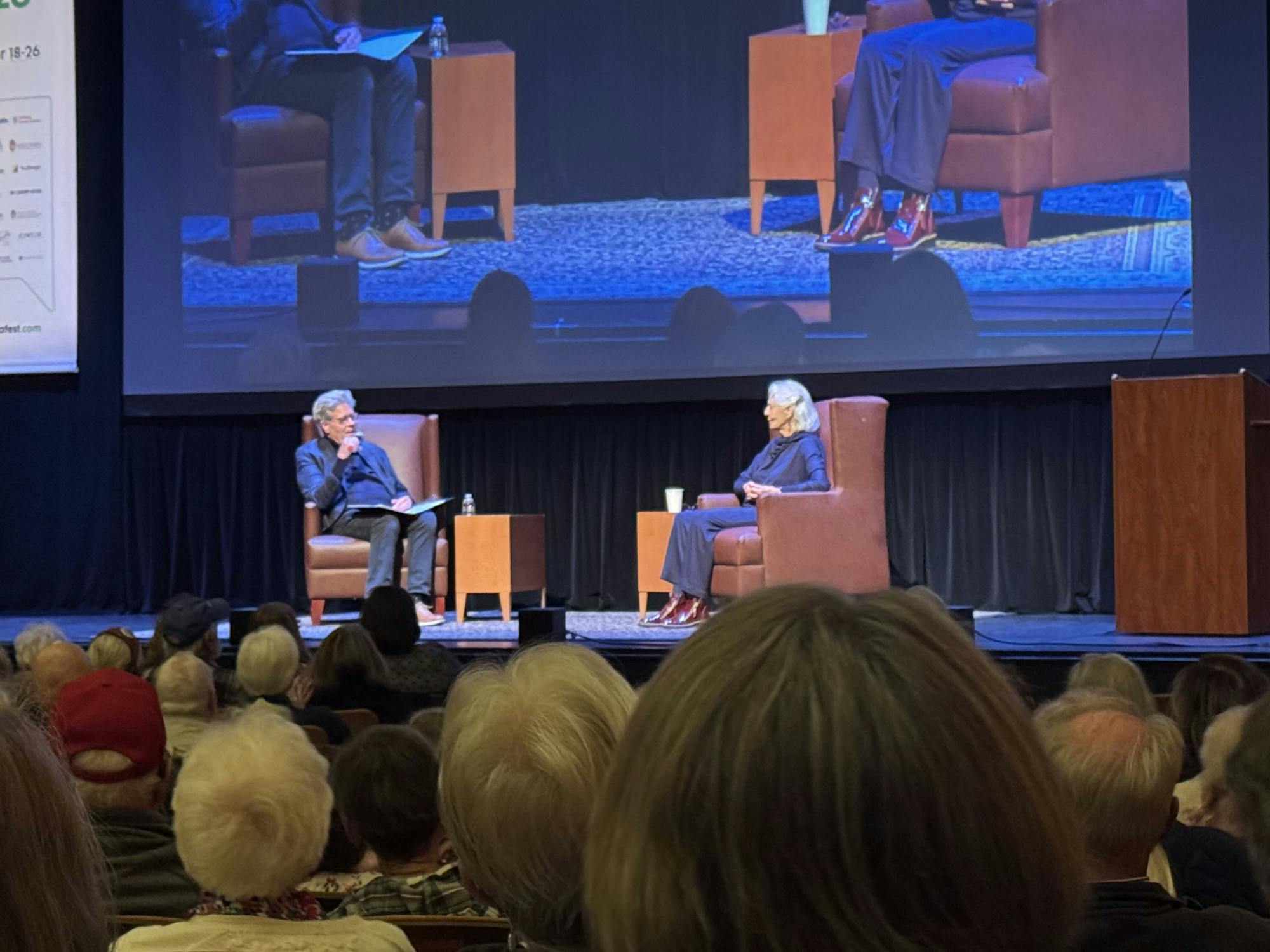
Award-winning actress Jane Alexander sat down for a mediated conversation with Pulitzer-Prize winning journalist David Maraniss at the 10th annual Cap Times Idea Fest, expressing concern over the arts while remaining hopeful for their future.
As an actress, former chairwoman of the National Endowment for the Arts (NEA) and activist for the arts and the environment, Alexander told Maraniss about the importance the arts hold while addressing threats at the Idea Fest between Sept. 18-26.
Alexander starred in six plays at the Kennedy Center, and said she formed a close relationship with producer and founding chairman Roger Stevens, whom President John F. Kennedy appointed to develop the center in 1961.
Maraniss asked Alexander how she felt about the recent political turmoil surrounding the Kennedy Center — President Trump closed the center’s doors earlier this month for the first time in 50 years and against a judge’s orders, citing repairs.
The Trump Administration said they would demolish the performing arts center if Trump’s renovation project doesn’t pass in court.
“It’s heartbreaking,” she said. “I love the Kennedy Center. I love the Eisenhower Theater. I just am praying every day that it is not torn down because it doesn’t need to be torn down. It’s fine.”
This warning wasn’t the first threat to the arts in Alexander’s industry experience. As NEA’s chairwoman between 1993 and 1997, Alexander presided over “massive budget cuts” for the agency, according to its website.
The NEA gives grants to art programs of all types, like dance and theater companies, Alexander said.
Alexander said the NEA and the National Endowment for the Humanities were at the top of the Republican-controlled Congress’s “hit list.” She went to all 50 states to convince people how important the NEA was to keeping the arts alive.
“We were in the trenches for four years, fighting for that agency to stay alive,” she said. “And the American public, including Madison, Wisconsin, came out for it.”
Maraniss asked about her leadership during a “very contentious period” and what similarities are seen today.
“It’s much worse today because we have one person calling all the shots at the top,” Alexander said. “I don’t think the American people really know what the NEA does for them in their backyards.”
During Alexander’s time in the NEA, individual artist grants were eliminated by Congress. They have since not been reinstated, according to the list of grants on their website. Alexander said the one thing Congress did not get rid of was the literary grants.
“Isn’t that how a revolution starts?” she asked.
Alexander said the chairwoman position wasn’t a job she wanted at first, and someone else had put her up for nomination. She decided to take the position because her Tony award-winning play, “The Great White Hope”, started from a $25,000 NEA grant in 1965 to “explicitly bring in more diversity, mainly African-American, to the theater.”
The Great White Hope was based on a true story about Jack Johnson, the first African-American heavyweight champion, who defeated a retired former champion White boxer James Jefferies— known as the Great White Hope. Johnson’s win sparked deadly racially-motivated riots all over America.
The cast was composed of 63 actors playing 205 roles, around half of whom were Black, according to Alexander. She said the cast of a play during this time period had “never been equal.”
Alexander said “The Great White Hope” brought more Black people in the community out to the play, contributing to diversity in the arts.
Maraniss asked Alexander how she keeps her hope alive during the current troubles facing the arts.
Alexander referred to a saying her mother used to tell her: “‘This too shall pass.’”
“It’s given to us to overcome and to find ways to better the world, believe it or not,” she said. “And that’s my undying belief.”