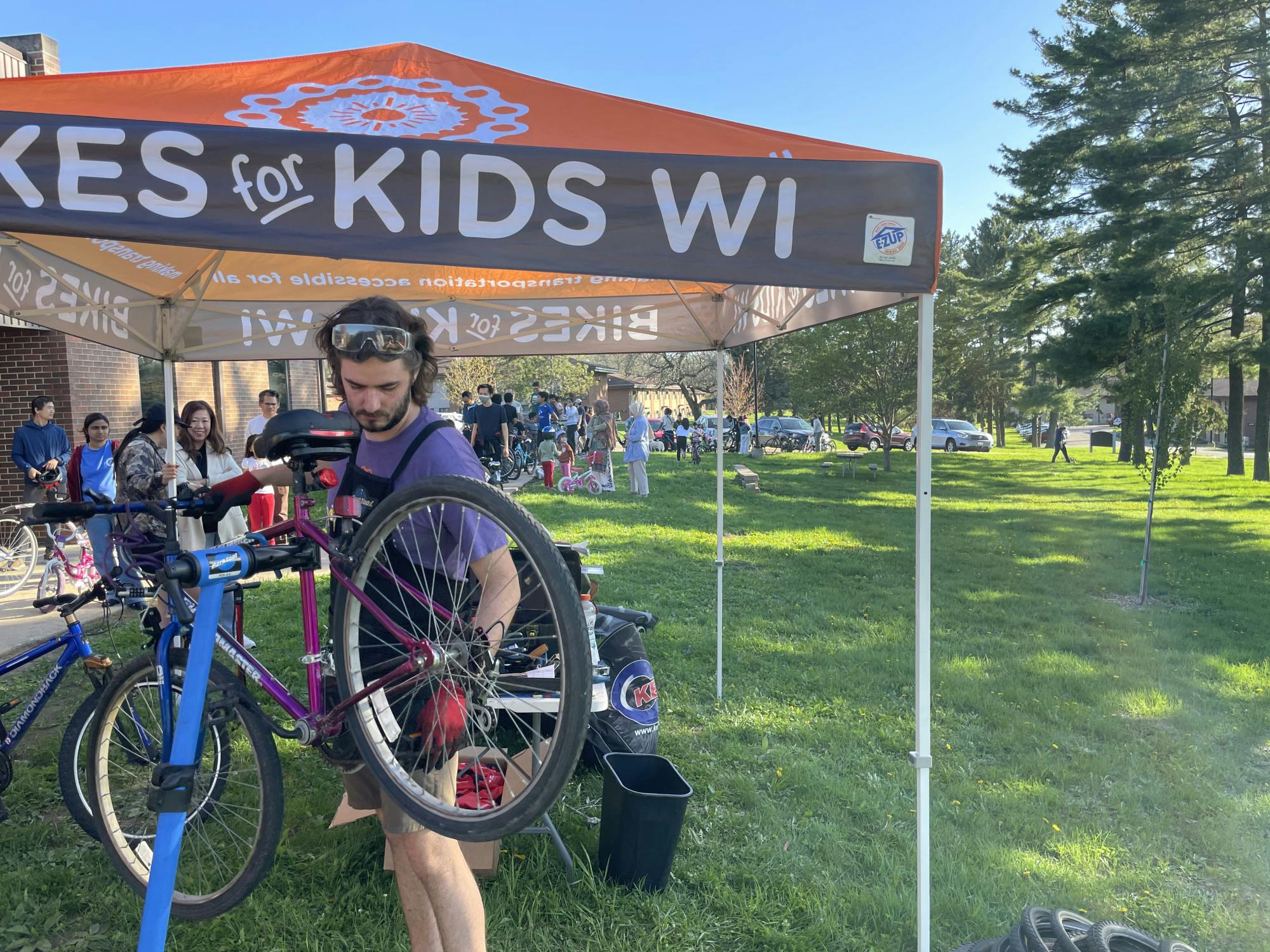
On a sunny, mid-60s Friday afternoon in Madison, Wisconsin, Mar is getting her bike fixed. During her 20s in Costa Rica, Mar would mountain bike everywhere. Now, as a resident of the Eagle Heights community, Mar’s bicycle connects her to the University of Wisconsin-Madison campus and the city of Madison as a whole.
In Madison, a bike is the key to the city. Designated as a platinum “Bike-friendly” community by the League of American Bicyclists, bike lanes, commuter paths and ample bike racks make not owning a car a reasonable reality in the city.
“It really is my independence because we don’t have a car,” Mar said. “The bus is pretty good, but with the bike, I really don't have to wait for anything.”
Mar is part of the estimated 30-40% of Dane County residents who do not drive a car. In the City of Madison, that percentage is over 40%.
Owning a bike won’t save you from mechanical difficulties, but Bikes For Kids Wisconsin provides Dane County with a myriad of resources. Bikes for Kids is a non-profit organization whose mission is to, “increase the use of bicycle-based transportation for underserved communities through access, low-cost repairs and education.”
“We're working to make sure everyone has access to a bicycle,” Kristie GoForth, executive director of Bikes for Kids and advocate for underprivileged communities told The Daily Cardinal. “We view bicycles as far more than just fun or recreational. We see them as a tool for economic mobility.”
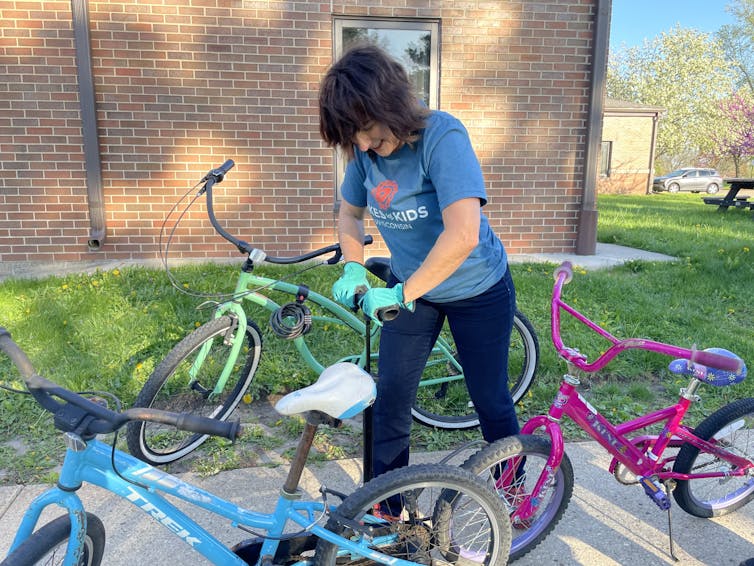
GoForth inflates a child's bike tire during a Bikes for Kids event at Eagle Heights Community Center.
GoForth joined Bikes For Kids in April 2020, when it was still called Free Bikes 4 Kidz Madison. GoForth said she immediately had ideas for expansion.
Since GoForth’s arrival, Bikes for Kids Wisconsin has expanded from the City of Madison to give away free bicycles to both children and adults throughout Dane County. GoForth told the Cardinal the pandemic was a key factor in forcing that organizational pivot.
“That first year we ended up giving 1,101 bikes away, almost all to essential workers,” GoForth said.
Freddie, a Madison nurse’s assistant, is one example of Bikes for Kids service. Before Bikes for Kids stepped in with a new commuter bicycle, Freddie rode a Razor scooter an hour and a half both ways to work in the COVID wing of St. Mary’s Hospital.
“They [Freddie’s co-workers] gave that to him, and he was just tears streaming down his cheeks saying, ‘nobody's ever done anything this nice for me.’ It changed his life,” GoForth said.
Freddie could now get to work in 20 minutes and stop at the grocery store on the way home. Thanks to Bikes for Kids, Freddie is an example of what transportation equity looks like in practice.
The Greater Madison Metropolitan Planning Organization (MPO) is just one organization responsible for Madison’s strong bicycling infrastructure. The Greater Madison MPO has access to federal funding streams and to access them, proposed transportation plans must further their goal to “balance roadway, public transit, bicycle, pedestrian, and other transportation needs to achieve an exceptional quality of life for all in the Greater Madison area.”
Benjamin Lyman, a transportation planner at Greater Madison MPO, works on administering a few of the federal initiatives. One is the Transportation Alternatives Program, which funds projects that improve bicycle and pedestrian facilities and infrastructure. Another is the Surface Transportation Block Grant Program, which administers roughly $10.5 million to roadways, pedestrian paths and busing infrastructure.
For any project up for review, Lyman and the Greater Madison MPO apply a scoring system. Many factors are included in the score, including if the project will result in equitable transportation.
“We made some adjustments in 2019 and 2020 and again in 2021 and really looked more at historical underinvestment in a lot of our neighborhoods at a regional basis, not just within the City of Madison,” Lyman told The Daily Cardinal.
According to Lyman, projects could score better if they connected those underrepresented neighborhoods to employment opportunities or other areas of the city. Those underserved areas were determined through a multitude of factors, like income-level, race and ethnicity. Lyman told the Cardinal that because of new federal restrictions on how their funds can be appropriated, that criteria may have to change.
The Trump administration’s executive orders targeting DEI prohibit federal funds from going towards any program that uses race or ethnicity as a criteria for review. For the MPO, this means they cannot consider the racial demographics of a community being impacted in a proposed plan to insure project approval. According to Lyman, the MPO instead focuses solely on economic elements of a region, such as income, education and access to a vehicle.
Lyman also said that he doesn’t anticipate the shift in criteria having a noticeable effect on where and how funds get used.
“We are doing our best to serve the people of our planning area and of Dane County and to ensure that the people who are transportation disadvantaged reap the benefits of our investments,” Lyman said.
Another way the Greater Madison MPO is meeting the transportation needs of its region is the RoundTrip program, aiming to cut down on single-driver commuters by connecting people to alternative transportation resources.,
Zia Brucaya, RoundTrip’s Program Manager for Greater Madison MPO, takes Bikes for Kids’ transportation equity mission one step further.
“We really provide a one-stop shop for people to come learn what their transportation options are in Dane County and then connect [them] with information and resources to support them in using those different modes of transportation,” Brucaya told the Cardinal.
Brucaya said administering the RoundTrip program gives her a unique perspective on the existing transportation network.
“We are relying on communities to be implementing public transit, bicycle networks and safe pedestrian networks so that these options are appealing to people and actually accessible to them,” Brucaya said.
At Bikes for Kids Wisconsin, GoForth and her team are hoping to make it easier for people to connect to those alternative transit networks. For the past two years, they have had help from Badger Volunteers, a semester-long program from the Morgridge Center for public service connecting badgers to community organizations. The volunteers at Bikes for Kids learn how to do basic bike repairs and help organize the 12,000-square-foot warehouse.
“It makes me feel like I'm doing something important and gets me away from my schoolwork and actually involved in the community,” Avery Damel, a UW-Madison senior and volunteer with Bikes for Kids Wisconsin, told the Cardinal.
Damel participated in the annual Spring Bike Giveaway on April 11. The organization gave away 1,200 bikes at the event.
“It was cool seeing one of the kids get on a bike and it fit perfectly and they were just smiling and like riding around the parking lot multiple times,” Damel said.
For GoForth, that 1,200 number is around the maximum they are able to provide for right now. “In 2024 we gave away 2,435 bikes and it almost killed us,” GoForth said.
With less time and resources spent on bike repair, Bikes for Kids can focus on the other aspects of their goal.
The organization’s latest project is their “Meals on 2 Wheels” program. Launched on June 2nd, the program aims to connect community members and reduce emissions on “last-mile” food delivery.
“Being an executive director of this organization is an incredible gift to me because I get to see the generosity of people every single day,” GoForth said. “It just blows my mind.”