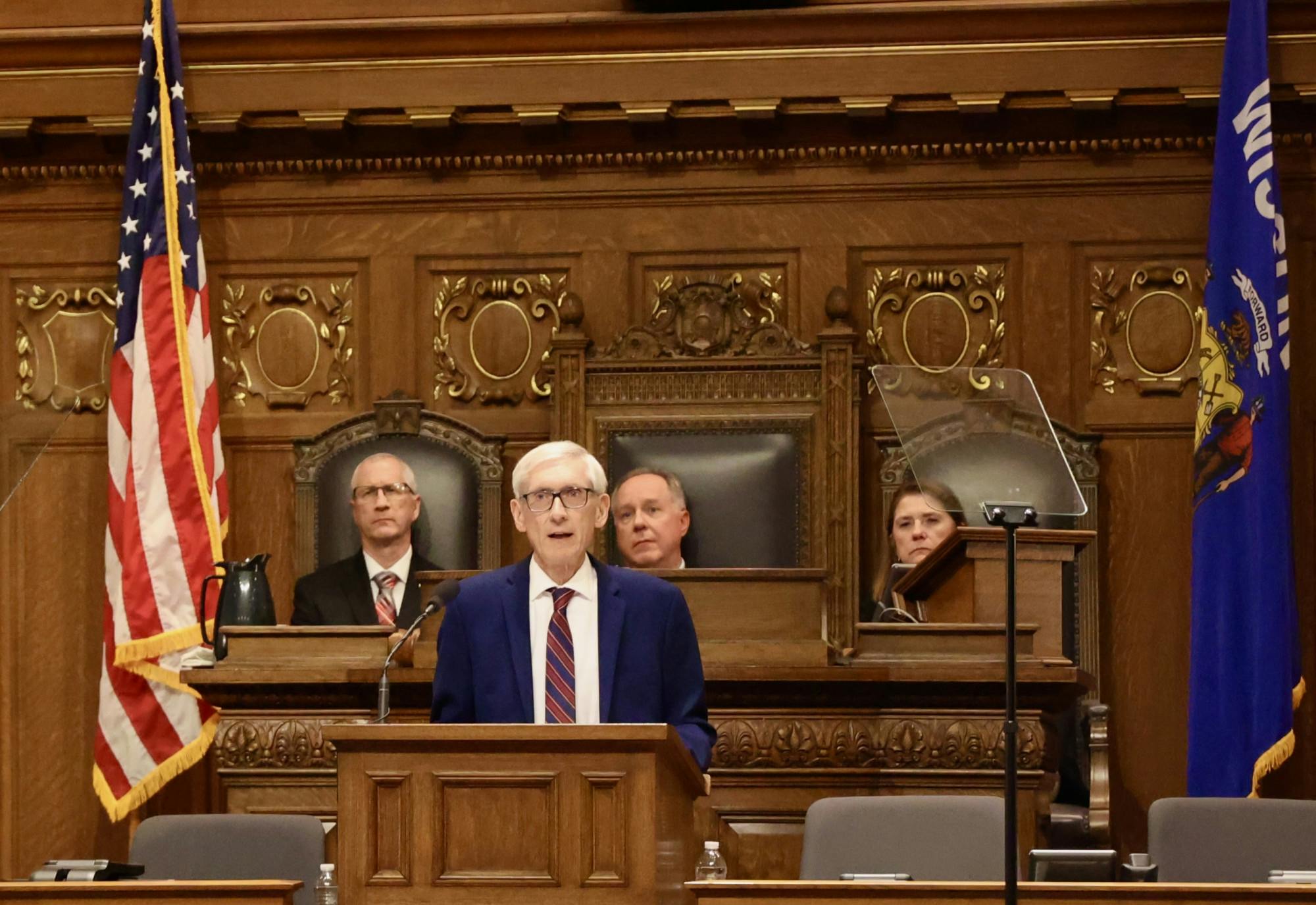
A $1.8 billion spending agreement backed by Gov. Tony Evers and Republican legislative leaders failed to pass in the Senate last month, despite polling showing overwhelming public support.
The package, negotiated by Evers, Senate Majority Leader Devin LeMahieu, R-Oostburg, and Assembly Speaker Robin Vos, R-Rochester, would have increased funding for special education and technical colleges while providing tax relief through payments of $300 to individuals and $600 to married couples.
Evers praised the agreement after its announcement, stating that the leaders were able to “put politics aside” on a plan that uses a portion of the projected $2.37 billion surplus to “do the right thing for Wisconsinites across our state.”
Throughout his two terms, Evers has championed financial support for working families and public education in his budgets, particularly through his declarations of the Year of the Worker in 2024 and Year of the Kid in 2025. He also strongly committed to tax cuts in his 2026 State of the State address for the Year of the Neighbor.
Despite this support, the bill failed after an analysis by the Legislature's nonpartisan budget office found it would have created a $2.9 billion deficit at the end of the 2027-29 biennium.
Controversy surrounds the deal as Evers, LeMahieu and Vos all retire at the end of this term. If the deal had passed, the three lame-ducks would then leave the deficit with the new governor, legislative leaders and budget next year.
In the 18-15 vote, three Senate Republicans joined Democrats on party lines to curb the deal.
Gubernatorial candidate Sen. Kelda Roys, D-Madison, who voted against the proposal, said the Fiscal Bureau’s analysis heavily influenced her vote.
“Our job is to make responsible long-term fiscal decisions for the state of Wisconsin,” Roys told The Daily Cardinal. “You don’t spend money before you know how much you have.”
Roys added that economic uncertainty at a national level played a part in her decision, saying that rising costs amidst international conflicts make it “very difficult to plan as a state lawmaker.”
Since the beginning of the Iran war in February, prices have skyrocketed for Americans, including gas, energy, flights and other fuel-related expenses.
After the bill failed to pass, a Marquette Law School Poll found that roughly 80% of Wisconsinites supported the agreement — including 77% of Republicans and 82% of Democrats.
The question given to respondents outlined the bill’s appropriations but did not mention its potential to leave Wisconsin’s budget in the red.
Roys believes the poll’s results may have been different if it included the findings of the Legislative Fiscal Bureau, and said the poll was not conducted in a “responsible and truthful way.”
On June 4th, Sen. LeMahieu released a statement citing the poll’s findings. He urged two more Senators to “stand with the 80% of Wisconsinites who support [the] compromise.” Because much of the Senate is currently focusing on campaigning for the midterm elections in November, it’s not likely two senators will raise their hand to re-vote and pass the deal.
Although the proposal failed, Roys said Senate Democrats are “eager and willing” to negotiate a deal with a smaller price tag, particularly one focused on education.