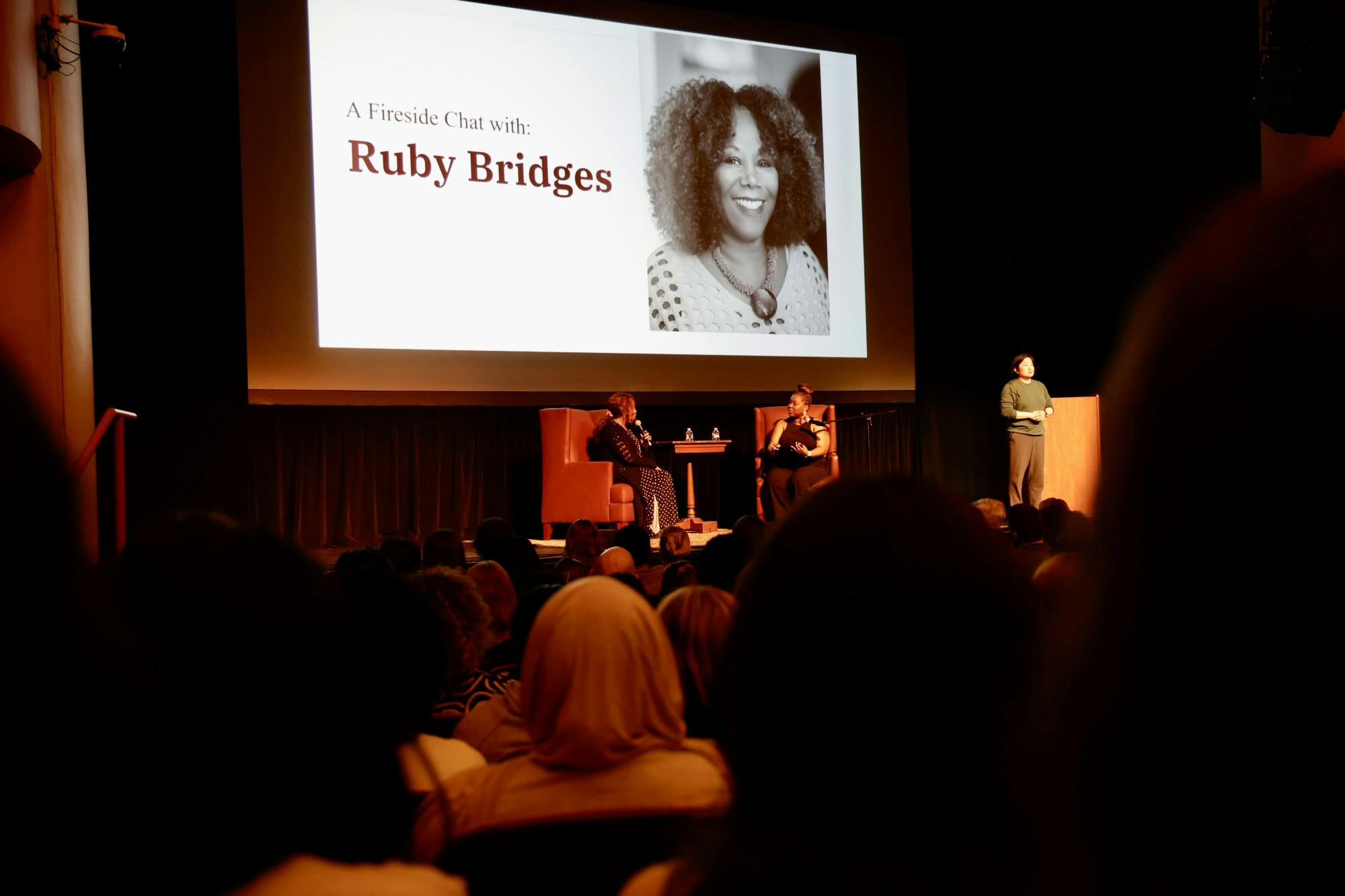
American civil rights activist Ruby Bridges shared her experience as the first African American student to integrate into a white-only school in Louisiana at a sold-out, moderated Q&A lecture in Memorial Union’s Shannon Hall Wednesday.
The event was moderated by assistant professor of higher education Airedale Rodgers. Community members, students and members of Black activism and community student organizations attended the event, expressing excitement toward Bridges’ visit.
“We don’t get a lot of this type of feeling and information at our [Predominantly White Institution], and to be able to talk to someone who is just a historical figure but they’re still here to share their entire story is just going to be an amazing experience,” Jada Matson, the Black Student Union’s outreach coordinator, told The Daily Cardinal.
On Nov. 14, 1960, 6-year-old Bridges became the first African American student to attend an all-white elementary school in New Orleans. Louisianan schools had refused to admit African American students despite the 1954 Brown v. Board of Education ruling that made segregation in public schools unconstitutional nationwide. This was until Bush v. Orleans Parish School Board in 1960 called for the desegregation of New Orleans schools.
Bridges was able to attend William Frantz Elementary School with the help of the NAACP, who identified Bridges as one of six children to pass an entrance exam that determined which African American students can succeed in an all-white school.
“We took the streetcar back home. It was sort of a field trip for me, but shortly thereafter, people came to the house to meet with my parents, and I overheard them talking saying, ‘oh my gosh, she passed,’” Bridges said. “[Out of] 150 kids, only six kids passed the test, and that was because the test was really set up to eliminate kids. It wasn't set up to see how smart you were.”
Bridges said the NAACP encouraged her parents to let her attend to help desegregate the school system. She said school was a luxury for her parents, and her mother only had an eighth grade level education. She said her mother often talked about wanting to go to school, but instead had to assist her parents, who were sharecroppers.
“When that knock came at the door, I believe that what she saw was an opportunity for her to give something to her kids that she was not able to have,” Bridges said. “So she agreed.”
She was escorted by federal marshals on her first day of school as an angry, white mob stormed the school to protest her attendance. Despite the threats, she persisted and continued to attend the school for several years. Her determination was later depicted in Norman Rockwell’s piece "The Problem We All Live With" and Disney’s "Ruby Bridges."
Bridges has since received the NAACP Martin Luther King Award and the Presidential Citizens Medal, and now continues to share her story to children nationwide about equality and diversity through the Ruby Bridges Foundation. She has also authored several books, including “Through My Eyes” and her most recent “Ruby Bridges: A Talk with My Teacher.”
Bridges shared her admiration for her teacher, Mrs. Henry, who had flown from Boston to teach Bridges after many teachers at the elementary school resigned in protest to Bridges' attendance. She described her relationship with Mrs. Henry and how her classroom was “filled with love despite all the hatred outside the school building.”
“When you show your heart to a child, they will know it. They’ll feel it. It won’t matter what you look like. It didn’t matter to me,” Bridges said. “I knew she was there for me. She made school feel safe, she made school fun and I did not want to miss a day.”
Bridges said she learned how racism was a choice after witnessing Mrs. Henry's actions and the testing process required to get into the elementary school. She noted how easily racism can be passed onto children, saying the beginning step of ending racism is to stop teaching children racist beliefs.
“All of our babies in the world are a very special gift, and that is a clue of a fresh start in life. They don’t know nothing about racism, disliking someone that looks different, until we pass it onto them,” Bridges told the audience.
Bridges opened up about the misconceptions of trusting another person based on their race by sharing the murder of her eldest son Craig Hall. She revealed that Hall was murdered by another Black man who Hall described as a “brother.” She told the audience that when the doctors announced his death to her, it didn’t matter that the doctors were white — their sympathy is what mattered most.
Bridges said her son’s death made her realize all evil comes in different races and identities.
“We are not seeing the forests through the trees,” Bridges said tearfully to the audience. “This is not the 1960s. This is worse. If we don’t come together and begin to understand that, we are going to lose.”
Many attendees expressed disbelief by how recent Bridges’ integration was. Mandy Descorbeth, a UW-Madison senior, had the opportunity to meet Bridges twice in her life — once when she was in fifth grade and most recently at Wednesday’s event.
“I’ve encountered this historical figure twice within my life, and she’s still a very young person. It just puts into perspective that this is not something that’s far behind us and is still actively going on,” Descorbeth told the Cardinal.
Bridges highlighted how her books and movies were banned in Southern schools because white conservative families feared her story would make their children uncomfortable, calling it “unfortunate.” She encouraged the audience to value and continue to learn about history, including all the good, bad and ugly parts, to help guide the future generation. She also credited her parents’ decision to let her go to school for her position today.
“I believe that all of our stories are important. I was always taught that you don’t really know where you are headed in life unless you know where you come from,” Bridges told the Cardinal. “I’m proud of [my parents] for doing that, and I think I’m living out their history now, even though I was a part of it, I do it to honor them and what they went through.”
Bridges’ visit was in collaboration with the Wisconsin Union Directorate Society and Politics Committee and concluded the Wisconsin Union Directorate Distinguished Lecture Series’ events for the academic year. “Rupaul’s Drag Race” star Trixie Mattel, National Geographic photographer Ami Vitale and physicist John Martinis were among this year’s speakers.