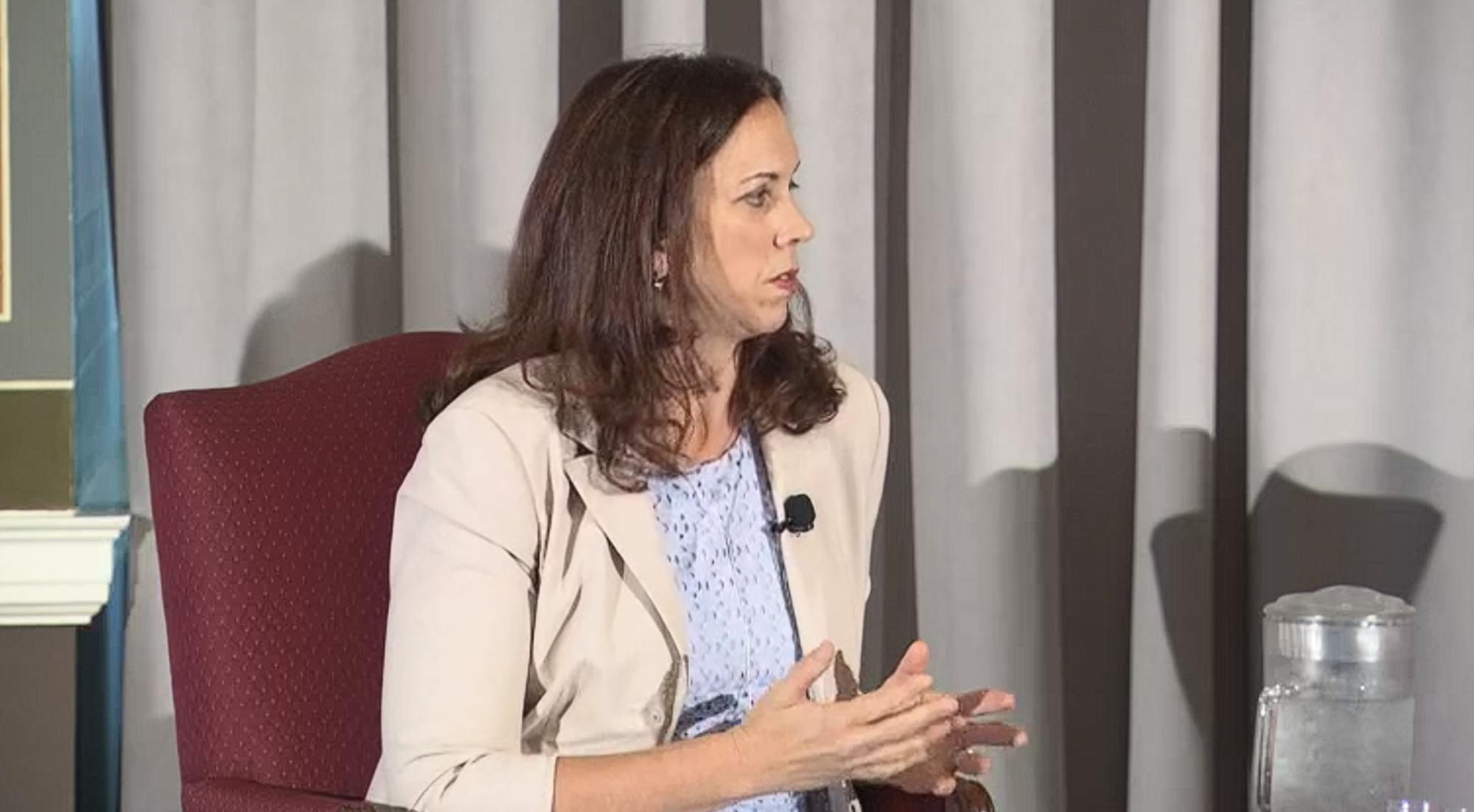
Former head of the National Archives Colleen Shogan talked about her experience as an archivist, the role of record-keeping in democracy and the Trump’s administration’s layoff of her at a fireside chat March 23.
The fireside chat was a part of the third event of the Wisconsin Exchange: Pluralism in Practice initiative, where Shogan conversed with Allison Prasch, an associate professor in the communication arts.
Shogan served as archivist of the United States from May 2023 to February 2025, when she was laid off by the Trump administration.
“I’d never been fired from a job previously in my life,” Shogan said. “You probably don’t want to start by being fired by the President of the United States.”
Since leaving the National Archives, she said she has worked with More Perfect, a nonprofit dedicated to uplifting democracy in the U.S. She is currently leading their program In Pursuit, an initiative that documents the achievements of American presidents and first ladies, from George Washington onward.
Shogan discussed how she joined the program in response to personal sentiment that not enough was being done to document American history.
“250 years in, it seems like there should be some sort of nationwide history project that would take us back,” she said. “[It could] have us reconsider some of our successes, some of our failures, when we learned from the past, and how we could apply those lessons for the next 250 years.”
The program publishes essays written by historians, former presidents and first ladies on its website weekly. Former President George W. Bush wrote the first published essay about George Washington, and the most recent essay about Martin Van Buren was written by American historian Lonnie G. Bunch III.
Shogan emphasized the need to consider the faults of these individuals while discussing the role they’ve played in shaping American society and governance.
“I think that criticism is actually wholly American,” she said. “The only way that we’re going to learn from these individuals is if we look at them as holistic human beings.”
She also stressed the need to maintain these historic documents to keep contemporary officials in check.
“I started to think of the National Archives in a different way,” Shogan said. “[Records] establish accountability — accountability for the decisions that are made by our leaders, our public officials, by people that run these institutions that engage in decisions every day.”
Shortly after Shogan was nominated to become archivist, the FBI searched President Trump’s Mar-a-Lago residence in Florida. Shogan had received scrutiny from the president for the agency’s involvement in the case.
While the National Archives played a key role in the criminal case against Trump in 2022 by alerting the Justice Department of his failure to return documents that the agency had requested after his departure — something required of presidents when leaving office — Shogan was not leading the National Archives during the agency’s involvement in the criminal case.
She discussed her attempt to reconcile her relationship with the Trump Administration before Trump’s reentry into office.
“I invited [Melania Trump] to the National Archives when I was an archivist, and she spoke at a naturalization ceremony,” she said. “I did that as a way to say, listen, even though I was nominated by President Biden, I want to extend and make sure you understand that I’m willing to work with the Trump administration.”
In hindsight, Shogan said she was unsure if anything could have saved her job.
“I made sure that I was executing the law very carefully,” she said. “I’m not really sure I could have done anything differently.”