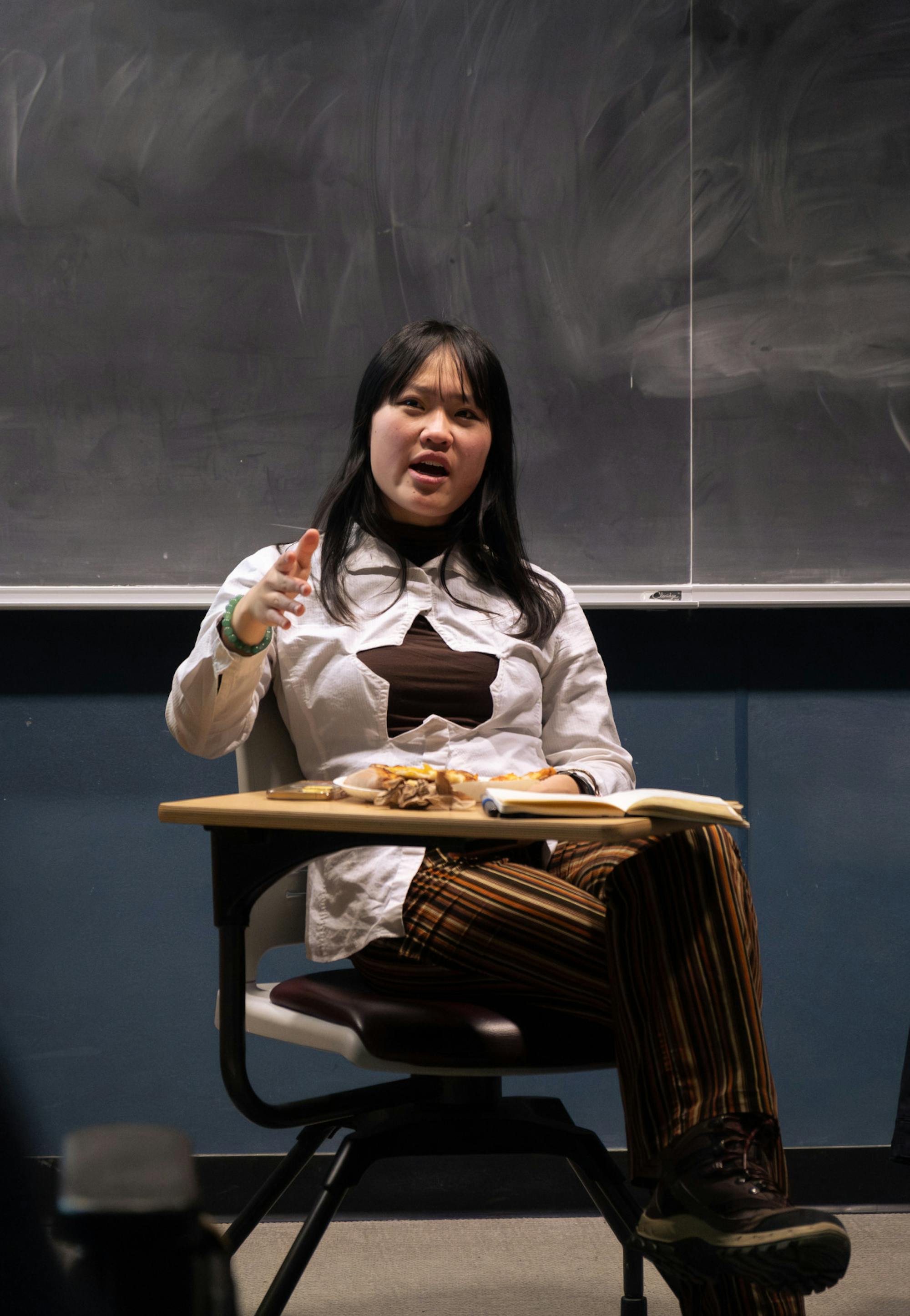
District 8 alder candidate and University of Wisconsin-Madison sophomore Ellen Zhang discussed her campaign and vision for the seat in an interview with The Daily Cardinal ahead of the April 7 election.
Zhang said she plans to prioritize making Madison a more affordable and safe community for everyone, stressing her state government ties and “common ground” approach.
Zhang, who is endorsed by UW College Democrats, will face fellow UW-Madison sophomore Bobby Gronert. MGR Govidarajan, the current District 8 alder, will not seek reelection.
This interview has been edited for brevity and clarity.
Why do you want to become a Madison alder?
I am a student, a renter, an artist and a daughter of immigrants. All of these things give me a perspective of the issues, not only we as students have, but people across Madison have with housing insecurity, food insecurity and income insecurity. I am a huge nerd. I love reading reports and talking to people, so between all of these things, I feel like that makes me a really great candidate. I’ve really enjoyed running and learning about what people care about.
Many students face less-than-ideal landlord situations in Madison, with poor management and rent hikes. What will you do as alder to help students deal with dismissive landlords and rent hikes?
There are a couple of things. Number one, the city has to enforce its housing code and strengthen it. I’ve been working with Madison Tennant Power, an organization that is trying to address policy and individualized landlord-tenant relationships. From that I’ve learned, we need to have stronger rules and punishments for when landlords don’t live up to their responsibilities. At the same time, it’s about providing resources for tenant recourse.
Building inspection is a service that the city provides, so if we can provide more inspection services, more capacity and advertise these services better to students who experience the most housing code violations, students will feel empowered to have better quality of housing, not just a trade-off between quality vs. affordability.
Madison faces a housing shortage. Your platform supports policies to allow new development, but recent housing developments near the UW-Madison campus boast some of the highest rents for students. What is your plan to support building new housing units that will be competitive in pricing, while still providing quality?
With student housing, it’s not just students competing for these units. There are a lot of young professionals and long-time Madison residents who choose to live downtown because of all of the amenities. One thing we should think about is increasing development outside of the isthmus, which can take some pressure off of the downtown rental market, making more space for students so they can live near where they study.
Also, making more kinds of housing available across the city of Madison so that there is more density and availability for people with families outside of downtown. Expanding transit is important to ensure it is easy for everyone to get around and can incentivise people to live in different communities by making transportation easier.
What is your plan to support Metro Transit in Madison?
I think improving late-night service would be the most immediately beneficial. After midnight the buses don’t run, making it difficult for people who rely on public transit, who have very few ways to get home at night.
Route expansion is also important. Looking at a map of bus routes, it looks like whiskers coming out of the isthmus, making it hard to get around in the peripheries of Madison where we should be expanding service.
As we rebuild our streets, we should be including better dedicated bus lanes, bike lanes and pedestrian infrastructure to reduce car congestion and increase the speed of getting around everywhere.
How will you support improvements to the 80 line?
Every 10 years, UW-Madison reevaluates its transit plans. This will take place during this next alder term, so my job will be to advocate for what students are looking for in the bus system.
Something people have been excited about is the idea of a reverse 80. This is just an example of trying to figure out how we can make routes and make getting around more effective. As far as other ways to support the 80, much of it is supported by student segregated fees charged by UW-Madison to students, so if we’re paying into it, we should have a say in how it operates.
How will you respond to concerns over ICE in Madison?
With this very deep concern, there have been a lot of efforts in a lot of different community groups, as well as the city. I think it's important to merge these two efforts so we can present as a united front and strengthen our community ties.
This means we need stronger tenant protections, protections for kids in schools, community organization development and legal trainings to ensure citizens know their rights. I think that there are a lot of ways the city can step up and take a stronger stance than we already have.
What is your plan to address state preemptions that prohibit the city from regulating certain issues like rent control?
As far as preemptions go, they are under state control, but even before running for alderperson, I have had relationships within the state legislature. I worked for Rep. Francesca Hong, and I feel it's important to leverage these relationships within the state legislature to make Madison and the rest of Wisconsin a better place for its residents.
With the coming fall midterm election, we have the opportunity to switch the makeup of the Wisconsin Legislature and hopefully take down the preemptions to make Madison better.
How will you manage community-police relations as an alder? What measures would you take regarding public safety/policing in Madison?
I think it's important to look at what the police are being used for right now and where we don’t need them. Madison has recently started a CARES program, which dispatches mental health professionals to 911 calls. Once CARES responders are on the scene, 93% of the time further police response has not been necessary, which shows that people are not looking for law enforcement — they’re looking for help.
Prioritizing alternative resources is really important, but it’s also good to consider passive surveillance like Flock cameras, which has been something that people on campus and across Dane County are pretty uneasy about. The city has an ordinance banning their use, but UW-Madison still has them up.
I think part of the solution is considering where people feel police presence, even when the police aren’t there. That also involves public schools and worries about police collaboration with ICE.
What, if anything, do you believe was positive about MGR's time in office? Is there something he started that you wish to continue? What makes you different?
I admire how proactive MGR has been in reaching out to students. Last school year, he was always doing town halls and trying to answer student questions about rent hikes, building inspection and transit. I think a lot of his service was being a resource and being very present, and I would really like to continue that.
Policy-wise, something that he has championed is more student housing and safer streets in the campus area. Obviously, Oliv's average rents have been very high, but they were able to exceed the downtown height limit in exchange for offering some units at a discounted price with a density bonus and additional developer requirements. I think that’s an interesting program to consider. I think it’s important to consider how we can be creative in order to provide affordable housing in different ways.
Where he has come up short, I believe there are decisions he has made in the past year where he has received a lot of scrutiny, especially with the Dairy Drive Homeless Encampment closure and promising the end of bar raids, which the MPD did not follow. I think what that is emblematic of is difficult decisions amidst a lot of public scrutiny around issues people care about.
I think that he received a lot of bad press for those two events. Part of it was because of factors which I would say are out of his control. But at the same time, I would say that people were looking for more ownership of responsibility and responsiveness to community feedback.
You and Bobby are similar in a lot of ways. What’s the biggest way you two differ?
The two ways we differ are in experience and approach to collaboration. I have had extensive experience with the city on affordable housing policy and voting barriers within UW-Madison, on student civil rights barriers and within the state with Rep. Hong. I think having all of these experiences has given me a very clear perspective on the jurisdiction and limits of city power.
Regarding [Bobby’s] policies, some of them are clear overreaches of city power and would be difficult to enact even if he tried to leverage relationships beyond the city.
As far as collaboration goes, from my experiences, I’ve built up a lot of relationships and mutual respect amongst people across the city. I’m able to consider different perspectives and acknowledge them while staying true to my principles, and try to find common ground.
Where he can fall short is having an overly combative approach. When we were asked about the changing of the UW-Madison administration [in a student town hall last week], he responded, “I am not afraid to be mean to the university,” which I think represents a fundamental misunderstanding that this is not going to be a relationship based on competing interests. We’re all trying to increase affordable housing and make the city a better place for students and residents of Madison. My approach is that I would rather find the common principles that we share and move forward toward solutions that work for everybody, rather than being abrasive.
In your opinion, are property taxes in Madison too high, too low or pretty fair?
Property taxes are a response to an unfair state Legislature. Right now, we do not get enough money from the state. They are creating an undue burden on Madison residents. Because of this, taxes are too high for what they are, but understandable for the situation.
Is there anything else you would like the voters to know?
You can vote in Wisconsin as an out-of-state student, and you can register day of.
Staff writer