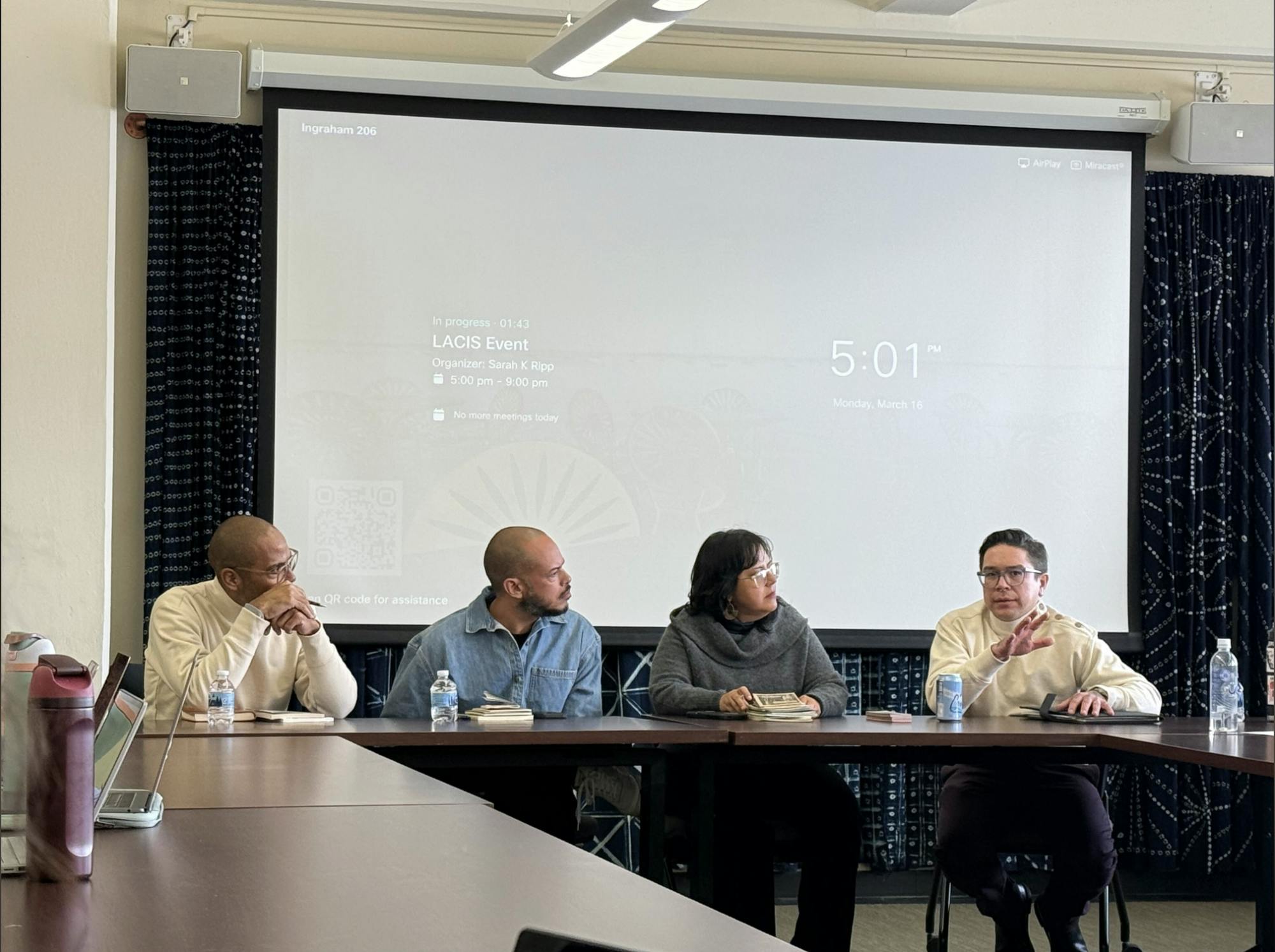
The Puerto Rican Studies Hub hosted a roundtable Monday featuring three Puerto Rican authors who discussed how their culture and experiences have shaped their writing.
The hub, which the University of Wisconsin-Madison launched in October, has focused on impacting “our local communities on campus and beyond, and creating bridges, solidarities and collective knowledge creation,” co-director and gender and women’s studies professor Aurora Santiago Ortiz told The Daily Cardinal.
Xavier Valcárcel de Jesús, author of “Los Nidos,” a historical fiction about artists delivering paint pigments to the south of the island, discussed his experiences as an author. Through his research and writing process, where he deeply studied the train system in Puerto Rico, he realized the “holes” and various failures that came with modernizing the island.
“I’m honoring the work of Puerto Rican writers that have taken up the task of making visible, problematizing and discussing the incomplete stories,” Valcárcel de Jesús said.
According to Valcárcel de Jesús, the key to historical writing is to work “historiographically” — the study of how history is written, focusing on shifting interpretations, methodologies and scholarly debates, rather than just a chain of events. This type of writing allows one to have a broader understanding of all perspectives and strengthen the voices of those who have been silenced by history.
Delgado raised concerns about the limited access to resources, such as printing and publishing, in Puerto Rico. She said it causes many artists and writers to turn to different methods in order to produce art freely and in a cost-efficient manner.
Nicole Cecilia Delgado, a poet and visual artist, constructs all her poetry books by hand, a process she feels connects her to her culture and community.
Delgado discussed a social and artistic publishing movement that originated in Argentina under the context of an economic collapse — Cartonera — that she and many Latin American artists use. She said during economic collapse, printing and publishing presses also fell, resulting in writers resorting to different methods to create their art.
She described how writers and artists alike worked with recyclers to buy cardboard from them, ultimately creating a community of book-makers and publishing spaces to make simple, handmade books with cardboard covers.
Influenced by the movement, Delgado created her own cartonera in 2009, focusing on contemporary poetry.
“I learned how to hand-make books at the same time I was working on my writing,” Delgado said. “For me, writing and literature is not an isolated process. It’s something that is created in community, and relates to filling in the gaps of history or accounts of what life in Puerto Rico is like.”
Delgado said the cartonera movement highlights the resilience of Puerto Rican artists, and “showed a way of making [art] sustainable, even in the context of scarcity.”
Cezanne Cardona Morales, a writer, columnist and professor at the University of Puerto Rico-Ríos Piedros, discussed the importance of immersion in Puerto Rican culture as a key part of the writing process.
“All the contradictions — the suffering and the joy, the pain and the pleasure — of living in [Puerto Rico] allows me to do the writing and have the writing flow,” Morales said.
One of the hub’s three pillars is “Learning and Unlearning Together,” which includes a summer study away program in Puerto Rico and the Luisa Capetillo Cultural Series, including public lectures like Monday’s event.
The series also includes film screenings, musical events and culinary festivals. The first event occurred last October and featured Los Pleneros de la Cresta, a band on Bad Bunny’s most recent album.
The additional two pillars of the hub are “Imagining Puerto Rican Futures” and “Solidarity Ecosystems.”
Santiago Ortiz said the former aims “to create spaces for intellectual interrogation, innovation, knowledge production and scholarly diffusion,” including a lecture series with historian Francisco Scarano and an upcoming April symposium called “Interrogating the Future of Puerto Rican Studies.” Additionally, she said it includes a solidarity mentorship program and mentioned that the hub will sponsor the Puerto Rican Studies Association Conference in 2028.
The “Solidarity Ecosystems” component includes a fellowship program, featuring different artists, writers, scholars and two postdoctoral fellows who will participate in the intellectual life of the campus, according to Santiago Ortiz.
Santiago Ortiz and Co-director Jorell Meléndez-Badillo obtained a $3 million grant from the Andrew W. Mellon Foundation to help fund three years of performances, lectures, fellowships and programming.
“We envision the Puerto Rican Studies Hub as fertile ground for innovative partnerships and as a site for emergent and groundbreaking modes of knowledge production,” Santiago Ortiz said.
The hub is the first of its kind in the Midwest, which Santiago Ortiz said is crucial for starting conversations about issues within the Puerto Rican community — such as migration.
“The Midwest is this ideal location [for migration], and so we want to jumpstart conversations on a regional, national and transnational scale, and we do so while expanding the field of Puerto Rican studies,” Santiago Ortiz said.